
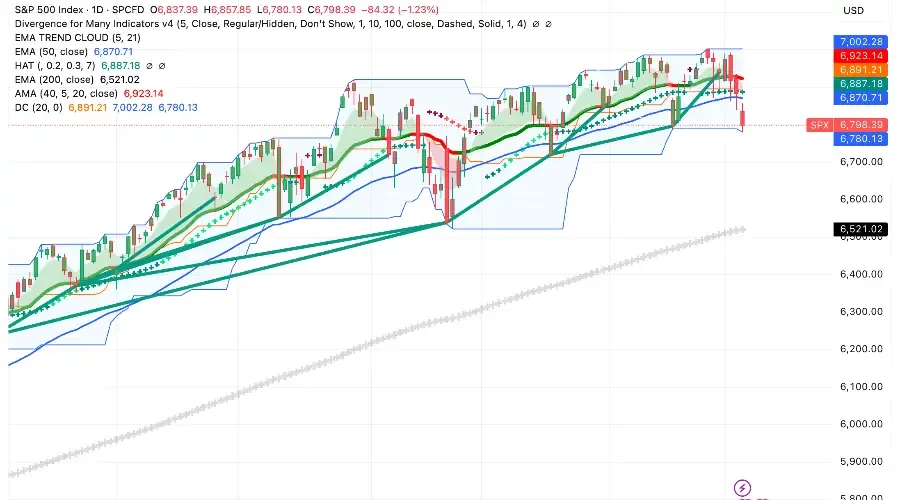
Opening Context (Opening Scenario)
You wake up, check the markets, and things feel unsettled-but not chaotic.
Futures aren’t crashing, yet they aren’t fully confident either. Some indexes are slightly green, others hesitant. Headlines mention tech weakness, global caution, and another important economic data release later in the day.
For retail investors, this kind of morning often creates confusion. Is the market calming down after yesterday’s selloff? Or is this just a pause before another move?
This pre-market note breaks down the current setup in simple terms-without predictions or trading calls—so you understand the market’s mood before the opening bell.
What the Pre-Market Is Showing
Pre-market action today reflects attempted stabilization, not strong conviction.
Broad markets are modestly positive, suggesting selling pressure has slowed. However, leadership remains uneven. Industrial and value-oriented stocks are showing relative strength, while technology is trying to recover from recent weakness.
When indexes move differently like this, it often signals rotation rather than panic. Money isn’t leaving the market altogether - it’s shifting between sectors as investors reassess risk.
This type of behavior usually appears after sharp moves, when markets pause to digest new information. It reflects caution and reassessment, not a clear directional decision yet.
Overnight Global Cues
Overnight markets added to the cautious tone.
Asian markets were broadly weaker, especially in tech-heavy regions. This reflected ongoing concerns around global technology spending and growth expectations. European markets opened mixed, with limited follow-through on selling pressure.
Why does this matter?
U.S. markets often absorb global sentiment before the open. When overseas weakness doesn’t turn into aggressive U.S. selling, it usually suggests investors are pausing and evaluating, not rushing to exit.
Global cues today reinforce uncertainty, not fear.
Why Today’s Key Data Matters
Today’s key event is the JOLTS job openings report, which gives insight into labor demand.
Markets track this data because it influences expectations around interest rates. A strong labor market can make inflation harder to cool, while a softer labor market can ease pressure on central banks.
Think of interest rates like gravity.
Higher rates pull down companies whose profits lie far in the future - often technology firms - more than businesses generating steady cash today.
This data doesn’t decide market direction on its own, but it helps shape how investors interpret growth, inflation, and future policy expectations.
How Retail Investors Should Read This Setup
For retail investors, the key takeaway isn’t “what to trade” - it’s what to observe.
Pre-market setups like this usually raise a few simple questions:
- Is weakness concentrated in one sector, or spreading across the market?
- Are defensive and value areas holding steady?
- Is volatility rising sharply, or remaining controlled?
When markets rotate instead of breaking down, patience matters more than speed. These sessions are often about information gathering, not decisive moves.
Understanding the environment helps reduce emotional reactions once regular trading begins.
Common Misinterpretation to Avoid
A common mistake is assuming that modestly green futures mean the risk is gone.
Pre-market signals provide context, not conclusions. Many sessions that start cautiously stabilize without becoming strongly positive or negative.
Focusing on why markets are moving is more useful than reacting to small price changes before the open.
Calm Closing
Pre-market analysis is about awareness, not prediction.
When you understand the market’s tone ahead of the open, you’re less likely to overreact during the day.
Clarity beats urgency - especially during periods of adjustment and uncertainty.