
BreakoutBulletin | AI Semiconductor Supply Chain Series, Part 1 of 3
The AI memory cycle has moved past the question of who makes the DRAM. The binding constraints now sit in the layers around the memory makers: who patterns the wafers, who implants them, who packages the stacks. This three-part series maps one under-covered supplier per layer. Part 1 covers the patterning layer, where Photronics operates.
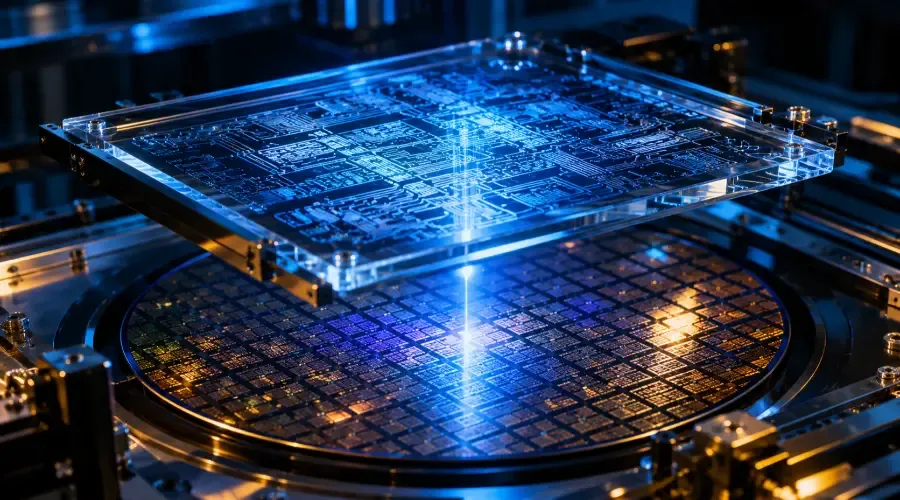
One framing correction up front, because precision matters more than a catchy angle. Photronics does not sit in the HBM packaging flow. Photomasks are the quartz templates that pattern circuits onto wafers inside the fab, upstream of packaging entirely. The accurate thesis is narrower and still interesting: every new chip design, at every node, at every memory maker and foundry, requires a mask set before a single wafer runs. Photronics is the largest merchant supplier of those templates. When design activity accelerates, mask demand accelerates with it, regardless of which chipmaker wins.
The Business in One Paragraph
Photronics manufactures photomasks for integrated circuits and flat panel displays, operating as the leading independent merchant in a market otherwise dominated by chipmakers' captive in-house mask shops. Fiscal 2025 revenue was $849.3 million, down 2% from 2024, split roughly $615 million IC and $234 million FPD. Gross margin ran 35.3% for the year. Within IC, the mix tells the strategic story: mainstream (older-node) mask revenue fell 8.2% while high-end mask revenue grew 4.6%. The company is deliberately migrating up the complexity curve, where masks are harder to make and priced accordingly.
Where the AI Exposure Actually Is
The pick-and-shovel logic runs through design activity, not through any single customer's volume. Advanced nodes require more mask layers per design, tighter tolerances, and more frequent revisions. Memory makers refreshing DRAM designs for HBM generations, and the broader wave of AI accelerator tape-outs, all generate mask orders. The exposure is diversified by construction: Photronics sells the template, and the template gets purchased whether the resulting chip succeeds commercially or not.
The company is investing as if it believes this. Fiscal 2026 capex guidance stands at $330 million, directed at expansion in the US and Korea. The Korea facility expansion is on track to begin delivering qualification masks in fiscal Q3 2026, with revenue contribution expected later in the year. In March 2026 the company took delivery of the most advanced mask writer available to it, a concrete marker of the high-end migration. Lake Street initiated coverage this year and subsequently raised its target from $46 to $55, for whatever a two-analyst coverage universe is worth, which is not much; thin coverage is part of what makes the name under-followed.
The Current Quarter Is the Complication
The near-term picture is softer than the structural story. Fiscal Q2 2026 (reported May 28) showed revenue of $209.9 million, flat year over year and down 6.7% sequentially. FPD carried the quarter, up 13% to $62 million, while IC fell 5% to $148 million. Margins compressed and EPS missed.
Management's explanation deserves attention because it connects directly to the bottleneck thesis of this series. Design releases were delayed, and the cited causes were elevated fab utilization extending product launch timelines, memory supply constraints raising cost pressures for OEMs, and geopolitical uncertainty (management specifically noted visibility clouding around the US-Iran conflict period). The delays occurred at the start of the design-release process, before tape-outs reach mask suppliers, and the post-Chinese New Year recovery ran weaker and longer than usual. Q3 guidance of $207 to $215 million implies more of the same.
Read carefully, this is a double-edged data point. The memory supply constraint that powers this series' thesis is, in the short run, suppressing PLAB's own order flow, because customers absorbed by capacity problems delay new design starts. The bottleneck helps the patterning layer only when designs actually release. A trader tracking this name is effectively tracking the design-release cadence, and management has flagged that customers remain optimistic about the midterm while near-term visibility stays limited.
Balance Sheet and the Concentration Caveat
The company ended Q2 with $637.7 million in cash and short-term investments, though $477.3 million of that sits inside consolidated joint ventures, a structure worth understanding before treating the full figure as freely deployable. Operating cash flow was $47 million for the quarter against $45.8 million of capex, meaning the expansion is currently self-funded at roughly breakeven cash burn.
The risk section for any merchant supplier starts with customer concentration. Academic work on supplier risk consistently finds that concentrated customer bases raise financing costs and de-rating speed when a large customer pauses. Photronics is more diversified than most single-fab suppliers, but the mainstream IC decline shows what happens when a demand segment softens: it flows straight through. Cyclicality is the second structural risk; mask demand follows design activity, and design activity follows capex confidence. The Q4 2025 print demonstrated the other side of that coin, when a beat sent the stock up 45% in a session. This is a name that moves violently on results in both directions.
Valuation & Trade Invalidation
From a valuation perspective, merchant photomask suppliers historically trade at a discount to front-end toolmakers (typically 11x–13x P/E), reflecting the structural reality that tier-one chipmakers keep their highest-margin, leading-edge masks in-house. While $PLAB’s low multiple looks attractive, merchant capex returns are naturally capped by captive shop dominance. The trade thesis invalidates if Q3 revenue drops below the $207 million guidance floor or if memory customers convert near-term design delays into outright cancellations, pushing gross margins below 33% and signaling permanent market share loss in mainstream node
The Observational Summary
The setup as it stands: a structurally advantaged merchant supplier migrating to the high end, investing $330 million into capacity ahead of demand, trading with thin analyst coverage, and currently stuck in a design-release air pocket its own customers' capacity constraints helped create. Historically, supplier stocks in this position have re-rated when the delayed demand releases rather than cancels, and de-rated further when delays turn into cancellations. The distinguishing data points to watch are the Q3 report (whether the $207 to $215 million guide holds), the Korea expansion's first revenue contribution, and any management commentary on design-release normalization. The next earnings print is the scheduled test of all three.
Continuing the AI Memory Supply Chain Series
Photronics sits at the very beginning of the AI memory buildout, where every new DRAM and accelerator design begins with a photomask. The next layer moves from design activity to wafer fabrication itself. In Part 2, we examine Axcelis ($ACLS), where DRAM and HBM demand shows up directly in ion implantation tool orders. Finally, Part 3 explores Kulicke & Soffa ($KLIC), where the packaging bottleneck becomes literal as thermo-compression bonding capacity determines how quickly HBM stacks can actually be assembled.
Read Next: https://www.breakoutbulletin.com/article/acls-ai-semiconductor-series-veeco-merger-analysis
Also in this Series: https://www.breakoutbulletin.com/article/klic-thermo-compression-bonding-hbm-stacking
Sources: Photronics fiscal Q2 2026 results and earnings call (May 28, 2026), fiscal 2025 Form 10-K, company press releases. All figures verified against primary sources at time of writing.
This content is for educational purposes only and does not constitute investment advice or a recommendation to buy or sell any security. Markets involve risk. Verify all data independently before making any trading decision.