
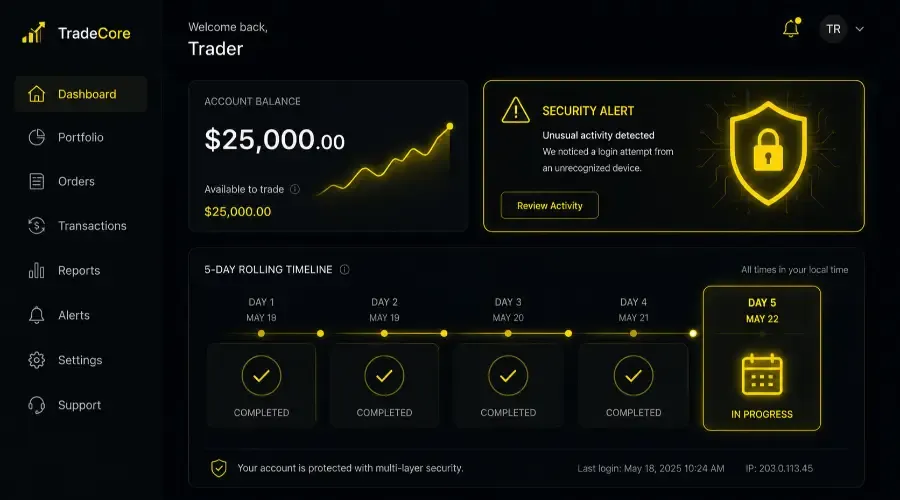
The Pattern Day Trader (PDT) rule is a FINRA regulation that applies to margin accounts and restricts how frequently investors with under $25,000 can execute same-day trades. Understanding it prevents one of the most frustrating surprises in retail investing: having your trading account restricted for 90 days without realizing what triggered the restriction.
What Counts as a Day Trade
A day trade is defined as opening and closing a position in the same security on the same trading day. Buying 10 shares of Tesla at 10:00 AM and selling those 10 shares at 2:30 PM constitutes one day trade. Buying in three separate lots during the morning and selling the combined position in the afternoon still counts as one day trade – what matters is whether the position was opened and closed on the same calendar day.
Selling a stock you've held overnight is not a day trade, even if you sell and buy it back the same day. The PDT rule only counts trades where you open and close a position within a single session.
The Rolling 5-Day Window
The rule triggers when you make four or more day trades within any rolling five-business-day period. "Rolling" means the window shifts forward each day rather than resetting on a fixed schedule like Monday morning.
If you make day trades on Monday, Tuesday, and Wednesday of one week, and then make a day trade the following Monday, all four occur within the same rolling five-day window (Monday through Friday of week 1, plus Monday of week 2). That fourth day trade triggers the PDT flag.
The trades from earlier in the window "fall off" after five business days. In the example above, the Monday trade from week 1 drops off at the open of Tuesday in week 2, giving you room for another day trade.
What Happens When You Trigger PDT
When your fourth day trade in a five-day window executes, your broker marks your account as a Pattern Day Trader. At that point, you face a choice: deposit funds to bring your account balance above $25,000 by the following trading day, or your account enters a "closing-only" restriction for 90 days. Under this restriction, you can still sell existing positions and close trades you already hold, but you cannot open new positions.
The 90-day restriction is the outcome most investors want to avoid. It removes flexibility precisely when you may want to respond to market events, and it can't be resolved by any action short of depositing funds to clear the $25,000 threshold.
Some brokerages offer a one-time PDT reset – essentially erasing the flag as a courtesy – once per lifetime of the account. Not all brokers offer this, and it's not a sustainable workaround for investors who regularly approach the three-trade limit.
The $25,000 Threshold
Accounts with $25,000 or more in equity at the end of each trading day are exempt from the PDT rule entirely. They can execute unlimited day trades without restriction. The $25,000 minimum is measured at market close – if your account drops below $25,000 intraday but recovers by close, you're still compliant.
If your account falls below $25,000 at the close of trading, you cannot day trade the following day until you deposit funds to restore the balance above the threshold.
Cash Accounts Are Different
The PDT rule applies only to margin accounts – accounts where your broker extends credit beyond your deposited funds. Cash accounts, which restrict you to trading only with your deposited balance, are not subject to PDT restrictions.
However, cash accounts face settlement constraints instead: proceeds from stock sales are "unsettled" for two business days, during which time rapid buy-and-sell cycles using those proceeds can trigger Good Faith Violations. Switching to a cash account to avoid PDT trades one set of constraints for another.
Why the Rule Exists
The PDT rule was adopted in 2001 by FINRA and the SEC following concerns about inexperienced retail investors making rapid, frequent trades during the dot-com boom – often with borrowed margin funds – and suffering significant losses. The $25,000 threshold was set as a proxy for financial sophistication: the idea being that investors with larger account sizes could absorb the losses that day trading tends to produce.
Whether the rule effectively achieves its protective purpose is genuinely debated. Critics note that the $25,000 threshold discriminates by account size rather than actual trading ability, and that many small-account investors would make better risk-adjusted decisions than the rule's design implies. Supporters note that the day trading failure rate among retail investors is documented to be high, and some friction may reduce impulsive behavior.
Practical Approaches for Accounts Under $25,000
Three primary options exist for investors with under $25,000 who want active market participation.
Accept the three-trade limit and deploy it selectively – using day trades only on high-conviction setups and holding other positions overnight. Holding overnight introduces gap risk but avoids PDT constraints.
Use a cash account and manage the settlement calendar carefully – understanding that proceeds from Monday's sales are available for a new round trip starting Thursday.
Shift toward swing trading – holding positions for two days to two weeks – which avoids PDT entirely while still allowing active portfolio management.
This content is for educational purposes only and does not constitute investment, legal, or tax advice. Investing in securities involves risk, including possible loss of principal. Always conduct your own research and consult a licensed financial professional before making investment decisions.
The PDT rule is a constraint that shapes your entire active trading approach if your account is under $25,000. Understanding the rolling window and the alternatives ( cash accounts, swing trading) determines how you operate within it.
→ Trading Timeframes and Strategies → The full framework of trading approaches and the regulatory context for each - www.breakoutbulletin.com/article/trading-timeframes-strategies-day-swing-investing
→ Day Trading vs. Swing Trading vs. Position Trading → How the PDT rule affects each approach differently - www.breakoutbulletin.com/article/day-vs-swing-vs-position-trading-teens
→ Understanding Settlement (T+2) → The parallel cash account constraint for investors avoiding PDT via the cash route - www.breakoutbulletin.com/article/understanding-settlement-tplus2