
BreakoutBulletin | Catalyst Brief · Media Strategy Series
Published: March 9, 2026
Educational commentary only. Not investment advice.
The Hook
Everyone focused on the headline: Paul Allen’s estate acquiring a 10.7% stake in Starz.
But the percentage is not the real story.
The real story is what an Allen–Starz strategic alignment could mean for dozens of cable networks currently trapped between two collapsing worlds: a declining linear television ecosystem and a streaming economy that has no clear place for them.
These are the media industry’s stranded assets-the middle class of cable brands that are too small to compete with Netflix and Disney+, yet still valuable enough to generate audience loyalty and licensing revenue.
If the Allen–Starz axis develops into a genuine strategic partnership, it could become the first credible consolidation engine for these marooned networks.
And that would directly affect Lionsgate’s long-term ambition: turning Starz into the distribution backbone of a niche streaming empire built on acquired cable brands and premium content libraries.
Allen’s Stake Is Soft Activism - Not Passive Ownership
The key signal is not the 10.7% stake itself.
It is the type of SEC filing used to disclose it.
Allen’s estate filed a Schedule 13D, which is typically used by investors who intend to play an active role in corporate strategy.
Unlike a passive 13G filing, a 13D explicitly allows the investor to propose changes involving:
-
corporate strategy
-
financing structures
-
board composition
-
operational decisions
This language signals soft activism-a strategic approach where influence is exercised through cooperation rather than confrontation.
Allen’s media history reinforces that interpretation.
Over two decades he has attempted to acquire major media assets including ABC and Paramount, while building a portfolio of television stations, cable networks, and content properties.
This is not the behavior of a passive investor seeking dividends. It is the pattern of a buyer seeking control over content distribution pipelines.
A minority stake in Starz therefore functions as a strategic negotiating platform, ensuring that Allen-related content and media assets have direct access to Starz’s streaming ecosystem.
Starz and the “Marooned Networks” Opportunity
Starz CEO Jeff Hirsch has been unusually explicit about the company’s strategic direction.
In multiple public comments he has described a major opportunity in second-tier cable networks that cannot survive independently in the streaming era.
These networks share a common problem:
-
They are too small to build standalone streaming platforms.
-
They are too niche for flagship services like Netflix or Disney+.
-
And they are increasingly unwanted by the conglomerates that own them.
Examples across the industry include:
-
niche lifestyle or women-focused channels
-
underinvested Black-audience networks
-
factual entertainment brands similar to A+E properties
-
regional sports-adjacent channels after the RSN collapse
These brands still have audiences, content libraries, and recognizable identities.
What they lack is technology infrastructure and streaming distribution.
Starz believes it can provide both.
Every acquired network potentially delivers three strategic assets:
-
Existing subscribers, even if they originate in linear cable bundles.
-
Content libraries that can populate streaming catalogs.
-
Defined audience segments aligned with Starz’s niche programming strategy.
In theory, Starz’s technology stack allows these brands to transition into streaming faster and cheaper than legacy media companies can manage internally.
Why the Allen-Starz Combination Makes Strategic Sense
This is where the story becomes more than theoretical.
Paul Allen’s media holdings include:
-
the Weather Channel
-
a large portfolio of local television stations
-
various cable and production assets
In other words, Allen controls exactly the type of linear media inventory that Starz aims to absorb and modernize.
But Allen lacks one key component: a streaming platform.
Starz provides that missing infrastructure.
The partnership dynamic therefore becomes clear.
Allen brings:
-
media brands and audience relationships
-
content production pipelines
-
acquisition capital
-
strategic influence via the 13D stake
Starz brings:
-
a streaming technology stack
-
distribution through Amazon Prime, Max, and AMC+ bundles
-
millions of existing streaming subscribers
-
Lionsgate’s content library as anchor programming
Together, the two could create a credible buyer for cable assets that major media companies increasingly want to sell.
Companies like Warner Bros. Discovery, Paramount Global, and Comcast hold dozens of secondary cable networks that no longer fit their strategic priorities.
An Allen-backed Starz could become the natural destination for these brands.
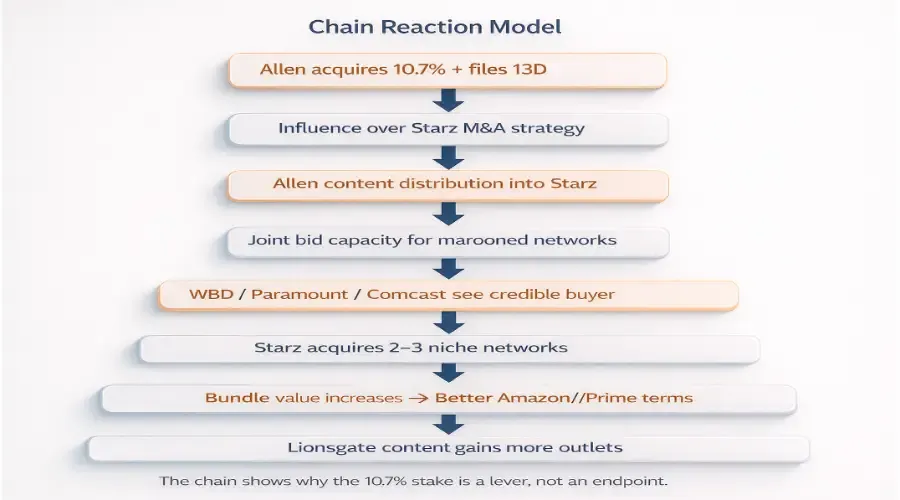
The Strategic Chain Reaction
If the partnership evolves beyond passive ownership, the strategic sequence becomes straightforward.
Allen acquires a 10.7% stake in Starz and files a 13D.
This creates formal influence over Starz’s strategic direction.
Allen content gains preferential distribution opportunities through the Starz platform.
Starz gains an expanded content pipeline.
Joint acquisition capacity emerges for stranded cable networks.
Major media conglomerates gain a credible buyer for unwanted assets.
Starz acquires niche networks and migrates them into its streaming infrastructure.
The platform’s subscriber base expands and bundle value improves.
Lionsgate’s content library gains more distribution outlets.
And the long-planned Lionsgate–Starz separation becomes strategically cleaner.
The critical point is that the stake itself is not the catalyst.
The catalyst is what the stake enables.
Lionsgate’s Streaming Endgame
For several years Lionsgate has been preparing to separate its two core businesses:
-
Lionsgate Studios, a content production company
-
Starz, a streaming distribution platform
The logic behind this separation is straightforward.
A standalone content studio with franchises like The Hunger Games, John Wick, and Saw can license its content to multiple streaming services.
Being permanently tied to one distribution outlet limits that flexibility.
At the same time, Starz as a standalone company can pursue streaming consolidation strategies without being constrained by Lionsgate’s balance sheet.
If Starz successfully acquires marooned cable brands, its value proposition strengthens in two directions:
-
It becomes a stronger distribution partner for Lionsgate content.
-
It becomes a more attractive standalone streaming platform for investors.
The two businesses would then appeal to different types of institutional capital.
Content studios attract investors focused on intellectual property and licensing revenue.
Streaming platforms attract growth investors focused on subscriber metrics and platform economics.
Separating them allows each to be valued according to its own economic model.
What the Market Is Missing
The market reacted quickly to the headline that Allen’s estate bought a 10.7% stake.
But what remains largely unpriced is the scenario where Allen and Starz become active partners in consolidating second-tier cable networks.
The market for these stranded assets is substantial.
Industry estimates suggest 20 to 40 cable networks currently sit within conglomerates that would prefer to divest them.
If Starz acquires even two or three of these networks, the platform’s economics change.
Subscriber numbers rise.
Content libraries expand.
Bundle negotiations with Amazon and other partners improve.
And Lionsgate’s eventual separation could occur at meaningfully higher valuations for both entities.
Bottom Line
Paul Allen’s 10.7% stake in Starz is not just a financial investment.
It is a strategic foothold in a consolidation play that could reshape the future of niche cable brands.
If Allen’s capital and media assets combine with Starz’s streaming infrastructure, the result could be the first platform capable of migrating dozens of stranded cable networks into the streaming economy.
The percentage ownership is only the surface story.
The real story is the Allen–Starz axis—and the consolidation strategy it could unlock.
DISCLAIMER :
This article is for informational and educational purposes only and does not constitute financial, investment, or trading advice. You are solely responsible for your own investment decisions and should consult a licensed financial professional before acting on any information in this post.