
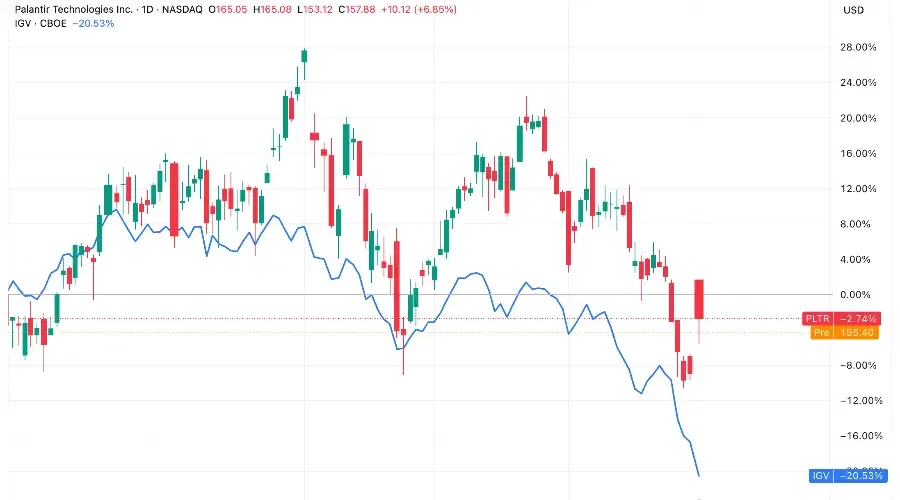
Palantir delivered one of the most decisive AI earnings statements of the cycle.
PLTR surged 8% in after-hours trading to $118, lifting its market capitalization toward $260 billion. For traders tracking software stocks-or following the broader AI infrastructure narrative—the past six hours clarified something critical: Palantir has moved beyond AI promise and into measurable, scalable revenue conversion.
That signal came even as the Software ETF (IGV) declined 2.1% during Monday’s regular session. The contrast was sharp. While the sector sold off, Palantir’s post-earnings move highlighted a growing market divide-AI companies proving real monetization versus those still selling future potential.
This divergence is not accidental. It reflects capital rotating away from uncertain enterprise AI stories and toward models where revenue visibility is already established.
What Actually Happened
On February 2 at 8:00 PM ET, Palantir reported Q4 2025 revenue of $1.407 billion, representing 70% year-over-year growth, alongside adjusted EPS of $0.25, beating analyst expectations on both measures (Bloomberg).
The larger surprise came from guidance. Palantir forecast 2026 full-year revenue of $7.18–$7.2 billion, exceeding the Street’s $6.27 billion estimate by 14.5%. This was not a marginal beat—it was a clear signal of confidence in forward demand.
Management emphasized accelerating adoption of government and commercial AI workloads through Q4. Palantir’s positioning as a core AI infrastructure provider for defense and enterprise applications continues to differentiate it from peers.
Crucially, the company’s government contracts-particularly with U.S. defense and intelligence agencies—provide multi-year, locked-in revenue streams. These contracts scale without the return-on-investment uncertainty currently weighing on broader enterprise AI spending.
Market Reaction and Positioning
The response was immediate. PLTR, which closed near $109 in the regular session, jumped to $118 after hours on 22 million shares, far exceeding typical post-market liquidity.
Options markets reinforced the move. Call volume in March $120–$130 strikes surged 240%, indicating institutional positioning rather than short-term retail speculation.
This behavior matters. After-hours accumulation on elevated volume typically reflects forward positioning, not profit-taking.
Why This Matters
PLTR shareholders captured an 8% gain within minutes, but the broader takeaway lies in sector behavior.
Despite Palantir’s strength, 67% of Software ETF (IGV) constituents closed lower, underscoring that this was not a sector-wide AI rally. Instead, it signaled internal rotation—capital exiting uncertain AI names and concentrating in companies with proven revenue conversion.
Enterprise software peers without Palantir’s government revenue moat struggled. Snowflake fell 1.8%, Datadog dropped 2.3%, and CrowdStrike declined 1.9%. These companies remain exposed to the same narrative weighing on enterprise AI spending.
That narrative intensified earlier in the week when Gartner reported that CIOs are “slowing and deferring everything possible” related to AI spend. Gartner’s own stock dropped 20% as enterprises delayed projects that lack clear ROI justification.
Palantir largely bypasses this risk. Defense and intelligence agencies deploy AI based on strategic necessity, not near-term cost-benefit analysis. This structural difference is now being priced into Palantir’s valuation.
The Mechanics Behind the Move
The options flow—heavy call buying paired with elevated after-hours volume—points to institutional accumulation, not retail FOMO.
Equally important, software market breadth remained deeply negative while Palantir surged. That divergence confirms this move reflects quality selection, not broad AI optimism.
What to Watch Next
Over the next 48–72 hours, three events will determine whether Palantir’s breakout sustains.
1. Alphabet earnings (February 4, after hours)
Google’s Q4 2025 results will place particular focus on Google Cloud growth and AI workload commentary.
- Growth above 35%, especially with government or defense AI wins, would reinforce Palantir’s thesis.
- Growth below 30% would suggest enterprise AI hesitation is broader, increasing downside risk despite Palantir’s moat.
2. Regular-session volume confirmation (February 3–4)
The after-hours move needs validation during regular trading.
- Sustained trading above $115 with volume exceeding 85 million shares would confirm institutional conviction.
- A low-volume fade would suggest the after-hours pop reflected short-term positioning.
3. Amazon Web Services earnings (February 5, after hours)
AWS revenue growth and margins will test whether AI infrastructure spending converts into profitable workloads.
- Growth above 25% with expanding margins supports Palantir’s scalability narrative.
- Growth below 20% would raise questions about long-term AI monetization across the ecosystem.
The Cross-Story Connection
Palantir’s success contrasts sharply with Gartner’s warning on enterprise AI spending. The explanation lies in customer type.
Palantir’s revenue is government-led—defense, intelligence, and national security contracts funded by multi-year budgets. These deployments prioritize mission criticality over ROI models.
Gartner’s client base, by contrast, consists of enterprise CIOs who must justify every AI dollar. With implementation timelines stretching and productivity gains still uncertain, spending has stalled.
Upcoming cloud earnings from AWS and Google Cloud will determine whether commercial AI adoption can bridge this gap—or whether the bifurcation widens.
The Question Traders Should Ask
Is Palantir’s government-led AI monetization model broadly scalable, or is it a narrow success tied to defense spending?
That answer will come with Q1 2026 earnings (expected May 2026), when commercial revenue composition becomes clearer. If commercial revenue fails to accelerate toward 40%+ of total revenue, Palantir’s valuation becomes increasingly sensitive to defense budget risk.
Congressional defense appropriations hearings in March 2026 will be a critical checkpoint.
From a technical perspective, momentum favors bulls if PLTR holds $105 support (50-day moving average) and clears $125 resistance (December 2025 high at $127).
- Volume above 85 million shares confirms strength.
- A breakdown below $105 on heavy volume invalidates the setup.
This analysis is for educational purposes only and not investment advice.