
AI Infrastructure & Physical Constraints | By Manish T.
For two years, every AI chip roadmap pointed in one direction: more memory per accelerator, generation after generation. Now, One of the most telling developments being reported in AI hardware is that Nvidia may be considering a different direction for its next flagship.
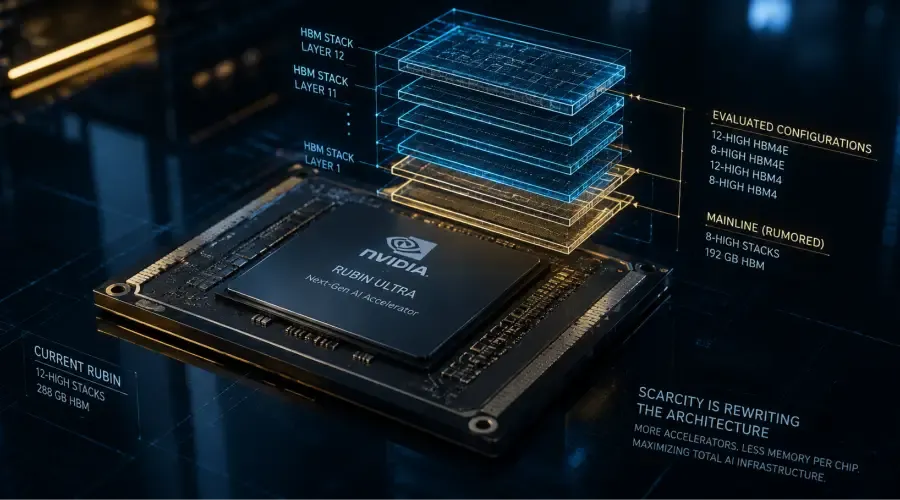
According to memory-industry researchers, Nvidia is evaluating configurations for its upcoming Rubin Ultra that give it less high-bandwidth memory (HBM) than the chip it replaces. Nothing is official yet. However, the mere fact that a flagship accelerator is being considered with a memory step-down is the clearest sign yet that the AI memory shortage has stopped being a procurement problem and become a chip-design constraint.
What Is Actually Being Reported
Per a TrendForce report in Q3 2026, Nvidia expanded its evaluation of Rubin Ultra’s memory beyond the original 12-high HBM4e design to include lower-specification alternatives: 8-high HBM4e, 12-high HBM4, and 8-high HBM4.
The Information separately reported that Nvidia is weighing lower-memory versions due to HBM supply bottlenecks, while SemiAnalysis points to a mainline configuration near 8-high stacks and 192 GB.
A mainline configuration near 192 GB would mark roughly a 33% reduction from the 288 GB carried by the current Rubin. While 192 GB still provides ample headroom for today's workloads, a flagship accelerator stepping backward on memory capacity is a striking precedent for the industry.
Why Nvidia Is Even Considering It
Three physical and technical bottlenecks sit behind this evaluation:
- DRAM Capacity Constraints: Global DRAM supply is expected to remain tight through 2027, strictly limiting the wafer capacity memory makers can allocate to HBM.
- Validation & Yield Timelines: The newest 12-high HBM4e faces uncertain validation schedules and complex yield ramps, threatening volume availability when Rubin Ultra launches.
- Power & Thermal Ceilings: Data-center power limits force strict watt-per-node trade-offs, making lower-layer memory stacks thermally and electrically attractive.
That trade-off is part of a broader hardware constraint. AI servers increasingly depend on specialized power-management chips and supporting components, so a design change that reduces memory per accelerator can also alter the demand profile for the surrounding server power architecture.
The Counterintuitive Logic of Less Memory
Fewer stack layers per chip–8-high instead of 12-high–means each HBM stack consumes fewer scarce, known-good DRAM dies.
From a fixed pool of memory, Nvidia can assemble more complete stacks and ship more total GPUs by putting less memory in each unit. Lower stacks also simplify demanding advanced packaging and improve overall yields.
This is scarcity actively rewriting chip architecture to maximize total accelerator delivery into a shortage.
Why This Is the Real Signal (and the Interconnect Trade-Off)
A year ago, the question was whether enough HBM could be supplied at all. Now, memory availability directly shapes capacity, interface speeds, and total unit volumes.
The Interconnect Trade-Off: Trimming per-GPU memory isn't free. When memory capacity drops per accelerator, the burden shifts directly to the network. System architects must rely far more heavily on ultra-fast interconnects and scale-up networking domains (like NVLink topologies) to shard massive frontier models across larger clusters of GPUs.
Don’t Be Fooled by Calm Pricing
HBM contract pricing appears relatively steady in 2026, leading some to assume supply is easing. The research points the other way.
This steadiness reflects long-term contract structures that delay spot market pass-through. Analysts expect 2026 to be a temporary pricing pause before a sharp reset in 2027, even as AI-server shipments grow ~31% this year.
Not Simply Good News for Memory Makers
If Rubin Ultra steps down from HBM4e to HBM4, demand for the highest-margin memory shrinks, trimming the scarcity premium for top-tier products.
While memory suppliers retain broad pricing power, revenue shifts across product lines. A structural shortage isn't a uniform rising tide; it creates distinct winners and losers depending on which final configuration Nvidia selects.
What Would Change the View
This thesis hinges on unconfirmed evaluations. Concrete signposts to track include:
- Validation Milestones: Whether 12-high HBM4e completes validation and ramps yield on schedule before final specs lock.
- Final Spec Locking: Official confirmation of the 192 GB vs 288 GB mainline configuration.
- Peer Alignment: Whether other cloud providers designing custom ASICs follow suit with lower HBM footprints.
The Bigger Picture
The memory shortage first manifested in prices; now it reaches into the blueprint of the world's most important AI accelerator. When physical scarcity starts designing the chip, the industry can no longer simply spend its way out of the constraint in a quarter or two.
And the constraint does not necessarily stop at semiconductors. As AI infrastructure scales, shortages can migrate into the specialized metals and materials required to manufacture the servers, power systems and advanced computing hardware around the accelerator itself.
Related Reading
• The Memory Shortage Behind the AI Boom: How HBM Demand Is Draining Conventional DRAM
• It's Not the Wafer Anymore: How Advanced Packaging Became the Binding Constraint on AI Chips
• The AI Build-Out's Deepest Bottleneck Isn't Chips or Memory. It's Getting Power to the Building.
Disclaimer: BreakoutBulletin publishes educational and analytical content only. Nothing here is investment, financial, legal, or tax advice, or a recommendation or solicitation to buy, sell, or hold any security. Product configurations discussed are based on third-party research and reporting and are unconfirmed as of the publication date; no official specification has been announced, and figures may be revised. Past performance does not indicate future results. Readers should conduct their own research and consult a qualified, registered financial adviser before making any decision.
Potential Accuracy Notes
- The discussion of Rubin Ultra configurations, including 192 GB, 288 GB, 8-high HBM4e, 12-high HBM4e, 12-high HBM4, and 8-high HBM4, is based on third-party reporting and evaluations rather than officially announced Nvidia specifications.
- The statement that Nvidia is evaluating lower-memory configurations due to HBM supply bottlenecks relies on third-party reporting and has not been officially confirmed by Nvidia.
- The expectation of a pricing reset in 2027 and the cited ~31% AI-server shipment growth are forward-looking projections and may change as market conditions evolve.