
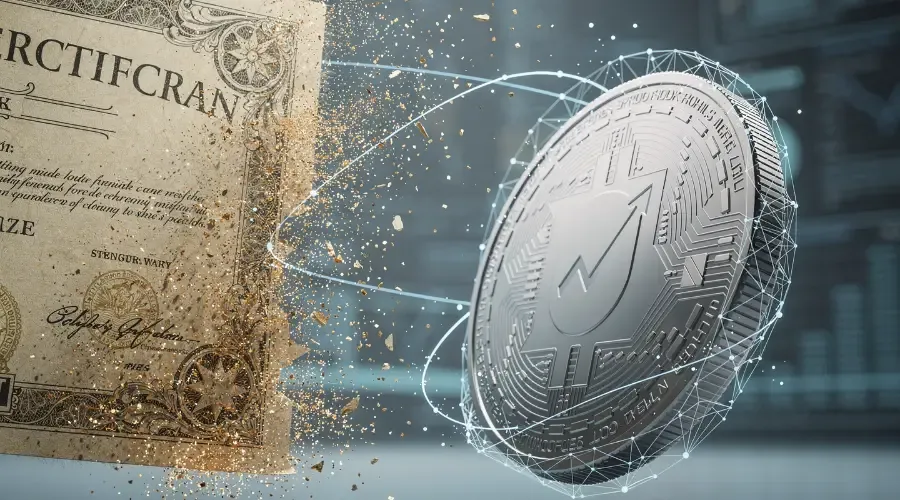
Forget Bitcoin’s price for a moment. Something far more structural - and arguably more important - just happened.
The New York Stock Exchange is launching a tokenization platform to put traditional stocks and ETFs on blockchain rails. Not a crypto exchange. Not a Bitcoin ETF. But a system that could fundamentally change how stocks trade, settle, and are owned.
And this is happening at the same time Bitcoin ETFs are seeing their largest outflows in months.
That might sound contradictory - but it isn’t. What’s unfolding isn’t about crypto hype. It’s about the future of financial infrastructure.
Here’s what NYSE tokenization really means, why it’s different from “normal crypto,” and how it could quietly make today’s brokerage model obsolete.
What Is NYSE Tokenization, in Simple Terms?
Tokenization means taking a real-world asset - like a share of Apple, a bond, or an ETF - and representing it as a digital token on a blockchain.
Instead of owning:
“1 Apple share in your brokerage account”
You could own:
“1 tokenized Apple share in your crypto wallet”
The value stays the same. The underlying company stays the same.
Only the infrastructure changes.
NYSE’s goal is to build a regulated platform where stocks and ETFs can trade 24/7, settle instantly, and integrate with blockchain-based financial tools.
This isn’t a startup experiment.
It’s Wall Street betting that blockchain rails are the future of global markets.
Why Is NYSE Doing This If Stock Markets Already Work?
Traditional stock markets function - but they’re far from efficient.
Here’s what still feels outdated:
1. Settlement Takes Two Days (T+2)
You buy a stock today, but ownership doesn’t fully settle for two days. That delay creates:
- Counterparty risk
- Capital inefficiency
- Operational complexity
2. Markets Close - But News Doesn’t
Stocks trade only during fixed hours.
But earnings, global events, and geopolitical shocks happen 24/7.
3. Ownership Is Layered and Indirect
Your broker doesn’t actually hold your shares.
Custodians and intermediaries do — creating a tangled, opaque ownership chain.
4. Cross-Border Investing Is Still Painful
Buying international stocks involves:
- Currency friction
- Foreign brokers
- Slower settlement
- Higher fees
What Tokenization Fixes
Putting stocks on blockchain rails unlocks:
- Instant settlement (T+0) - trades finalize in seconds
- 24/7 trading - no market hours restriction
- Direct ownership - fewer intermediaries
- Global access - easier cross-border participation
- Programmable securities - smart contracts automate dividends, voting, and rebalancing
In short: markets become faster, cheaper, and more flexible.
How Tokenized Stocks Differ From Bitcoin or Ethereum
It’s tempting to lump this into “crypto.” But it’s fundamentally different.
Bitcoin / Ethereum
- Native crypto assets
- No central issuer
- Value driven by scarcity, utility, or speculation
- Often volatile
Tokenized Stocks (NYSE Model)
- Represent existing traditional assets
- Issued and regulated by financial institutions
- Value tied directly to real company shares
- Volatility mirrors normal stock behavior
Bitcoin is a new asset class.
Tokenized stocks are old assets running on new technology.
Is NYSE Tokenization Actually Useful - Or Just Buzzwords?
Bloomberg raised a smart question:
Is NYSE adding real value — or just repackaging old systems with blockchain branding?
The truth likely sits somewhere in the middle.
The Real Upside
- True 24/7 equity markets
- Faster settlement reduces risk
- Lower back-office costs
- Smart-contract-enabled financial products
- Easier global investor access
The Skeptical View
- Stocks already trade efficiently for most people
- Regulation could slow innovation
- Decentralized exchanges already offer similar functionality
- NYSE may simply recreate existing fee structures
Tokenization won’t replace traditional markets overnight - but it could transform specific segments first, especially global and institutional trading.
NYSE vs. Decentralized Exchanges: Who Wins?
On-chain exchanges like Uniswap and dYdX already offer:
- 24/7 trading
- Near-zero settlement time
- Low fees
- No centralized gatekeepers
So why does NYSE think it can compete?
NYSE Advantages
- Regulatory trust
- Institutional liquidity
- Compliance, tax reporting, and legal protections
- Integration with existing brokerage and banking systems
DEX Advantages
- Lower fees
- True decentralization
- Permissionless global access
- Faster innovation cycles
Likely outcome:
Institutions and regulated investors lean toward NYSE.
Crypto-native users stay on decentralized platforms.
Over time, the two worlds converge.
What This Means for Everyday Investors
Short Term (1–2 Years)
Not much changes yet.
You’ll still trade through Schwab, Fidelity, or E*Trade.
Medium Term (2–5 Years)
You may start seeing:
- Tokenized ETFs at major brokers
- Extended or 24/7 stock trading
- Faster settlement (T+0 instead of T+2)
- Crypto wallets supporting stock ownership
Long Term (5–10 Years)
Your brokerage account might become a crypto wallet — holding:
- Stocks
- Bonds
- Crypto
- Tokenized real estate
- Tokenized funds
All tradable instantly. Globally. Programmatically.
That’s the future NYSE is positioning for.
Why Banks and Institutions Love Tokenization
Banks are cautious about volatile crypto assets.
But tokenized stocks feel familiar — and safe.
They offer:
- Blockchain efficiency
- Traditional asset exposure
- Regulatory clarity
- Lower operational costs
Expect banks to push tokenized:
- Blue-chip stocks (Apple, Microsoft, Nvidia)
- Bond funds
- Global ETFs
- Real estate investment vehicles
Tokenization becomes the bridge between traditional finance and blockchain.
The Real Battle: Who Owns the Investor Relationship?
This isn’t just about tech — it’s about control.
Today:
- Brokers own customers
- Exchanges own trading
- Custodians own asset records
With tokenization:
- Wallets could replace brokers
- On-chain platforms could replace exchanges
- Self-custody could replace custodians
If NYSE wins, Wall Street keeps power.
If decentralized platforms win, finance becomes user-owned.
That’s why this shift matters.
What to Watch Over the Next 12 Months
- Does NYSE actually launch tokenized stock products?
- Do regulators approve or restrict tokenized securities?
- Do institutions meaningfully adopt them?
- Are trading fees reduced — or simply repackaged?
- Do Nasdaq or global exchanges launch competitors?
Execution will determine whether NYSE leads — or loses — this transition.
Final Thought: The Quiet Revolution in Investing
Bitcoin grabs attention.
Altcoins create noise.
But tokenization is the slow, infrastructure-level change that reshapes markets.
In a few years, you may not even think about whether your stocks are “tokenized.”
You’ll just expect instant settlement, global access, 24/7 trading, and lower fees.
NYSE is betting big that blockchain rails are the future.
Decentralized finance is already building that future.
For everyday investors, the lesson is simple:
Watch where financial infrastructure is going - not just where prices are moving.
Because when Wall Street goes on-chain, the rules of investing change.
Disclaimer
This article is for educational purposes only and does not constitute financial or investment advice. Investing involves risk. Always do your own research or consult a licensed financial professional.