
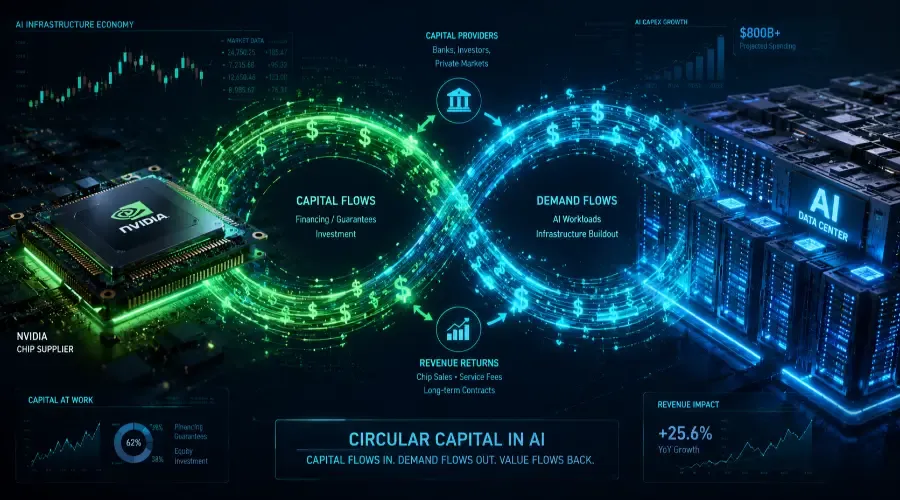
Nvidia is reportedly in talks to guarantee about $250 billion of financing for an OpenAI data-center project: one slice of a deal streak Bloomberg pegs at more than $750 billion. The market's reaction isn't really about the funding. It's about a harder question: whether Nvidia is financing the customers that then buy its chips.
The Metrics - At a Glance
| Metric | Amount | Structure / Context |
|---|---|---|
| OpenAI Guarantee | ~$250B | Covers lease & construction debt for Ohio 10GW data-center site |
| Separate Chip Discussion | Up to $350B | Parallel discussions for direct GPU purchases from Nvidia |
| Total Project Cost | >$500B | Comprehensive buildout target (SoftBank / OpenAI partnership) |
| Nvidia Deal Streak | >$750B | Combined total across recent AI infrastructure arrangements |
BREAKOUTBULLETIN THESIS
Bullish for the AI buildout in the short run, bearish for clean demand visibility because the market is starting to ask whether Nvidia is financing growth or merely recycling it. It's the same fault line now splitting the AI-capex trade between the equipment makers and the spenders.
What the News Is Saying
Per the Wall Street Journal, reported via Reuters, Nvidia is in talks to backstop roughly $250 billion of financing to help OpenAI lease a 10-gigawatt data-center campus that SoftBank's energy arm is building in southern Ohio. The guarantee would cover the lease and construction debt not the chips themselves, with a separate discussion about financing up to $350 billion of Nvidia chip purchases. The full project could top $500 billion.
Parsing the layers: The ~$250 billion guarantee covers the Ohio facility's lease and construction debt, while the up-to-$350 billion chip financing is a separate track, both sit inside the overall >$500 billion project. However, the exact figures don't perfectly reconcile across all reports ($250B + $350B exceeds $500B), so the relationship is best viewed as approximate. Crucially, don't sum these with the broader $750B (Nvidia's deal streak) or $800B (industry-wide circular arrangements) aggregates, as those broader totals already encompass this deal.
The detail that matters: OpenAI doesn't carry an investment-grade credit rating, which is precisely why a Nvidia backstop is on the table - it reassures lenders.
Why Traders Care - It Isn't a Funding Story
This isn't about who pays for the data center. It's a valuation-and-demand story. The market is asking whether Nvidia is financing the very customers that turn around and buy Nvidia chips: a structure that can prop up near-term demand while raising the question of how organic that demand really is.
What is "circular financing"? In circular financing, capital flows from a supplier to a customer, enabling that customer to buy the supplier's products, with revenue cycling back. The result: apparent demand that may be partly self-generated. The loop critics describe: a chipmaker funds an AI lab, the lab commits to cloud providers, the clouds buy the chipmaker's GPUs, and revenue circles back to where it started.
That's why Bloomberg reached for the phrase "AI circular financing," and why the reaction runs bigger than a typical partnership headline. Analysts have tagged more than $800 billion of such arrangements across the AI supply chain. Michael Burry's one-line verdict on the backstop: "around and around we go."
The counterargument—Nvidia's own framing: Nvidia has told analysts its OpenAI backing isn't meant for direct purchases of Nvidia products. The company's argument is that the guarantee is about removing a financing bottleneck for OpenAI, not inflating Nvidia's own revenue. The guarantee covers real estate and construction debt, not chips, meaning the circularity critique may be weaker than the headlines imply. If that's accurate, the structure is less about creating demand and more about enabling a customer's infrastructure buildout. Bulls will lean on this distinction heavily.
The Read-Throughs
The market is parsing this through two distinct lenses:
Bull case: Nvidia is deepening its grip on the AI stack, locking in future demand for chips, cloud, and power, and making itself indispensable to the buildout. The guarantee removes a financing bottleneck and accelerates the AI infrastructure timeline.
Bear case: The ecosystem is increasingly self-funded. If the same capital keeps circulating among a handful of names, it introduces accounting and valuation risk—apparent demand can flatter everyone's numbers until it doesn't. The guarantee structure also means Nvidia's balance sheet becomes a backstop for OpenAI's real estate obligations, a risk that is theoretical today but would turn very real if OpenAI's financing picture deteriorates. The market is already applying that skepticism elsewhere, marking SpaceX's AI business close to zero until monetization proves out.
The Oracle Read-Through
Oracle sits inside the same plumbing. It's borrowing heavily to build capacity for OpenAI under a multi-hundred-billion Stargate commitment, so any shift in OpenAI's funding picture flows straight to Oracle's risk profile. If OpenAI's financing wobbles, can it keep paying Oracle?
That cuts both ways. A stronger OpenAI/Nvidia financing narrative supports cloud-capacity demand, but Oracle also inherits more scrutiny on debt, capex, and customer concentration. Oracle has been quick to insist the Nvidia-OpenAI arrangement doesn't change its own relationship with OpenAI. The kind of reassurance that itself signals where the market's anxiety is pointed.