
BreakoutBulletin | Earnings Intelligence Desk
Q1 FY27 Results – May 20, 2026, Post-Market (5:00 PM ET)
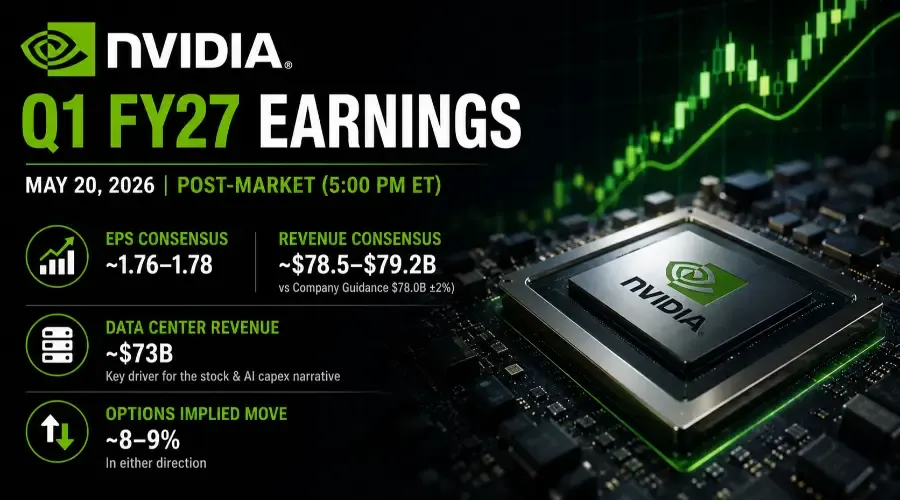
TL;DR – Nvidia Q1 FY27 Earnings (May 20, 2026, Post-Market)
When: Q1 FY27 results today at 5:00 PM ET; this is one of the most market-moving single-stock events of the year.
Consensus: Street looks for EPS ~1.76–1.78 and revenue ~78.5–79.2B vs company guidance of 78.0B (±2%).
Key line item: Data Center revenue – expected around 73B – is the real swing factor for the stock and the broader AI capex narrative.
Options pricing: The options market is implying roughly an 8–9% move in either direction, above Nvidia’s recent average earnings-day move (~7–7.6%).
What will move the stock most:
Q1 Data Center and total revenue vs those expectations.
Q2 FY27 guidance (revenue + margins) and Blackwell/Rubin demand commentary.
Any shift in tone on export controls, AI capex from hyperscalers, and gross margins in the mid-70s.
A note on this preview: This earnings preview is built from analyst consensus data, options pricing, and company guidance available as of May 20, 2026. The numbers referenced – revenue consensus, implied moves, segment estimates – reflect real market expectations for this report. We've flagged where estimates are ranges rather than single figures so you can calibrate accordingly.
Earnings Significance Score
| Category | Score | Reason |
|---|---|---|
| Market Cap Impact | 3/3 | ~$4.6T market cap – among the largest single-stock reports in market history |
| Sector Read-Through | 2/2 | Result will move semis, cloud, AI infrastructure, and broad growth indices |
| Consensus Uncertainty | 1/2 | Whisper slightly above published consensus, not a wide dispersion event |
| Macro Relevance | 2/2 | AI capex narrative, rate sensitivity, export controls – all macro-level signals |
| Guidance Weight | 1/1 | Forward guidance historically more important than results for NVDA |
Total: 9/10 – Landmark report. Treat it as a live case study in how mega-cap earnings move markets.
Executive Summary
NVIDIA reports Q1 FY27 results after the close on Wednesday, May 20, 2026, at 5:00 PM ET.
The single most important number to watch isn't EPS – it's Data Center revenue and the forward demand signal embedded in management's guidance for Q2 FY27.
At approximately $4.6 trillion in market cap, NVIDIA is the largest pure-play AI hardware company in the world. When a company this size reports, the result doesn't just move the stock – it tells the market whether the AI infrastructure spending cycle is still intact or starting to show cracks.
The macro backdrop adds another layer. Elevated Treasury yields are still pressuring long-duration growth valuations, which means NVIDIA's margin strength and free cash flow commentary carry extra weight today compared to a lower-rate environment.
This report is a practical case study in how growth quality gets tested when rate pressure is high and market expectations are already elevated.
The Consensus Landscape
Wall Street is looking for non-GAAP EPS of approximately $1.76–$1.78 for Q1 FY27. The informal whisper number – the unspoken expectation circulating among institutional traders – is reportedly tracking closer to $1.80, which sits above the published consensus.
That gap matters. When a company has beaten consensus consistently, the market's real bar drifts above what analysts publish. A result that clears $1.78 but misses $1.80 can sometimes produce a flat or negative reaction even though it technically "beat" on paper. Worth keeping that in mind as the numbers come in.
On revenue: NVIDIA itself guided Q1 FY27 to $78.0B (±2%) during its Q4 FY26 earnings call in February. Wall Street consensus has since drifted higher, clustering in the $78.5B–$79.2B range – representing roughly 78–80% year-over-year growth from the $44.1B Q1 FY26 result.
Beat/Miss History – Last 4 Quarters
| Quarter | EPS Beat/Miss | Revenue Result | Avg Post-Earnings Move |
|---|---|---|---|
| Q4 FY26 (Jan 2026) | Beat ~5–8% | $68.1B vs $65.6B est | ~7% absolute |
| Q3 FY26 (Oct 2025) | Beat | $57.0B | ~6–8% absolute |
| Q2 FY26 (mid-2025) | Beat | Record growth | High single digits |
| Q1 FY26 (Apr 2025) | Beat | $44.1B vs $43.2B est | Strong positive |
Four consecutive beats. That track record is partly why the whisper sits above the published number – and why the bar for a positive reaction may be higher than the headline consensus implies.
The Key Metrics Framework
What analysts are watching beyond the headline numbers:
Data Center Revenue
What it measures: Revenue from AI GPU sales and related infrastructure to hyperscalers, enterprises, and sovereign customers. Q4 FY26 came in at $62.3B for this segment – representing over 91% of NVIDIA's total $68.1B quarterly revenue. That concentration tells you everything about where the business actually lives.
What Street expects for Q1 FY27: Data Center revenue alone is expected to step up to approximately $73B, consistent with the overall company guidance of $78.0B and reflecting continued AI infrastructure build-out across hyperscalers and enterprise customers.
Bull read: If Data Center clears $73B and management describes sustained order momentum with no signs of hyperscaler budget caution, it reinforces the AI capex cycle narrative across the entire sector.
Bear read: If Data Center growth decelerates sequentially, or management mentions order push-outs, budget digestion, or customers pausing to absorb existing capacity, the market may start questioning how long the current spending cycle holds at this pace.
Non-GAAP Gross Margin
What it measures: How much revenue NVIDIA keeps after the cost of producing its hardware. Q4 FY26 came in at approximately 75%. Management had previously guided toward mid-70s gross margin "late this year."
Bull read: Margin holding at or above 75% signals pricing power and product mix strength even as export controls and competition evolve.
Bear read: Compression below 73–74% may suggest customer pricing negotiations, supply constraints, or competitive pressure are starting to bite.
Blackwell and Rubin Product Cycle Demand
What it measures: The transition from NVIDIA's Hopper GPU architecture to the current Blackwell line – and any early commentary on the next-generation Rubin architecture – is one of the most closely watched topics on today's call.
Analysts want to know whether Blackwell demand is tracking ahead of, in line with, or behind prior product cycle ramps. Any timeline commentary on Rubin – the next-gen platform after Blackwell – could shape how investors think about the multi-year AI hardware roadmap.
Bull read: Strong Blackwell demand with early positive Rubin signals suggests the product cycle has runway beyond the current build-out.
Bear read: Blackwell ramp delays, supply bottlenecks, or vague Rubin commentary could raise questions about whether the AI hardware upgrade cycle might slow before the next platform is ready.
Export Control Revenue Impact
What it measures: How much revenue has been lost or redirected due to U.S. restrictions on high-end chip exports to China.
Management has previously cited measurable impact from these controls. Analysts will want to know whether the drag has been fully absorbed, whether alternative markets are offsetting the loss, and whether new regulatory changes are on the horizon.
Options-Implied Move – What It's Telling You
How to read the options market before earnings:
Current options pricing implies a move of approximately 8.0%–8.7% in either direction around this earnings release. At a ~$4.6 trillion market cap, that percentage translates to a potential market cap swing of roughly $350 billion in a single session – making this one of the largest dollar-value earnings events in market history regardless of direction.
For context, ORATS and Reuters data show that NVIDIA's average implied move over the last 8–12 earnings events has been approximately 7–7.7%, with realized moves averaging a similar 7–7.6%.
Today's implied move of 8.0%–8.7% sits above that historical average – not below it. That's a meaningful distinction from what earlier estimates suggested. Options traders appear to be pricing elevated uncertainty specifically around the Blackwell product cycle update and whether demand characterization matches or exceeds the elevated expectations already baked in.
What the implied move actually tells you: The options market isn't predicting direction. It's pricing the size of the expected move. The straddle price – buying both a call and a put at the same strike – mathematically implies the range the market expects the stock to move within. When implied volatility is running above historical averages, it suggests options traders see more uncertainty than usual, not less.
Sector Read-Through
This result doesn't stay contained to NVDA.
The direct peer group watching this report includes AMD, Broadcom (AVGO), Taiwan Semiconductor (TSM), and key equipment makers across the SOX and SMH. All of these names have meaningful AI and data center revenue exposure. A strong NVIDIA Data Center result typically lifts sentiment across the group – a weak one often pressures it.
The hyperscalers – Microsoft, Amazon, and Alphabet – are equally relevant. NVIDIA's commentary on AI workload demand and cloud infrastructure spending feeds directly into how the market thinks about hyperscaler capex going forward. These companies are NVIDIA's largest customers.
ETFs with significant NVDA exposure – SOXX, SMH, QQQ, and XLK – will all respond to this report given the stock's weighting.
The transmission chain runs like this: NVDA Data Center result → AI capex narrative confirmed or challenged → hyperscaler sentiment repriced → broad growth and tech sector follows.
Guidance Is the Real Story
Why forward guidance often matters more than the results themselves:
For a company growing at NVIDIA's pace, Wall Street cares more about what's coming than what already happened. The Q1 FY27 results are backward-looking. The Q2 FY27 guidance range is where the stock's next move typically gets priced.
Three guidance signals carry the most interpretive weight on today's call:
Revenue guidance range
Is management guiding Q2 FY27 in line with, above, or below current Street expectations? A guide above consensus is the clearest positive signal. A guide in-line after a beat is sometimes interpreted as conservatism, sometimes as caution – the tone of management's accompanying commentary usually determines which read the market takes. A guide below consensus, regardless of the Q1 result, is typically what produces the most significant negative reactions.
Margin language
Management previously guided toward mid-70s gross margin. If that language tightens to specific numbers or improves directionally, it signals confidence in pricing power and product mix. If it becomes more hedged – something like "we expect margins to remain roughly stable, subject to product ramp timing" – that softer framing is worth noting even if the number itself hasn't changed.
Demand characterization and Blackwell commentary
Listen for whether management describes demand as broad-based and accelerating, or introduces any language around digestion periods, push-outs, or supply constraints on the Blackwell ramp. Early Rubin timeline signals, if offered, could be the forward-looking highlight of the call beyond the near-term guidance numbers. These subtle shifts in language often appear before they show up in actual quarterly results.
The cleanest bullish combination is a beat on Q1 results paired with a raise on Q2 guidance. Maintained guidance after a beat may be interpreted as conservatism or caution depending on how demand is characterized. A miss on guidance is the significant surprise risk in either direction.
Macro Context
The Q1 FY27 report arrives while elevated Treasury yields – driven by persistent inflation and a higher-for-longer Federal Reserve stance – continue to apply pressure on long-duration growth valuations.
This is the "AI vs. rates" test playing out in real time. Twelve months ago, AI enthusiasm was strong enough to largely override rate sensitivity in growth names. Today, with yields elevated and the macro debate unresolved, NVIDIA's margin strength, free cash flow generation, and forward demand commentary carry added weight as offsets to the discount rate pressure.
NVIDIA returned over $41B to shareholders in FY26. At multi-trillion dollar market cap levels, commentary on buyback pace and dividend sustainability is relevant to how the market thinks about valuation support even in an elevated rate environment.
Game Day Checklist – First 5 Minutes After the Release
When the numbers drop at 5:00 PM ET, here's what to check first and in what order:
- Data Center revenue vs. the ~$73B Street expectation – This is the most important single number. Everything else is secondary to whether AI infrastructure demand is tracking as expected.
- Total revenue vs. the $78.5B–$79.2B consensus range – And separately, whether it cleared the $78.0B company guidance midpoint.
- Q2 FY27 guidance range vs. current Street estimates – A guide above consensus is the clearest signal. A guide in-line or below changes the interpretation significantly regardless of the Q1 beat.
- Gross margin print vs. the mid-70s target – Any meaningful move above or below 75% in either direction is worth flagging before the call begins.
- First mention of Blackwell demand and any Rubin commentary – These product cycle signals may end up being more market-moving than the headline EPS number itself.
The earnings call begins shortly after the release. The first 10 minutes of prepared remarks often contain the guidance language and demand characterization that moves the stock more than the press release numbers alone.
Disclaimer
This earnings preview is produced for educational purposes only. It does not constitute financial advice, investment recommendations, or trading instructions of any kind. All analysis is presented as a framework for understanding how professionals approach earnings events – not as a guide for action. Consensus estimates, implied move ranges, and segment expectations referenced in this post reflect analyst data available as of May 20, 2026, and may differ from final reported figures. Past earnings reactions do not guarantee future outcomes. Options involve significant risk and are not appropriate for all investors. Consult a licensed financial professional before making any investment or trading decisions. BreakoutBulletin does not hold positions in any securities mentioned in this report.