
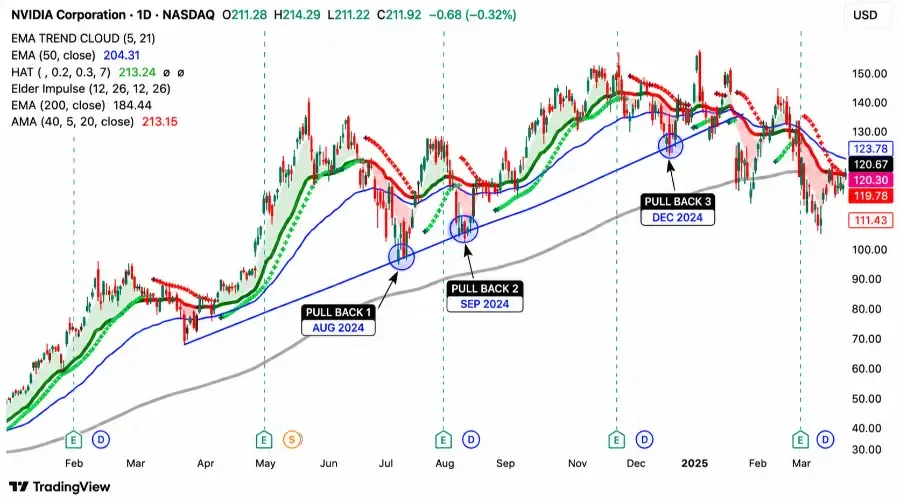
If you are trying to day trade or swing trade by chasing green breakout candles when an asset is already extended, you are playing a losing game. Smart money doesn't buy the peak; they wait for price to return to established institutional baselines.
In our foundational guide, we introduced the 3-Tier Trading Framework and explained that you must anchor your strategy in Tier 1: Market Structure before pulling any triggers. Today, we are looking at how a major high-timeframe trend structure functions in the real world using NVIDIA (NVDA).
By tracking a core institutional baseline–the 50-day Exponential Moving Average (EMA)–combined with dynamic trend clouds, we can strip away market noise and identify high-probability entry zones with mathematical precision.
The Core Concept: The Institutional Moving Average
Many retail traders treat moving averages like simple crossover lines. If the fast line crosses the slow line, they buy.
Professionals look at moving averages differently. To an institutional execution algorithm or an accumulation desk, a high-timeframe baseline like the 50-day EMA represents the average cost basis of the trend. When a powerful growth stock pulls back to this level, it isn't just a random dip–it is an area where major funds are mathematically incentivized to step in and defend their positions to maintain their average cost criteria.
Let's look at how this structural reality played out over a multi-month macro cycle on NVDA.
Case Study: The NVDA 3-Pullback Masterclass
To see this structural framework working flawlessly across an entire market cycle, let's analyze the specific annotations marked on the daily chart in NVDA_2026-05-28_20-13-41.jpg.
Pullback 1: The Liquidity Flush (August 2024)
During early August, NVDA underwent a violent, sharp correction. To the untrained retail eye, the stock looked broken as it sliced violently through the green EMA Trend Cloud. Panic sellers dumped their shares right at the bottom.
However, looking at the structural architecture, the price slammed directly into the solid blue 50-day EMA line. This acted as an absolute structural floor. The moment the liquidation ended at this institutional baseline, smart money stepped in, absorbing the shares and launching an explosive multi-week reversal back to the highs.
Pullback 2: The Trend Reconfirmation (September 2024)
Following the aggressive bounce off Pullback 1, NVDA pushed higher before experiencing a shallow cooling-off period in September. This time, the market didn't panic. The price drifted back down and checked the solid blue line a second time.
Pullback 2 is a classic continuation play. Because the 50-day EMA had already been proven as a major structural floor, buyers immediately defended the line on a shallow retest, reconfirming the health of the macro uptrend and kicking off the next massive leg upward.
Pullback 3: The Post-Expansion Consolidation (December 2024)
After an epic run into the $140–$150 price zones, NVDA finally exhausted its momentum and entered a prolonged sideways consolidation through November and December.
Notice where the absolute floor of that multi-week choppy range formed: once again, right along the solid blue 50-day EMA line. Pullback 3 demonstrates how a structural baseline acts as a steady gravity well. Even during extended periods of market distribution and chop, the institutional average cost basis holds the line, building a rock-solid launchpad for the next major market expansion.
Integrating Multi-Pullback Analysis into Your 3-Tier System
The lesson from NVDA_2026-05-28_20-13-41.jpg is clear: Structure repeats itself if you know what baseline to track.
When applying the 3-Tier system to this chart:
Tier 1 (Structure): You identify a high-timeframe institutional anchor like the 50-day EMA (the solid blue line) and wait for the price to return to it (Pullbacks 1, 2, and 3).
Tier 2 (Confirmation): You wait for momentum filters (like the green trend crosses or candle color shifts) to prove the sellers are exhausted.
Tier 3 (Timing): You drop down your timeframe to execute an entry right at the structural boundary, ensuring your stop-loss is placed safely just beneath the baseline invalidation level.
Trend Structure Strategy Q&A
Q: Why did price drop below the Trend Cloud but stop perfectly at the blue 50 EMA during Pullback 1?
The EMA Trend Cloud (5, 21) measures short-to-medium-term momentum. During deep market liquidations or macro panic events, short-term momentum will always break. However, macro institutions look at the deeper structural value. The 50-day EMA acts as a high-timeframe value anchor, which is why major capital stepped in to save the trend precisely at that blue line.
Q: How do you know a pullback is a buying opportunity rather than a true trend reversal?
Look at the slope of your structural baseline. Throughout Pullback 1, 2, and 3, notice how the blue 50-day EMA line remained angled upward. As long as the high-timeframe average cost basis is pointing up, the macro structure is bullish, meaning deep dips are statistically high-probability pullbacks rather than structural reversals.
Q: Should a trader buy blindly the exact moment price touches the blue line?
No. While the blue line provides your Tier 1 location, executing blindly leaves you vulnerable if a true macro trend reversal is occurring. Always wait for your Tier 2 momentum indicators to print or for the candles to shift color, confirming that active buying volume has physically entered to defend that specific level.
Next Step in the Masterclass:
Now that you see how institutions leave a physical structural blueprint across an entire year, it's time to learn how algorithms judge value intraday. Read our next guide: [How Banks View Value: Mastering VWAP Standard Deviation Bands].