
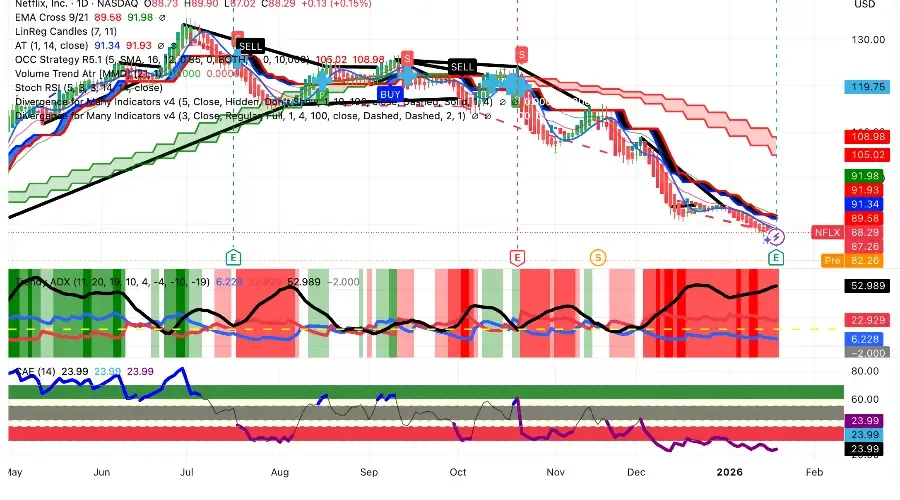
Netflix’s guidance cut didn’t land in a vacuum. It landed on the same day the S&P 500 suffered its sharpest selloff of 2026, volatility spiked above 20, and foreign investors began reducing exposure to U.S. assets. In that environment, leverage stops being an abstract balance-sheet detail and becomes the primary lens through which markets price risk.
On Monday evening, Netflix reduced its 2026 revenue growth outlook, citing slower subscriber momentum and higher content spending commitments tied to its Warner Bros. acquisition. Under normal market conditions, the revision might have been absorbed quietly. Instead, the stock underperformed sharply as investors reassessed what high leverage means when capital becomes selective.
This wasn’t about Netflix’s business model breaking. It was about how debt behaves when markets shift from expansion to preservation.
What Actually Changed
Netflix entered 2026 carrying approximately $82 billion in committed acquisition and content-related debt, much of it incurred during a low-rate, risk-on environment. That leverage was manageable as long as revenue growth remained predictable and capital markets remained accommodative.
Monday altered both assumptions.
First, the company lowered forward growth expectations, reducing confidence in near-term cash flow expansion. Second, the broader market moved decisively risk-off, driven by geopolitical uncertainty and foreign capital retreating from U.S. assets. When those two forces collide—slower growth and tighter risk tolerance—leverage stops being neutral.
The issue is not solvency. Netflix is not facing a liquidity crisis. The issue is optionality. High leverage narrows the range of strategic responses available when conditions deteriorate.
Why Leverage Matters More in Risk-Off Regimes
In risk-on markets, leverage amplifies upside. In risk-off markets, it compresses valuation.
As volatility rises and capital becomes defensive, investors begin sorting companies into two buckets:
-
Those with balance-sheet flexibility
-
Those without it
Netflix falls into the second category.
With significant debt obligations, Netflix must prioritize cash generation, debt servicing, and rating stability. That constrains its ability to:
-
Accelerate content investment opportunistically
-
Pursue counter-cyclical acquisitions
-
Absorb temporary revenue shocks without multiple compression
Contrast that with companies like GlaxoSmithKline, which deployed $2.2 billion in cash to acquire RAPT Therapeutics on the same day markets sold off. One company was able to act offensively during volatility. The other was forced into defensive posture.
That divergence is the market signal.
Market Reaction Confirms the Mechanism
Netflix’s underperformance wasn’t isolated. It fit a broader pattern:
-
High-beta, leveraged growth stocks sold off the most
-
Defensive sectors and balance-sheet-strong companies held up
-
Credit sensitivity increased across equity valuations
This is how markets behave when the cost of capital becomes visible again.
In these regimes, investors stop asking, “How fast can this company grow?”
They start asking, “How much room does this company have if growth slows?”
Leverage reduces that room.
What to Watch Going Forward
If you’re tracking whether Netflix’s leverage becomes a sustained valuation headwind, focus on these signals:
1. Credit market response
Watch Netflix’s bond spreads relative to investment-grade peers. Equity usually reacts first, but credit confirms durability.
2. Content spend discipline
Listen for language around pacing, prioritization, or “return-focused investment” on earnings calls. That signals constraint, not choice.
3. Refinancing commentary
Any discussion of extending maturities or managing interest expense reveals how management views future capital access.
4. Relative performance during volatility
If Netflix continues to underperform on down-market days and fails to lead on rebounds, leverage is being structurally priced in.
The Bigger Picture
Netflix’s guidance cut matters less than when it happened.
In a calm market, leverage is tolerated.
In a volatile market, leverage is interrogated.
As foreign investors reassess U.S. political and macro risk, and as volatility remains elevated, markets will continue to favor companies with balance-sheet flexibility over those with debt-heavy growth models.
Netflix didn’t suddenly become a worse company.
The market simply changed the question it was asking.
Educational only. Not investment advice.