
BreakoutBulletin | Market Narrative Desk – May 20, 2026
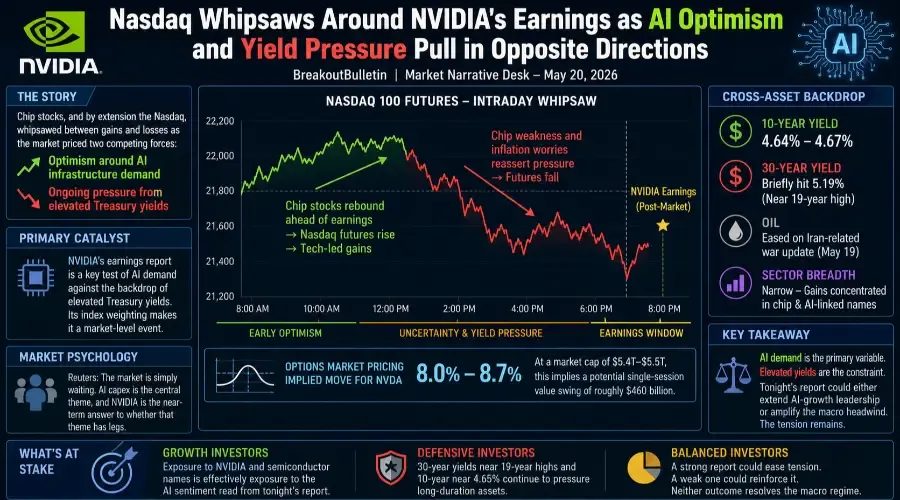
The session going into NVIDIA's post-market earnings report on May 20, 2026 told a straightforward story with a complicated surface: chip stocks, and by extension the Nasdaq, swung between gains and losses as the market tried to price two competing forces at the same time – optimism around AI infrastructure demand and ongoing pressure from elevated Treasury yields.
NVIDIA's report was the dominant event. Not just for the stock itself, but for the broader market. When a company carries the kind of index weighting and thematic weight that NVIDIA does right now, its earnings don't stay contained to a single ticker. They become a read on whether the AI spending cycle is real, durable, and worth the valuations attached to the names tied to it. That's the structural reason this session was unusually sensitive to every piece of chip-related news.
Primary Catalyst: NVIDIA as a Market-Level Event
Reuters covered the setup from multiple angles through the day. U.S. stock index futures initially rose as chip stocks rebounded ahead of the report, with the Nasdaq leading gains on Wall Street. Later in the session, futures fell as chip weakness and inflation worries reasserted pressure. That two-directional move within a single session reflects the genuine uncertainty around how the report would land – not noise, but actual positioning tension.
The mechanism is worth understanding clearly. NVIDIA's weighting in the Nasdaq 100 and S&P 500 is large enough that its pre-earnings moves pull index-level futures with it. When chip stocks rebound in anticipation of a strong result, the Nasdaq typically follows. When they slide on macro concerns, the same transmission runs in reverse. The index isn't leading the chip stocks here – the chip stocks are leading the index.
Reuters explicitly framed the report as a key test of AI demand against the backdrop of elevated Treasury yields. That framing captures what the session was actually pricing: not just a quarterly revenue beat or miss, but a signal about whether enterprise AI spending is tracking fast enough to justify the current valuation premium across the entire growth complex.
Reinforcing Signals
The transmission chain across the session ran like this:
NVIDIA earnings anticipation → chip stocks rebound in early trading → Nasdaq futures rise and Wall Street opens with tech-led gains → Reuters and market commentators frame the setup as an AI sentiment test → uncertainty around yield backdrop introduces selling pressure → chip stocks extend a slide → futures fall → the market enters the post-market earnings window with positioning concentrated but directionally unresolved.
Story #8 – Reuters' "Morning Bid: Nvidia vigil" – adds an important layer. Reuters described the broader market as simply waiting. AI capex was the central theme, and NVIDIA was the near-term answer to whether that theme had legs. That's not a secondary data point – it describes the actual market psychology heading into the close, where most participants were holding position rather than adding or reducing aggressively ahead of a binary catalyst.
The combination of these four stories – pre-market futures rebound, Wall Street gains on chip strength, subsequent futures decline on chip slide and inflation concern, and the "vigil" framing – creates a coherent picture of a market that was event-locked. The range of outcomes was wide. The positioning reflected that.
Cross-Asset Confirmation
Treasury yields were the ambient pressure throughout. The 10-year yield was sitting near 4.64–4.67% heading into the session, with the 30-year briefly touching 5.19% in the prior session – near a 19-year high according to CNBC. Yields at these levels raise the discount rate applied to future earnings across all long-duration assets, which is why growth stocks and chip names face a structural valuation headwind even when their near-term demand picture looks constructive.
Oil eased on the latest Iran-related war update, according to Reuters coverage from May 19. That removed one inflation input at the margin, though it didn't materially shift the broader yield picture.
Sector breadth was narrow through the session. Gains were concentrated in chip and AI-linked names during the positive phase, while the broader market didn't participate proportionally. That kind of narrow breadth typically indicates event-driven positioning rather than genuine risk-on appetite across the tape.
VIX and dollar data weren't specifically quantified in the sourced stories for this session. The qualitative picture – volatile intraday swings in futures, concentrated chip positioning, elevated yield backdrop – is consistent with a higher-uncertainty environment, but specific readings weren't available to confirm directionally.
Divergent or Secondary Signals
Cluster B – the yield-driven macro stories from May 19 – adds important context without dominating the narrative.
Reuters reported on May 19 that a global stock index fell as 30-year Treasury yields hit their highest level since 2007. The Dow, S&P 500, and Nasdaq all closed lower that session as inflation worries pushed yields higher, with chip stocks contributing to the drag. CNBC flagged the 30-year yield briefly topping 5.19%.
These stories matter because they establish the macro backdrop that NVIDIA's report is being measured against. The yield pressure isn't new – it's been building. What the May 20 session reflects is a market trying to hold AI-growth positioning in an environment where the cost of capital is rising and inflation hasn't resolved. Those two things can coexist for a period, but they create the tension that explains the intraday volatility.
The yield-driven cluster doesn't dominate because it doesn't introduce a new catalyst. It reinforces the existing regime. The dominant driver remains the NVIDIA earnings event, and the yield backdrop is the frame around it rather than a competing force.
Structural Implications
The positioning picture heading into the NVIDIA print reflects concentration, not conviction.
When a market's pre-earnings moves are driven heavily by a single name – with chip stocks pulling the Nasdaq in both directions through the session – it typically indicates that participants are sizing around an event rather than expressing a directional macro view. That's a different kind of risk than a broad market selloff driven by deteriorating fundamentals.
The liquidity regime is one where a single result could produce outsized index-level moves in either direction. The options market was pricing an implied move of approximately 8.0%–8.7% for NVDA, which at a market cap in the $5.4T–$5.5T range translates to a potential single-session value swing of roughly $460 billion. That number describes the structural stakes of the event – not just for NVIDIA holders, but for index-level exposure across QQQ, XLK, and SMH.
Breadth is narrow. The gains in this session were concentrated rather than broad. That's consistent with an event-driven setup where capital is positioning around a specific catalyst rather than rotating into risk assets broadly.
Portfolio Context
For growth-heavy investors, the session's two-directional move in chip stocks may highlight how quickly positioning can shift around a binary catalyst. Exposure to NVIDIA and semiconductor names is effectively exposure to the AI sentiment read that comes out of tonight's report.
For defensive investors, the yield backdrop that's been building through Cluster B – 30-year yields near 19-year highs, 10-year near 4.65% – continues to provide a structural reason for caution around long-duration assets. That pressure doesn't disappear with a strong NVIDIA result.
For balanced portfolios, the tension between AI growth positioning and elevated yields may be the defining dynamic of this period. A strong NVIDIA report could temporarily reduce that tension. A weak one could reinforce it. Neither outcome resolves the underlying macro regime.
Bigger Picture
This session doesn't introduce a new macro tension – it concentrates an existing one.
The market has been navigating the same fundamental conflict for months: AI-driven growth enthusiasm running against an elevated rate environment that raises the discount on that growth. NVIDIA's earnings are, in that context, a near-term data point in a longer unresolved debate.
If the report confirms strong AI capex demand with constructive forward guidance, the current regime of AI-growth leadership may extend. If it introduces doubt – through softer guidance, demand push-outs, or margin pressure – the yield-driven macro headwind that's been present throughout Cluster B could assert itself more forcefully across the growth complex.
What today's session confirms is that the market is still treating AI demand as the primary variable and yield pressure as the constraint around it. That relationship may shift, but it hasn't shifted yet.
This article is for informational and educational purposes only and does not constitute financial, investment, or trading advice. You are solely responsible for your own investment decisions and should consult a licensed financial professional before acting on any information in this post.