
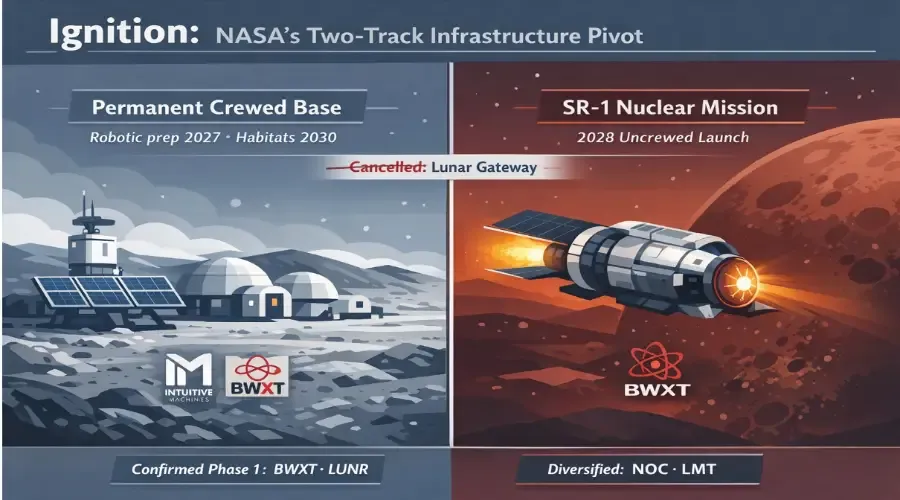
NASA’s latest announcement marks a structural shift in US space policy. With a $20 billion, seven-year programmeto build a permanent lunar base and a parallel 2028 nuclear propulsion mission to Mars, the landscape for space investing has changed.
This is not a mere continuation of Artemis; it is a policy pivot. By redirecting funding from the Lunar Gateway toward surface-based operations, NASA is concentrating economic value into specific contractors and technical components. For investors, the distinction between confirmed contract exposure and thematic alignment has never been more important.
What NASA Actually Announced: The “Ignition” Framework
The programme, internally referred to as “Ignition,” consists of two parallel tracks:
Permanent Lunar Base
Targeted for the lunar south pole, where water ice has been confirmed. Robotic site preparation begins in 2027, with crewed habitat deployment starting in 2030 and expansion extending toward 2050.
SR-1 Nuclear Mission
A 2028 uncrewed Mars launch to validate nuclear-electric propulsion—a first-of-its-kind system that enables faster, more efficient deep-space travel.
What changed is the cancellation of the Lunar Gateway, which had been central to previous Artemis plans. By redirecting funding to surface infrastructure, NASA is prioritizing operational presence over orbital staging, reshaping which companies participate in near-term revenue flows.
Why This Policy Shift Matters
The most important element is not the lunar base itself, but the introduction of nuclear-electric propulsion with a defined timeline and identified contractors at the point of announcement. That level of specificity suggests parts of the contract architecture are already advanced, increasing the probability that near-term contracts translate into revenue visibilityrather than remaining long-dated projections.
Funding timing is critical. The $20 billion commitment requires annual appropriations. Phase 1 contracts—robotic site preparation, lunar delivery, and nuclear reactor development—are expected to be awarded in late 2026 through 2027, with revenue visibility beginning as early as 2027 for surface power systems and delivery services. This matters because companies with exposure to Phase 1 activities will see cash flows before those tied to later habitat or crew phases.
Company Exposure: Confirmed vs. Speculative
The shift from orbital infrastructure to surface operations narrows the field of beneficiaries. Exposure can be grouped into three tiers:
Direct, Confirmed Exposure
BWX Technologies (BWXT) – Nuclear reactor for lunar surface power and SR-1 propulsion, with dual-track exposureacross Moon and Mars timelines.
Intuitive Machines (LUNR) – Robotic site preparation and lunar delivery, aligned directly with Phase 1 execution.
Diversified, Established Exposure
Northrop Grumman (NOC) – Habitat modules and crew systems with Phase 2 (2030+) relevance.
Lockheed Martin (LMT) – Crew systems and integration, with exposure tied to longer-term programme development.
Speculative / Thematic Exposure
Rocket Lab (RKLB) – Potential launch services and components, dependent on subcontract awards.
Redwire (RDW) – Space infrastructure and in-space manufacturing, with indirect exposure to future phases.
The key distinction is between confirmed contract exposure and thematic alignment. Historically, markets have rewarded companies with near-term, visible revenue linkage more consistently than those with longer-term positioning.
What History Shows About Space Policy Announcements
Past space policy announcements provide a useful framework. Following the initial Artemis unveiling in 2019, a basket of space-related stocks rallied 15–20% over three months, but much of that gain was erased as funding delays emergedand programme architecture shifted.
The pattern is clear: markets respond most strongly to confirmed, near-term contracts, not long-term narrative potential. The “Ignition” announcement may follow a similar trajectory, where initial enthusiasm depends on follow-through via appropriations, execution milestones, and contract awards.
Cross-Asset Context: Space vs. Broader A&D
To gauge whether the policy shift is driving sector-specific value, it is useful to compare space-exposed stocks with the broader aerospace & defense (A&D) sector. Since the announcement, ARKX and XAR have both moved higher, but space-focused names—particularly BWXT and LUNR—have shown stronger relative performance.
This suggests that the market is distinguishing between general defense exposure and specific space infrastructure beneficiaries. If this gap widens as contract awards materialize, it validates the concentrated exposure thesis.
The Risk Framework: Announcement vs. Appropriation
Despite the scale of the announcement, several risks could shape how markets respond:
Congressional Budget Approval
The $20 billion commitment requires annual appropriations. Any delay in the FY2027 budget could stall the 2027 robotic preparation phase.
Regulatory Hurdles
Nuclear systems and commercial launch certification introduce timing uncertainty.
Technical Milestones
First-of-kind systems like SR-1 carry inherent execution risk.
Policy Continuity
Long-term programmes must navigate changing political priorities.
Valuation Risk
Companies may re-rate on narrative without confirmed contract visibility.
These risks are not theoretical. Every major space programme has historically encountered execution challenges that impacted market performance.
Structural Implications for the Space Sector
The “Ignition” announcement introduces a shift from distributed programme value to concentrated execution value. By cancelling the Gateway and focusing on surface infrastructure, NASA is narrowing the set of companies with near-term economic participation.
This creates a clear distinction between core beneficiaries and peripheral participants. Companies directly tied to Phase 1 activities stand to benefit earlier in the cycle than those linked to longer-term infrastructure.
What to Watch Next
- Whether the FY2027 NASA budget request aligns with the $20 billion commitment
- Timing of Phase 1 contract awards expected in late 2026 through 2027
- Progress in robotic lunar site preparation
- Development milestones for the SR-1 nuclear propulsion system
- Evidence of revenue visibility from awarded contracts
These signals will determine whether the announcement evolves into a sustained sector re-rating or remains a short-term narrative catalyst.
The Bigger Picture
This is not just a space exploration story. It is a policy-driven capital allocation shift that reshapes how government spending flows into the private sector. The key question is whether the programme transitions from policy intent to funded execution.
If it does, it could mark a sustained re-rating phase for parts of the space sector. If it does not, historical patterns suggest that initial enthusiasm may give way to a more measured reassessment.
Engagement Question
If the SR-1 nuclear propulsion programme faces delays beyond 2028 while lunar surface contracts proceed on schedule, which company exposures become more valuable—and which lose their long-term premium?
DISCLAIMER :
This article is for informational and educational purposes only and does not constitute financial, investment, or trading advice. You are solely responsible for your own investment decisions and should consult a licensed financial professional before acting on any information in this post.