
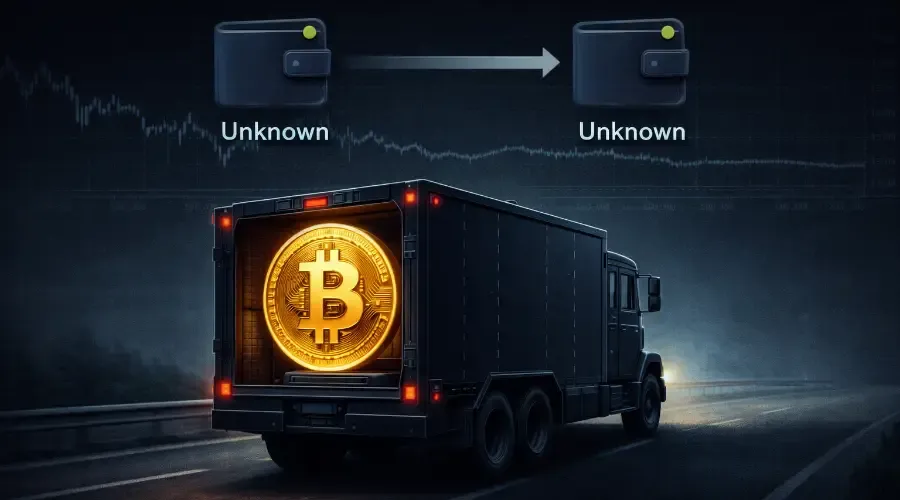
A mysterious $238 million Bitcoin transfer just appeared on‑chain, and crypto social lit up. Around 06:50 UTC, trackers flagged 3,401 BTC moving between two unlabeled wallets—one of those classic “unknown to unknown” transactions that immediately raises questions: Who? Why? Should traders care?
Unlike a tagged exchange deposit such as a clear Binance inflow, this transfer’s destination isn’t identified, and that ambiguity changes how you should interpret it. This note breaks down what we actually know, why most unknown transfers matter less than they seem, and how to track whether this one evolves into anything important.
The Transaction: Facts vs Speculation
What’s confirmed on‑chain:
- Amount: 3,401 BTC (roughly $238M at $70,000 per BTC).
- Source: Unlabeled wallet address.
- Destination: Unlabeled wallet address.
- Timestamp: 06:50 UTC with normal network confirmations.
What’s not known yet:
- Who controls either wallet (individual, institution, exchange, fund, OTC desk).
- Whether the move is related to a sale, custody change, or OTC settlement.
- If the BTC will ever hit exchanges or remain in long‑term storage.
It’s like seeing an armored truck on the highway: you know something valuable is moving, but without a destination or context, the signal is incomplete.
Why Unknown Transfers Usually Matter Less
The critical factor is destination:
- To a known exchange deposit address:
- High probability of eventual selling or hedging.
- Traders often front‑run potential sell pressure; price can react quickly.
- From unknown → unknown:
- Could be OTC, internal rebalancing, custody changes, or anything else.
- Often never touches public order books.
- Markets typically ignore these unless follow‑up data turns them into a clear pattern.
In this case, BTC price barely budged—moving only a fraction of a percent around the alert—well within normal intraday noise. That’s consistent with how markets tend to treat ambiguous flows compared with clearly tagged exchange deposits.
Three Plausible Scenarios
Instead of precise probabilities, think in terms of typical use‑cases for big unknown‑to‑unknown moves.
1) OTC Trade Settlement
Large buyers and sellers often transact via over‑the‑counter desks to avoid slippage on exchanges. A multi‑hundred‑million‑dollar transfer can easily be:
- An institutional buyer receiving BTC from a large holder.
- Settlement moving between the desk’s and client’s wallets.
- Both addresses untagged in public datasets.
Market impact: generally neutral to slightly bullish if the buyer is now long BTC and the sale was already agreed at fixed terms.
2) Exchange or Custody Rebalancing
Major exchanges and custodians frequently move thousands of BTC between hot wallets and cold storage as part of their security policy. Not every address they control is publicly labeled.
- Internal rebalancing appears on‑chain as “unknown → unknown.”
- It often involves 2,000–5,000 BTC chunks, similar to this size.
Market impact: zero if the coins were already part of user balances and stay within the same organization’s control.
3) Large Holder Reorganizing Storage
A whale might simply be:
- Consolidating coins from older wallets.
- Moving to a new cold‑storage setup or multisig.
- Preparing for lending, staking, or estate planning.
Market impact: neutral until proven otherwise. Only if these coins later move to exchanges or are broken into many smaller outputs aimed at liquidity venues does it become a clearer sell signal.
How to Track Unknown Transfers the Right Way
Rather than trading the first alert, treat it as the start of an investigation.
Step 1: Wait for Better Labels
On‑chain analytics firms and community researchers often update labels within hours or days by comparing transaction patterns and clusters. Watch updates from platforms like Arkham, Nansen, or Glassnode for signs that:
- The destination is an exchange or brokerage → more bearish.
- The destination is a known custodian, fund, or long‑term storage address → neutral to slightly bullish.
- The address stays unlabeled but inactive → likely operational or custody‑related.
Step 2: Observe Follow‑Up Activity
Over the next 24–72 hours:
- Consolidation: More BTC flows into the same wallet and then sits. That often implies accumulation or a new cold‑storage hub.
- Fragmentation: The 3,401 BTC is split into many smaller outputs that then interact with exchanges or mixers. That pattern can precede distribution.
- No movement: Most likely an internal move or completed OTC settlement with no immediate market consequence.
Step 3: Cross‑Check Exchange Balances
Look at aggregate BTC exchange reserve data. If exchange balances rise by roughly the same amount as the unknown transfer and no other major inflows are visible, it may have been an untagged deposit. If reserves stay flat or fall, the transfer likely remained off‑exchange.
What It Means for the Bitcoin Market Right Now
In the absence of an exchange tag or follow‑through evidence, the default is:
- Short term: Minimal direct impact. BTC will likely trade more on other catalysts (derivatives positioning, macro data, ETF flows, clearly identified whale activity) than on this single unknown jump.
- Medium term: Impact only if subsequent moves show that the coins are heading toward venues where they can be sold, or if similar unknown transfers repeat in a pattern.
Past episodes with clusters of unknown‑to‑unknown moves have sometimes turned out to be innocuous custody reshuffles or OTC desks handling large accumulation campaigns. Other times, they’ve preceded later exchange inflows—but the difference was only clear after watching the next few days of on‑chain behavior.
Trader Takeaways
- BTC holders: This transfer alone is not a reason to change your positioning. Log it, watch for confirmation, and avoid reacting purely to the headline.
- Altcoin traders: There’s no direct read‑through. Only if BTC later sells off for other reasons (for example, known exchange inflows or macro shocks) will alts follow.
- On‑chain students: This is a textbook case of why “whale alert” ≠ “trade signal.” The skill is in distinguishing exchange deposits, which demand fast attention, from ambiguous unknown moves, which demand more data and patience.
Bottom Line
A 3,401 BTC transfer worth roughly $238M has moved between two unlabeled wallets. That’s interesting, but without a clear destination, it’s a data point, not a directional signal. It could end up being:
- A benign custody reshuffle or OTC settlement.
- A precursor to future selling if the coins later land on exchanges.
- Part of a larger pattern that only becomes obvious after several similar transactions.
Good traders note the move, track wallet labels and exchange reserves, and act only once the story becomes clearer. Bad traders see “whale alert” and panic into trades based on incomplete information.
Until we know where that BTC ultimately goes, the best stance is simple: stay alert, not alarmed.
⚠️ Disclaimer: This analysis is for educational and informational purposes only and is not investment, trading, or financial advice. Crypto assets are volatile and involve significant risk of loss. Always conduct your own research or consult a qualified financial advisor before making investment decisions.