
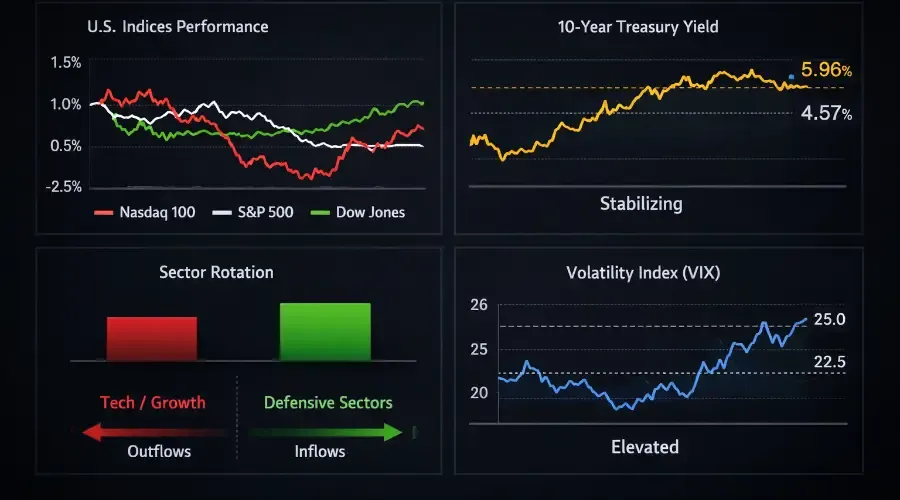
U.S. markets are navigating a familiar but uncomfortable tension.
On one side, technology stocks are under pressure, weighed down by earnings reactions and growing scrutiny of artificial-intelligence capital spending. On the other, signs of cooling in the labor market are reviving expectations that interest rates may eventually move lower, offering potential support to valuations.
These forces are pulling markets in opposite directions - and the result is not clarity, but hesitation.
A Market Defined by Crosscurrents
The latest session has highlighted how uneven the current environment is. Technology-heavy benchmarks have led declines, while broader indices have shown more restraint. Volatility has risen, but not enough to suggest panic. Sector performance has diverged sharply.
That combination points to repositioning rather than capitulation.
Investors are not exiting risk wholesale. They are adjusting exposure based on where earnings visibility, capital intensity, and macro sensitivity intersect.
Why Technology Is Bearing the Brunt
Pressure on the technology sector is coming from two related directions.
First, recent earnings reactions - particularly in semiconductors - have reminded markets how tightly expectations are set. When results fail to clearly exceed a high bar, the adjustment can be swift and spill across peers.
Second, and more structurally, AI-related capital expenditures are becoming harder to ignore. Large technology platforms continue to signal sustained investment in data centers, infrastructure, and specialized hardware. While the long-term strategic logic remains intact, the near-term cost is margin pressure.
Markets are not questioning whether AI matters. They are questioning how long investors must wait for returns to justify the spending.
That distinction explains why selling pressure has concentrated in growth-heavy and capital-intensive names rather than across the market as a whole.
The Counterweight: Cooling Labor Data
At the same time, macro data is introducing a countervailing force.
Recent labor indicators suggest the U.S. job market is gradually losing momentum. Hiring demand appears to be easing, and some of the tightness seen earlier in the cycle is fading. That trend raises concerns about growth durability, but it also strengthens the case for eventual policy easing.
This is where the tension lies.
Weaker labor conditions can pressure cyclical earnings and risk appetite. Yet they also increase the probability that the Federal Reserve may have room to cut rates later, which would support valuations - particularly for longer-duration assets.
Markets are now trying to price both outcomes simultaneously.
What the Watchlist Is Really Telling Us
The assets drawing the most attention reflect this push and pull.
Technology proxies remain central, with tech-heavy indices leading declines and sector ETFs showing broad participation in selling. Key mega-cap names tied to AI spending are being watched as sentiment barometers rather than as isolated stories.
At the same time, volatility is elevated but not extreme. A move higher would signal that uncertainty is spilling beyond sector rotation into broader risk aversion. For now, volatility levels suggest caution, not fear.
The broader market benchmark is also instructive. While under pressure, it has not yet shown the kind of decisive breakdown that typically accompanies systemic stress.
Rotation, Not Resolution
Sector rotation is becoming more visible.
Flows appear to be edging away from growth-heavy technology toward more defensive or stable areas of the market. That shift does not require a recession call. It reflects a preference for balance sheets, cash flow visibility, and lower capital intensity while macro signals remain mixed.
Importantly, rotation can persist even if the overall market moves sideways. It is a way for investors to stay invested while reducing exposure to the most crowded or sensitive trades.
Signal Versus Noise
The signal in this environment is the conflict itself.
Technology pressure driven by capex scrutiny and earnings sensitivity is real. So is the potential support from cooling labor data and shifting rate expectations. Neither has fully asserted dominance yet.
The noise would be treating every intraday swing as a verdict on the broader market direction.
Instead, markets appear to be in a waiting phase - testing assumptions, watching data, and adjusting positioning incrementally rather than decisively.
Bottom Line
This is a market caught between two narratives.
Technology is being repriced as investors reassess cost structures and return timelines. At the same time, macro data is opening the door to future policy support, even as it raises questions about growth.
Until one force clearly outweighs the other, markets are likely to remain choppy, selective, and rotation-driven rather than trending decisively in one direction.
In environments like this, understanding why assets are moving often matters more than predicting where they go next.
This blog is for educational and informational purposes only. It is not financial, investment, or trading advice, and it does not recommend buying or selling any security, asset, or strategy. Markets are uncertain and can move in ways that differ from historical patterns or examples discussed here. Always do your own research, consider your personal risk tolerance and financial situation, and, if needed, consult a qualified financial advisor before making any investment decisions.