
📊 Today's Close: When the AI Story Lost Its Shine
Post-Market, February 5, 2026
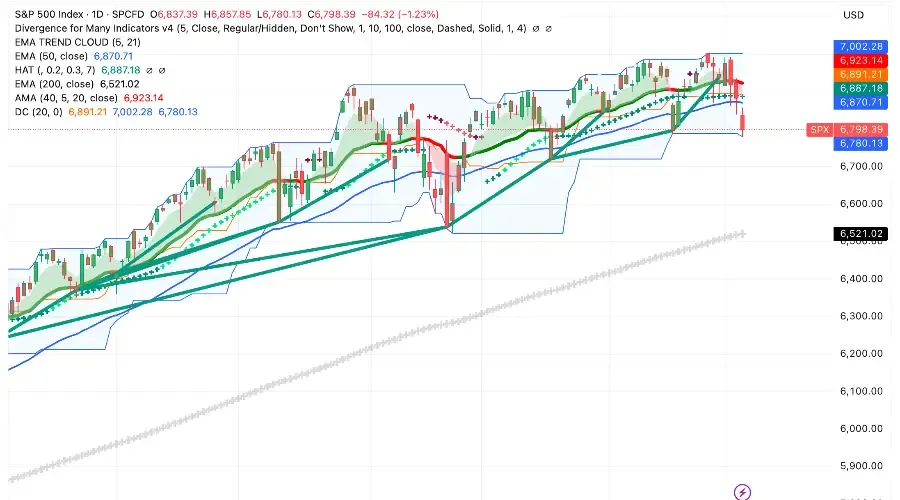
S&P 500: -1.23% → 6,798
Nasdaq: -1.59% → 22,905
Dow: -1.20% (down 593 points)
Translation: The market broke below 7,000 on the S&P and basically said "show me the money" to big tech's AI spending spree. Energy jumped 3.2%, materials rose 2.1%, and money piled into defensives while growth stocks got hammered. It wasn't panic—more like a calculated exit from expensive tech into things with actual cash flows you can see.
🎯 How It Went Down: Gap and Grind
Markets opened lower and never even tried to bounce. No midday reversal attempt. No late-session buying. Just steady pressure all day.
Here's what happened: At 8:30 AM, jobless claims printed at 231K versus the 212K everyone expected. Markets dropped immediately. Then Qualcomm's weak guidance (-8.5% on the day) triggered selling across semiconductors. By 11:00 AM, the S&P had broken through 6,950.
The afternoon? Even worse. Usually you get some dip-buying between 2:00-3:00 PM, but today nothing. The S&P just ground lower, settling near session lows around 6,800.
Here's what that tells you: When markets can't even manage a small bounce despite being oversold, buyers are missing. This wasn't retail investors panic-selling. Volume was 40-50% above normal in tech stocks—that's institutions methodically cutting exposure, which tends to play out over days or weeks, not hours.
🔄 Two Things Moved Markets Today
The Jobs Number That Changed Meaning
Jobless claims came in higher than expected. Simple enough. But watch how the market's reaction evolved:
First 60 seconds: "Weak jobs → Fed cuts sooner → good for stocks"
By afternoon: "Wait... weak jobs means layoffs → earnings will tank → bad for stocks"
Same data, opposite conclusions. The shift happened because markets went from worrying about inflation (where bad economic news helps since the Fed can ease) to worrying about recession (where bad news is just bad).
This happens more than you'd think. In 2022-2023, weak labor data was actually bullish because it meant cooling inflation. Now in 2026, it's starting to worry people about demand falling off a cliff.
When $185 Billion Sounds Like Too Much
Alphabet's AI spending guidance ($180-185B annually) didn't just hurt Alphabet. It triggered a whole rethink across tech.
The logic chain went like this: If Alphabet spends $185B, then Microsoft and Meta feel pressure to match. That's potentially $700B+ in collective spending. Free cash flow gets squeezed. And investors are now asking the uncomfortable question—when exactly do we see returns on all this capital?
Microsoft fell 5% despite solid recent earnings. That's the tell. When good companies drop on sector concerns rather than their own fundamentals, the narrative is shifting. AI spending went from "visionary investment" to "concerning cost" basically overnight.
📈 Reading the Rotation
What led:
Energy +3.2%, Materials +2.1%, Staples +1.6%
What lagged:
Tech -2.2%, Communication Services -1.6%
This pattern—commodities and defensives up while tech tanks—typically means money is rotating toward tangible stuff. Real assets, predictable dividends, value multiples around 12-15x instead of growth multiples at 30-40x.
But here's the thing: the S&P only fell 1.2% despite tech falling 2.2%. That's because energy and defensives absorbed the selling. It's a rotation, not a collapse. Institutions aren't fleeing stocks—they're just repositioning from expensive tech into cheaper sectors where you can actually see the earnings.
Small-caps held up decently too, which adds another layer. Investors aren't bearish on everything, just concentrated mega-cap tech. That distinction matters.
🔍 What the Internals Showed
Beyond the headline numbers, a few things stood out:
Volume was heavy in tech. When big selling happens on big volume, it's usually real money repositioning. Institutions take days or weeks to fully reposition, so this probably isn't over.
But breadth was selective. Tech got crushed while energy rallied. That's different from bear market days where 85% of everything falls together. Selective pressure suggests rotation rather than capitulation.
The 7,000 break mattered. Not because round numbers are magic, but because that's where a lot of people had set their risk limits. When those levels break, stop-losses trigger and the move feeds on itself.
🔄 When the Narrative Flips
This morning, the question was whether jobless claims would give the Fed room to cut rates. By the close, the question had become whether weak claims mean the economy's cracking.
Same data, totally different frame.
The surprise wasn't the claims number. The surprise was how fast sentiment shifted from "bad news is good news" to "bad news is actually bad news." Markets aren't reacting to the data itself—they're reacting to which risk they're currently focused on.
And once the S&P broke 7,000, things accelerated. Not because anything fundamental changed at 6,999, but because position sizing and risk management forced more selling. That's how technical levels work—they become self-fulfilling when enough people watch them.
🌙 What Happens Overnight
Asian markets will react to this when they open. If Tokyo's chip stocks and Hong Kong's tech names hold steady, it could signal overseas investors think we overreacted. If they follow us lower, it confirms this is a global rethink of AI valuations.
After-hours moves can be misleading because liquidity is thin. But today's decline happened on real volume during regular hours, which means overnight weakness is more likely to stick when everyone's back at 9:30 AM tomorrow.
🔮 Tomorrow's Setup
Quiet economic calendar, so price action will probably depend on whether today's themes continue or reverse.
Levels that matter (not predictions, just reference points):
S&P 6,800 barely held into the close. Below that opens up 6,750. Meanwhile, 7,000 probably flips from support to resistance now.
Nasdaq breaking its uptrend channel today was meaningful. Whether 22,905 holds determines if this is a blip or something bigger.
If we gap up tomorrow: Many traders would watch whether buying extends or fades into the 6,900-6,950 zone. Low-volume bounces usually mean short-covering, not real conviction.
If we gap down: Breadth becomes everything. Is this broad capitulation or just more tech weakness? VIX spiking above 20 would signal real fear. Modest elevation suggests controlled repositioning.
💡 What We Learned
Narratives flip fast. AI spending was celebrated six months ago. Today, $185B in capex triggers a 5% drop in Microsoft. Context beats formulas.
Technical levels matter because they're where people set risk parameters. When 7,000 broke, it forced adjustments that accelerated the move.
Rotation isn't panic. Energy up 3.2% while tech fell 2.2% means capital moved, it didn't vanish.
Volume tells the story. High volume in tech while energy rallied—that's deliberate institutional repositioning, which takes time to complete.
What's uncertain: whether this is a healthy correction or the start of something larger. That probably depends on whether companies can show AI spending actually generates revenue soon.
The traders who handle transitions best stay flexible. Markets change their mind about what matters. Recognizing when the framework shifts beats being right about any single day.
📋 Simple Framework for Tomorrow
Stabilization scenario: We find footing here, volume drops, VIX eases → probably a one-day flush.
Continued rotation: Tech stays weak, energy/defensives stay strong, indices chop → repositioning continues but controlled.
Acceleration lower: Asia follows our selloff, S&P breaks 6,800, breadth deteriorates → deeper correction developing.
The goal isn't predicting which happens. It's recognizing which one is happening and adjusting. That's responsive trading versus reactive guessing.
— Your Post-Market Desk
⚠️ Disclaimer: This is educational market commentary, not financial advice or a recommendation to buy or sell any security. Past performance does not indicate future results. Markets are risky and unpredictable. Always do your own research and consider consulting a qualified financial advisor before making investment decisions.