
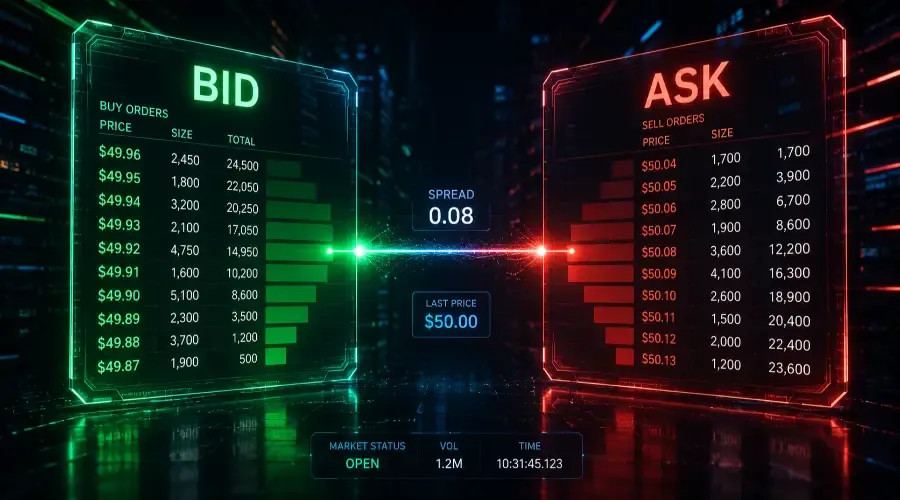
When you tap "buy" on a stock and the order fills within a second, a market maker is usually the counterpart. Understanding what market makers do – and how they profit – explains the bid-ask spread, why some stocks are expensive to trade, and why "commission-free" doesn't mean cost-free.
What Market Makers Do
A market maker is a firm that continuously quotes two prices for a stock: the bid (the price it will pay to buy shares from you) and the ask (the price it will charge to sell shares to you). The ask is always higher than the bid. The difference between them is the spread.
By posting continuous two-sided quotes, market makers ensure that investors can buy or sell at any moment during market hours without needing to find a matching counterpart in real time. Without market makers, you'd submit a buy order and wait – potentially hours – for someone else to decide they wanted to sell. Market makers eliminate that wait by acting as the immediate counterpart to either side of any trade.
Major market makers include Citadel Securities, Virtu Financial, and Jane Street. These firms trade across thousands of securities simultaneously, managing inventory risk through sophisticated technology and hedging.
How the Spread Works
Consider Apple trading at $180.50. A market maker might post a bid of $180.48 and an ask of $180.52 – a spread of $0.04. If you place a market order to buy 10 shares, you pay $180.52 per share. If another investor simultaneously places a market order to sell 10 shares, they receive $180.48. The market maker pockets $0.04 per share on the round trip – $0.40 on 10 shares.
At Apple's daily trading volume of roughly 50 to 60 million shares, a $0.04 spread across that volume produces roughly $2 million in potential daily spread revenue on a single stock. Multiply that across thousands of stocks, and the math behind major market-making operations becomes clear.
The spread is not a fee that appears on your confirmation. It's an implicit transaction cost embedded in the difference between what you pay and what the stock last traded at.
Liquid vs. Illiquid Stocks: Where Spread Costs Diverge
On large-cap stocks with deep trading volume, market makers compete aggressively – often 5 to 10 firms quoting simultaneously – driving spreads to fractions of a cent. On a liquid stock like Apple or Microsoft, the spread cost represents roughly 0.02% of the transaction. For a $1,000 purchase, that's approximately $0.20.
On thinly traded stocks – small-cap names, micro-caps, OTC securities – market makers face much higher inventory risk. If they buy 1,000 shares of a company trading 20,000 shares per day, they may hold that inventory for hours while the price moves against them. To compensate for that risk, they widen the spread dramatically. A stock priced at $2.50 with a bid of $2.20 and an ask of $2.80 carries a 24% spread. An investor who buys at $2.80 and immediately tries to sell receives $2.20 – a 21% loss before the stock moves at all.
This is why professional investors treat bid-ask spread percentage as a core screening criterion. Stocks with spreads above 0.5% of price impose a meaningful cost on entry and exit that compounds across multiple trades.
Payment for Order Flow
Most retail brokers don't route orders directly to exchanges. Instead, they sell the right to execute retail orders to market makers – a practice called payment for order flow (PFOF). Citadel Securities pays Robinhood approximately $0.002 per share for the privilege of handling Robinhood's order flow. The market maker executes the trade, captures the spread, and shares a portion with the broker.
This is how commission-free trading is economically viable. The broker earns revenue from the market maker rather than charging the investor directly. The implicit cost – potentially slightly less favorable execution than a direct exchange route would provide – is borne by the investor without a line item on the transaction confirmation.
On liquid, high-volume stocks, the execution difference is typically negligible. On less liquid names or in volatile conditions, the quality difference can be more meaningful.
Extended Hours Spreads
Bid-ask spreads widen substantially during pre-market and after-hours trading. With fewer participants and lower volume, market makers carry more inventory risk and price that risk into wider quotes. A stock showing a $0.04 spread during regular market hours may show a $0.40 to $0.80 spread at 7:00 AM. Investors trading during extended hours pay a much higher implicit cost per transaction.
Practical Application
Before placing any trade, checking the bid and ask prices takes five seconds and provides the actual cost of execution. The spread percentage – spread divided by mid-price, multiplied by 100 – tells you the implicit transaction cost.
On large-cap stocks during regular hours, that cost is usually negligible and market orders are fine. On smaller companies or during extended hours, using limit orders set near the mid-price allows you to avoid paying the full ask while still having a reasonable chance of execution.
This content is for educational purposes only and does not constitute investment, legal, or tax advice. Investing in securities involves risk, including possible loss of principal. Always conduct your own research and consult a licensed financial professional before making investment decisions.
Market makers are the invisible counterpart to most retail trades. Understanding how they profit directly explains why spread costs vary so dramatically between liquid and illiquid stocks - and why 'commission-free' isn't the same as 'cost-free'.
→ How Markets Function → Hub: the complete picture of exchanges, liquidity, market hours, and circuit breakers - www.breakoutbulletin.com/article/how-stock-market-works-behind-the-app
→ Understanding Liquidity → The bid-ask spread as a transaction cost and how to screen for it - www.breakoutbulletin.com/article/liquidity-explained-stock-market-for-beginners
→ How Stocks Are Bought and Sold → The full path of a trade from your app to market maker to settlement - www.breakoutbulletin.com/article/how-stocks-are-bought-and-sold-for-teens