
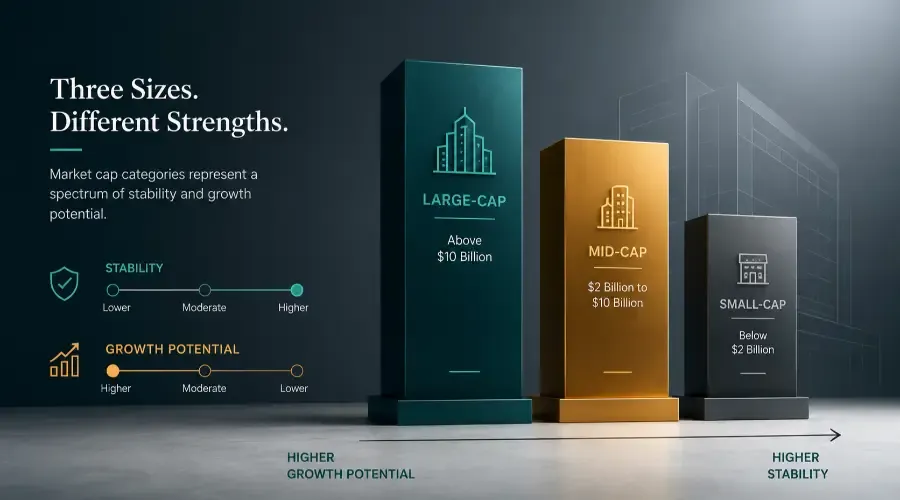
Market capitalization categories – large, mid, and small – give investors a quick framework for understanding the risk, volatility, and growth profile of any company. The labels are shorthand for a set of characteristics that tend to cluster by company size.
Large-Cap: Above $10 Billion
Large-cap companies are the most established businesses in the public markets. Apple, Microsoft, Walmart, Johnson & Johnson, JPMorgan Chase – these companies have decades of operating history, global distribution, diversified revenue, and the financial resources to weather economic downturns without existential risk.
Large-caps tend to move less dramatically than smaller companies. Their sheer size means growth rates naturally moderate – a business doing $400 billion in annual revenue cannot grow 40% per year the way a $500 million company can. But that predictability comes with stability. During market selloffs, large-cap names typically hold up better than mid- or small-caps.
Most broad market index funds, including those tracking the S&P 500, are dominated by large-cap companies. An investor in VOO or IVV is primarily investing in large-caps by default, which is why those funds tend to be lower in volatility than sector-specific or small-cap-focused alternatives.
Mid-Cap: $2 Billion to $10 Billion
Mid-cap companies occupy the growth phase of the business lifecycle. They've moved past early-stage risk – they have established products, paying customers, and operating infrastructure – but they're still expanding market share, geographic reach, or product lines. The mid-cap tier is where many investors look for a balance between growth potential and relative stability.
Historically, mid-caps have delivered returns between large- and small-caps with volatility somewhere between the two as well. They don't generate the headlines of mega-cap technology companies, but over 10 to 20 year periods, diversified mid-cap exposure has performed competitively.
The ETF VXF (Vanguard Extended Market ETF) and IJH (iShares Core S&P Mid-Cap ETF) provide broad mid-cap exposure for investors who want dedicated allocation to this segment.
Small-Cap: Below $2 Billion
Small-cap stocks carry the highest risk profile among the three categories. This is partly structural – smaller companies have fewer resources to absorb a bad quarter, less access to capital markets, and narrower product lines that leave them exposed to a single market shift. Small-caps also trade with lower volume, meaning bid-ask spreads are wider and prices can swing significantly on lighter trading activity.
The potential upside of small-cap investing is real. Companies that grew from sub-$2 billion market caps to tens or hundreds of billions – Nvidia in its early days, Amazon well before it became a household name for cloud computing – generated extraordinary returns for investors who held through the volatile early years.
The realistic distribution, however, includes many more small-cap companies that stagnated or failed than those that became giants. Sizing small-cap exposure appropriately – typically 5 to 15% of a portfolio rather than a dominant position – reflects that asymmetry.
IWM (iShares Russell 2000 ETF) tracks 2,000 U.S. small-cap companies and is the primary benchmark and investment vehicle for this category.
How the Categories Work Together
A common portfolio framework across market cap categories: 70% large-cap for stability and broad market participation, 20% mid-cap for incremental growth exposure, and 10% small-cap for higher-upside, higher-risk positioning.
The exact proportions depend on risk tolerance, investment timeline, and whether an investor is using individual stocks or index funds. The framework is less important than the underlying principle: diversifying across company sizes reduces the risk that any single category's underperformance dominates the portfolio.
Cap Categories Shift
Market cap is dynamic. A company that qualifies as mid-cap today may cross into large-cap territory after two years of strong growth. A large-cap that loses market share may decline into mid-cap territory. Index funds that track a specific category rebalance periodically to add qualifying companies and remove those that no longer fit.
This means that buying a mid-cap ETF today and holding it for a decade means owning a portfolio that continuously adjusts as companies graduate to larger categories or slip to smaller ones – a natural filtering mechanism that keeps the ETF relevant to its stated objective.
This content is for educational purposes only and does not constitute investment, legal, or tax advice. Investing in securities involves risk, including possible loss of principal. Always conduct your own research and consult a licensed financial professional before making investment decisions.
The size tiers give you a risk and volatility framework. The growth-vs-value distinction gives you a pricing philosophy framework. Both apply independently and together.
→ Stock Categories and Types → Market cap, growth vs. value, and how to use both frameworks together - www.breakoutbulletin.com/article/stock-categories-market-cap-growth-value
→ What Is Market Capitalization? → The formula and why per-share price tells you nothing about company size - www.breakoutbulletin.com/article/what-is-market-capitalization-for-teens
→ Growth vs. Value Stocks → How the two investing styles perform across different rate environments - www.breakoutbulletin.com/article/growth-vs-value-stocks-for-teens