
BreakoutBulletin | AI Semiconductor Supply Chain Series, Part 3 of 3
The premise of this series is that the AI memory cycle is constrained less by wafer supply than by everything downstream of the wafer: patterning capacity (Part 1, Photronics), front-end tool capacity (Part 2, Axcelis), and, most acutely, the packaging and stacking flow that turns memory dies into HBM stacks. Kulicke & Soffa is the series' packaging-layer entry, and it arrives with the strongest current numbers of the three names and the most direct claim on the bottleneck itself.
The Business and the Pivot
Kulicke & Soffa supplies semiconductor assembly equipment: wire bonders (its historical core and a market it leads), die attach systems, flip-chip bonders, and wafer-level packaging tools. The historical knock on the name was cyclicality tied to trailing-edge packaging, where wire bonding dominates and demand tracks consumer electronics.
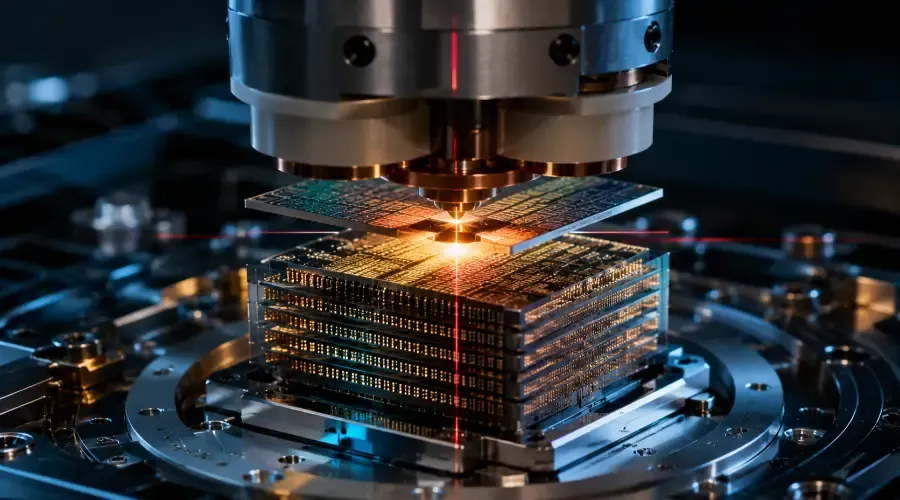
The pivot now underway is toward advanced packaging, specifically thermo-compression bonding (TCB), the process used to stack dies with fine-pitch interconnects. HBM is a stack of DRAM dies bonded vertically, which places TCB tooling directly in the HBM manufacturing flow. The company's APTURA platform and its work on fluxless TCB are the product-level expressions of this pivot, and management has now committed capital behind it: fiscal 2026 capex is being raised specifically to expand TCB manufacturing capacity for AI and high-performance chip packaging. The stock rose roughly 6% on that announcement, which suggests the market reads the capex as demand-revealed rather than speculative.
The Quarter That Reset the Narrative
Fiscal Q2 2026 (reported May 7) was the kind of print that turns a turnaround story into a momentum story:
-
Revenue of $242.6 million, up 49.8% year over year and 21.5% sequentially, beating the roughly $230 million consensus
-
Non-GAAP EPS of $0.79 against a $0.67 estimate, and net income of $35.2 million versus a net loss in the year-ago quarter
-
Gross margin of 49.3%, ahead of guidance and unusually high for assembly equipment
-
Q3 guidance of roughly $310 million, implying 28% sequential growth, a full 25% above what analysts had modeled
Management attributed the strength to general semiconductor and memory demand supporting data center capacity expansion, with improving conditions in premium smartphones as a secondary current. Two details from the call fill out the picture. Utilization rates across the installed base have been rising for a year, which is the standard precursor to capacity orders. And the recovery is broadening: advanced packaging solutions contributed $40 million in the quarter, while automotive and industrial revenue rose 63% sequentially to $22 million off a soft Q1.
A guidance beat of that size deserves its own scrutiny. Sequential guides 25% above consensus, in equipment companies, historically come from order books that filled faster than analysts could model, and they also set a bar that converts any subsequent normalization into an apparent miss. The name now trades against elevated expectations by construction.
Where the Moat Is and Is Not
The honest version of the moat: Kulicke & Soffa is not a sole-source HBM vendor, and TCB is a contested space with well-funded competitors (ASMPT and BE Semiconductor operate in adjacent and overlapping bonding territory, and memory makers qualify multiple toolmakers deliberately). The defensible position rests on the same mechanics as the other suppliers in this series: customer qualification cycles, process yield knowledge accumulated tool by tool, and the cost a memory maker faces when switching a qualified bonding step mid-ramp. Wire bonding leadership also functions as an underappreciated stabilizer, because data center buildouts require large volumes of traditional packaging alongside the advanced flows, a point management made explicitly on the call.
The capex raise cuts both ways and should be modeled that way. Expanding TCB capacity ahead of adoption lifts the fixed cost base, and if fluxless TCB or HBM-related tool adoption ramps slower than planned, operating leverage that currently works in the company's favor reverses. The company is, in effect, making the same bet its customers are: that the packaging bottleneck persists long enough to fill the new capacity.
Risk Matrix
| Risk | What the Data Currently Shows |
|---|---|
| Expectation reset | Q3 guide of ~$310M is 25% above prior consensus; the beat bar is now high |
| TCB adoption pace | Raised capex increases fixed costs; slower fluxless TCB uptake would magnify any revenue shortfall |
| Competitive contest | TCB is multi-vendor by customer design; qualification wins are the metric, not the category tailwind |
| Cycle dependence | 49.8% y/y growth includes trough-comparison flattery; the prior-year quarter was a loss |
| Customer concentration | HBM tooling demand concentrates among a handful of memory makers; one delayed ramp moves the number |
Valuation & Trade Invalidation
Despite the massive Q3 guidance beat ($310 million vs prior consensus),$KLIC remains an ambitious underdog in advanced packaging, competing against deeply entrenched incumbents like Hanmi Semiconductor and ASMPT in HBM thermo-compression bonding. The market has now priced in flawless execution, leaving zero room for operational slip-ups. The trade thesis invalidates if advanced packaging revenue falls back below the $40 million quarterly baseline, if TCB qualification announcements stall at major DRAM makers, or if Q3 revenue fails to hit the upper bound of guidance, exposing the raised capex as unabsorbed fixed overhead.
The Observational Summary and the Series Verdict
Across the three layers this series mapped, the pattern is consistent: none of these suppliers holds monopoly control, and all three derive their position from qualification cycles, process knowledge, and the switching costs of trusted manufacturing partnerships. What distinguishes them is where each sits relative to the bottleneck right now. Photronics is upstream and currently in a design-release air pocket. Axcelis has direct memory exposure inside a flat aggregate guide and a pending merger. Kulicke & Soffa is the one whose current results, guidance, and capital allocation all already reflect the bottleneck paying, which is simultaneously the bull evidence and the reason its expectations bar sits highest.
The distinguishing signals from here: the Q3 print against the $310 million guide, TCB and APTURA order commentary, and any qualification announcements at HBM customers. For the series as a whole, the cleanest tell remains the one from Part 2: memory-segment disclosures across all three names, read quarterly, side by side. Bottleneck theses are proven in segment tables, not in narratives.
Continuing the AI Memory Supply Chain Series
Kulicke & Soffa represents the final layer of this AI memory supply chain framework, where advanced packaging capacity determines how quickly HBM demand can be converted into finished memory stacks. The series begins with Photronics ($PLAB), which supplies the photomasks required before a single wafer can be produced, and continues through Axcelis ($ACLS), where ion implantation demand provides one of the earliest direct signals of memory-capacity expansion. Together, the three companies provide a layered view of how capital moves through the AI semiconductor ecosystem – from chip design, to wafer fabrication, to advanced packaging.
Read Previous: https://www.breakoutbulletin.com/article/photronics-plab-stock-ai-memory-photomasks
Also in this Series: https://www.breakoutbulletin.com/article/acls-ai-semiconductor-series-veeco-merger-analysis
Sources: Kulicke & Soffa fiscal Q2 2026 results, earnings call transcript, and Q2 presentation (May 7, 2026), subsequent capex expansion coverage. All figures verified against primary sources at time of writing.
This content is for educational purposes only and does not constitute investment advice or a recommendation to buy or sell any security. Markets involve risk. Verify all data independently before making any trading decision.