
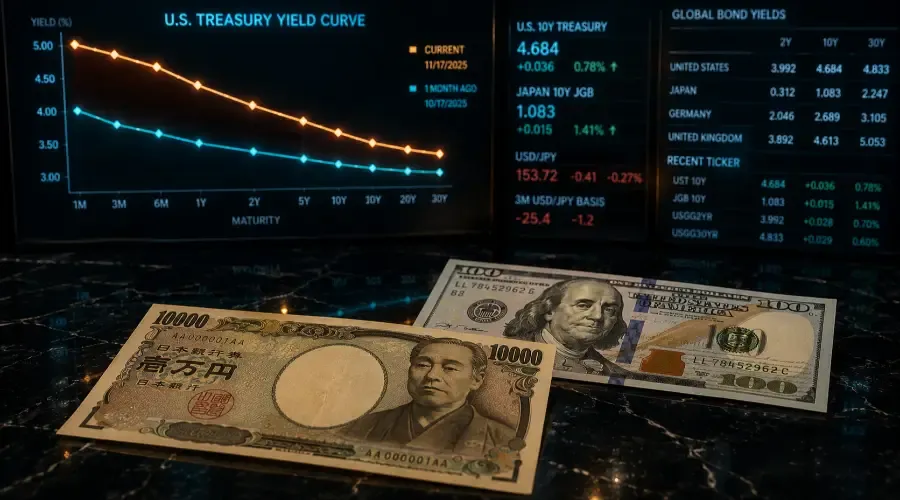
For two decades, Japanese institutional investors served as the single most reliable foreign anchor for long-duration U.S. Treasuries. That structural bid is now unwinding.
With the Bank of Japan progressively normalizing policy, 10-year Japanese Government Bond (JGB) yields trading at multi-year highs, and foreign exchange hedging costs remaining structurally elevated, the currency-hedged yield on U.S. Treasuries has collapsed relative to domestic paper. Japanese life insurers and regional balance sheets are systematically letting foreign debt holdings roll off to redeploy into domestic sovereign yields.
Executive Summary
-
The Hedged Yield Inversion: While the nominal 10-year U.S. Treasury yields 4.68%, rolling 3-month FX hedging costs (~4.35% annualized) reduce the net return for a yen-based investor to 0.33%—trailing the 10-year JGB (1.08%) by 75 bps and the 30-year JGB (2.25%) by 192 bps.
-
Institutional Bifurcation: Repatriation is concentrated among FX-hedged liability managers (Life Insurers, Norinchukin Bank, and regional banks) who must eliminate currency volatility. Unhedged allocators (such as the GPIF) remain selectively active in foreign paper.
-
The Super-Long ALM Pivot: Rather than just buying 10-year paper, domestic insurers are allocating heavily into 20-year, 30-year, and 40-year JGBs to satisfy long-dated Asset-Liability Matching (ALM) requirements without incurring cross-currency basis or currency volatility risks.
-
Compounding U.S. Term Premium Indigestion: Japan holds over $1.12 trillion in U.S. debt securities. The withdrawal of this structural, price-insensitive buyer coincides with record Treasury supply and Fed balance-sheet runoff, exerting sustained upward pressure on the 10-year ACM Term Premium (+42 bps).
-
Falsifiability Line: The repatriation thesis is invalidated if Japanese net foreign bond purchases exceed ¥1.5 trillion per month for two consecutive months, alongside a narrowing of the Fed–BoJ short-term policy differential below 200 bps.
The Mechanics of the Inversion
                      ┌────────────────────────────────────────┐
                      │    Nominal 10Y U.S. Treasury: 4.68%    │
                      └───────────────────┬────────────────────┘
                                          │
                                          ▼
                      ┌────────────────────────────────────────┐
                      │      Total FX Hedging Cost: -4.35%     │
                      │  • Short-End Rate Gap: ~4.10%          │
                      │  • USD/JPY Basis Spread: -0.25%        │
                      └───────────────────┬────────────────────┘
                                          │
                                          ▼
                      ┌────────────────────────────────────────┐
                      │   Net Hedged Yield to JPY Buyer: 0.33% │
                      └───────────────────┬────────────────────┘
                                          │
                  ┌───────────────────────┴───────────────────────┐
                  ▼                                               ▼
┌───────────────────────────────────┐   ┌───────────────────────────────────┐
│     10-Year Domestic JGB: 1.08%   │   │     30-Year Domestic JGB: 2.25%   │
│   Spread vs. Hedged UST: +75 bps  │   │   Spread vs. Hedged UST: +192 bps │
│   ► Repatriate intermediate debt  │   │   ► Core ALM liability matching   │
└───────────────────────────────────┘   └───────────────────────────────────┘
Core Operational Drivers
1. Dissecting the FX Hedging Drag
A common misconception is that the cross-currency basis swap alone creates the hedging penalty. In institutional fixed income, total hedging cost comprises two distinct market components:
-
Short-End Policy Divergence (~4.10%): Because FX forward pricing is governed by Covered Interest Parity (CIP), rolling 3-month USD/JPY hedges reflect the policy rate differential between the Federal Reserve and the Bank of Japan.
-
Cross-Currency Basis Surcharge (~25 bps): Persistent global demand for USD liquidity keeps the 3-month USD/JPY basis swap negative, creating an additional performance drag on foreign investors swapping dollars into yen.
With total annualized hedging friction at 4.35%, a 10-year Treasury yielding 4.68% nets only 0.33% in yen terms. Japanese life insurers—who face average domestic guaranteed policy hurdles of 1.25% to 1.75%—lock in an immediate negative carry on hedged foreign sovereign holdings.
2. Institutional Segmentation: Lifers vs. Pension Funds
Japanese institutional capital behaves according to distinct regulatory and currency mandates:
-
Life Insurers & Regional Banks (FX-Hedged): Institutions such as Nippon Life, Dai-ichi Life, and Meiji Yasuda operate under strict economic-value-based solvency frameworks and cannot absorb unhedged foreign exchange volatility. Facing negative carry, these institutions are letting maturing foreign bonds roll off and redeploying that capital locally.
-
GPIF & Trust Banks (Unhedged): The Government Pension Investment Fund operates under strategic target allocation bands (e.g., 25% foreign bonds, unhedged). Because they capture nominal yields without paying rolling forward costs, their allocations remain steady. The structural repatriation flow is primarily an insurer and bank balance-sheet dynamic.
3. The Super-Long JGB Solution for ALM
Historically, Japanese insurers invested overseas because the BoJ's zero-rate Yield Curve Control (YCC) eliminated domestic returns across intermediate durations. With policy normalization:
-
20-Year JGBs (~1.85%) and 30-Year JGBs (~2.25%) provide the absolute yields required to cover liability discount rates.
-
By reallocating from hedged Treasuries into super-long domestic debt, insurers eliminate currency volatility, remove quarterly forward-rolling friction, and optimize their Solvency Margin Ratio (SMR).
Empirical Flow Evidence & Lead Indicators
The transition from outward capital flight to domestic absorption is measurable across official reporting channels:
Japan MoF Weekly Flow Reports (Every Thursday)
  ► Life Insurers & Pension Accounts: Net sellers of foreign sovereign debt in 12 of the past 16 weeks.
  ► Domestic Absorption: Net purchases of 10Y–30Y JGBs accelerating at primary domestic auctions.

U.S. Treasury TIC Pipeline (Monthly Series)
  ► Japanese aggregate holdings of long-term U.S. debt contracting from peak levels.
  ► Foreign indirect bidding percentages at 10Y and 30Y Treasury auctions exhibiting wider dispersion.
Major Japanese life insurer operational plans confirm this shift: public asset allocation strategies for current fiscal terms project flat to declining foreign bond allocations, with 100% of incremental fixed-income flow directed toward domestic sovereign and high-grade corporate debt.
U.S. Treasury Market Microstructure & Term Premium Impact
The loss of Japanese structural buying compounds a fragile liquidity environment for U.S. sovereign debt:
-
Diminishing Foreign Sponsorship: Japan remains the largest foreign creditor to the United States ($1.12+ trillion). If Japanese investors merely stop reinvesting maturing principal, U.S. primary dealers must absorb hundreds of billions of dollars in additional duration.
-
Term Premium Expansion: The ACM 10-Year Term Premium has expanded to +42 bps. Without structural foreign central bank and institutional sponsorship, private price-sensitive buyers require higher term premiums to absorb heavy Treasury issuance schedules (Quarterly Refunding Announcements).
Quantitative Falsifiability Line
This thesis will be invalidated if the following market conditions occur simultaneously over a 60-day window:
-
Flow Reversal: Japanese net purchases of foreign long-term debt (per Japan MoF weekly reports) exceed ¥1.5 trillion per month for two consecutive months.
-
Hedging Relief: The Federal Reserve executes an aggressive easing cycle that compresses the 3-month USD/JPY hedging cost below 2.50%.
-
Hedged Yield Crossover: The currency-hedged 10-year U.S. Treasury yield crosses at least 50 bps above the prevailing 10-year JGB yield.
Scenario Matrix
| Scenario | Macro & FX Trigger | U.S. Fixed Income Transmission | Japanese Capital Realignment |
| Base Case: Persistent Repatriation | 10Y JGB holds 1.00%–1.20%; USD/JPY hedge cost >4.00% | U.S. term premium stays positive (+35 to +55 bps); auction tails on 10Y/30Y | Steady reallocation into 20Y–40Y JGBs; reduced reinvestment in USTs |
| Accelerated BoJ Normalization | BoJ hikes policy rate faster than consensus; 10Y JGB breaks >1.40% | Sharp selloff in global duration; upward yield pressure on USTs and Bunds | Aggressive liquidation of hedged foreign debt portfolios; sharp JPY strengthening |
| Aggressive Fed Easing Cycle | Fed cuts policy rates by >150 bps; rate differential collapses | Hedged UST yield re-enters positive spread vs JGBs; foreign selling halts | Japanese lifers stabilize foreign allocations; domestic JGB buying moderates |
Sector & Asset Class Allocation Matrix
Relative Outperformers
-
Domestic Japanese Sovereign Debt (20Y–30Y JGBs): Captures multi-year structural asset reallocation from domestic institutional liability managers.
-
Japanese Large-Cap Financials: Domestic bank net interest margins (NIM) expand as domestic lending rates and JGB reinvestment yields rise off zero bounds.
-
Japanese Yen (Structural Bullish Bias): Diminished outward portfolio investment flows reduce structural baseline selling pressure on JPY.
Relative Underperformers
-
Long-Duration U.S. Treasuries (10Y–30Y): Vulnerable to term premium widening as structural foreign price-inelastic buyers step aside.
-
U.S. Agency Mortgage-Backed Securities (MBS): Historically favored by Japanese banks (e.g., Norinchukin); remains exposed to portfolio balance-sheet pruning.
-
USD/JPY Long Positions: As the short-end policy divergence narrows and repatriation continues, asymmetric downside risk increases on unhedged long-dollar positions.
Key Metrics & Sourcing Dashboard
| Metric | Current Benchmark Level | Primary Verification Source |
| 10-Year Japanese Government Bond (JGB) | 1.08% | Japanese Ministry of Finance (MoF) / Bank of Japan |
| 30-Year Japanese Government Bond (JGB) | 2.25% | Japanese Ministry of Finance (MoF) |
| 10-Year U.S. Treasury Par Yield | 4.68% | U.S. Department of the Treasury |
| Rolling 3-Month USD/JPY FX Hedging Cost | 4.35% (Annualized) | Bloomberg FXFA / Refinitiv Forward Curves |
| 3-Month USD/JPY Cross-Currency Basis | -25 bps | Bloomberg Cross-Currency Basis Monitor |
| Hedged 10Y UST Yield for JPY Investor | 0.33% (vs. 1.08% 10Y JGB) | Calculated ($UST_{10Y} - \text{Total Hedge Cost}$) |
| ACM 10-Year Treasury Term Premium | +42 bps | Federal Reserve Bank of New York |
| Total Japanese U.S. Treasury Holdings | ~$1.12 Trillion | U.S. Treasury International Capital (TIC) System |