
CATALYST ANALYSIS · AI STOCKS · BREAKOUTBULLETIN
Published: March 24, 2026 · Analysis by the BreakoutBulletin Editorial Team
Subhead: Nvidia’s CEO has reignited the AI narrative-but the real impact is on sentiment, not science
This is not a breakthrough announcement-it is a narrative amplifier for AI infrastructure demand. The statement “we’ve achieved AGI” from Nvidia CEO Jensen Huang has quickly become a viral talking point across markets, but its real significance lies not in scientific accuracy, but in how it reinforces the AI investment narrative. For investors tracking Jensen Huang AGI Nvidia stocks, the key is to separate what was said from what actually changes. The comment does not represent a product launch, a breakthrough, or a shift in Nvidia’s earnings trajectory. Instead, it functions as narrative acceleration for AI infrastructure demand, which is the core driver behind current valuations
The Comment in Context
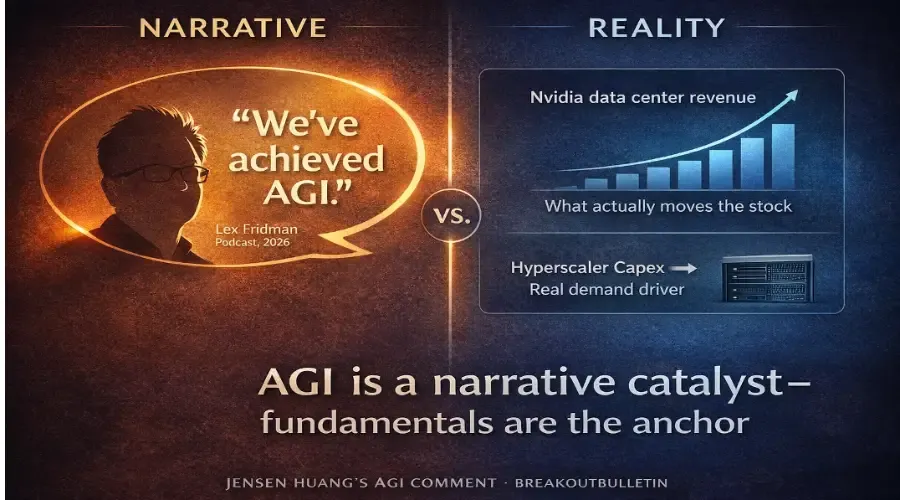
The remark came during a conversation on Lex Fridman’s podcast, where the discussion centered on when AI could potentially start and run a billion-dollar company. Huang responded by saying, “I think it’s now. I think we’ve achieved AGI.” This statement was based on a broad, colloquial framing of AGI rather than a formal scientific definition
Two clarifications matter. First, Huang was not announcing that Nvidia has developed an AGI system. Second, the definition being used is not aligned with academic or regulatory standards. Within AI research, AGI typically requires generalized intelligence across domains, autonomous decision-making, and consistent performance in novel environments. No existing system meets all these criteria
In practical terms, the comment should be understood as strategic positioning, not a technical declaration
Narrative vs Reality - Where AI Actually Stands
The reason this statement carries weight in markets is the absence of a universally accepted definition of AGI. This ambiguity allows for flexible interpretation, which can influence investor perception
Current AI systems demonstrate strong capabilities in language, coding, and pattern recognition. However, they remain dependent on prompts, lack persistent autonomy, and struggle outside trained environments. While they can assist in complex tasks, they are not independently operating entities capable of sustained decision-making at a human or organizational level
The gap between perceived capability and actual capability is where market narratives are formed. Huang’s comment operates within that gap, reinforcing the perception that AI is closer to transformative impact than critics argue
Why It Matters for AI Stocks - The Sentiment Mechanism
For markets, the importance of the comment lies in its effect on expectations. When the CEO of the central infrastructure provider to the AI ecosystem signals that AGI has effectively arrived, it strengthens the belief that AI investment is structural, not cyclical
This supports the current valuation framework for Nvidia and related AI stocks. If investors believe that AI is approaching general intelligence, then data center expansion, GPU demand, and hyperscaler capex appear justified at elevated levels
However, there is a second layer to consider. AGI-level language also increases the likelihood of regulatory scrutiny. Governments and regulators tend to respond more aggressively when technology is framed as transformative or potentially disruptive at a societal level. This introduces a medium-term risk that is often underpriced during early narrative expansion
The divergence in messaging across industry leaders reinforces this uncertainty. While Jensen Huang suggests AGI is effectively here, other executives have taken more cautious positions. This variation highlights that the industry itself does not have a unified view, which increases the probability of narrative-driven volatility
The Risk Framework - When Narrative Meets Reality
The critical question for investors is not whether AGI exists, but whether AI-driven revenue growth can sustain current valuations
If AI infrastructure demand continues to expand, with hyperscalers increasing capital expenditure, the narrative remains supported. In this scenario, Nvidia and related companies can maintain premium multiples because earnings growth aligns with expectations
If, however, enterprise adoption slows or return-on-investment concerns emerge, the gap between narrative and fundamentals becomes a risk. When narratives accelerate faster than earnings, markets tend to reprice sharply once data contradicts expectations
This dynamic has appeared in previous technology cycles. The higher the narrative ceiling, the greater the potential downside if revenue growth fails to match it
The more aggressively AGI is framed as “already achieved,” the more it pulls forward demand expectations-raising the risk that infrastructure investment outpaces actual enterprise adoption timelines. This is the non-obvious tension embedded in the current cycle: narrative strength can accelerate investment, but it can also compress future upside if expectations are met too early without corresponding revenue expansion
What Traders Are Actually Watching
Markets are not reacting to the definition of AGI-they are watching measurable signals
The first is hyperscaler capex guidance, particularly from Microsoft, Amazon, Google, and Meta. Continued investment confirms that demand for AI infrastructure remains strong
The second is Nvidia’s earnings trajectory, especially data center revenue growth and margins. These metrics determine whether current valuations are justified
The third is the progress of custom silicon from hyperscalers. If companies successfully shift workloads away from Nvidia GPUs, it alters the competitive landscape regardless of AGI framing
The fourth is the regulatory environment. Any policy action triggered by AGI-related claims could impact sentiment and valuation multiples
The Bigger Picture - Narrative as a Market Driver
What makes this moment significant is not the claim itself, but how effectively it aligns with an existing market narrative. AI is already positioned as a transformative technology, and statements like this reinforce that positioning
From a structural standpoint, this is how markets evolve during innovation cycles. Early stages are driven by narrative and expectation, while later stages depend on measurable outcomes and earnings validation
The current phase of the AI cycle still leans heavily toward narrative support. The transition to a fundamentals-driven phase will depend on whether revenue growth continues to justify the scale of investment
Bottom Line
Jensen Huang’s AGI comment is not a technological milestone-it is a sentiment catalyst. It reinforces the belief that AI is advancing rapidly and supports continued investment in infrastructure
For investors, the focus should remain on data, not definitions. The key variables are AI spending, Nvidia’s earnings performance, and the broader competitive landscape
The framework remains clear: Narrative → Capex → Earnings → Valuation. As long as the chain holds, the AI trade remains supported. If it breaks, the repricing can be significant
Frequently Asked Questions
Did Jensen Huang actually announce that Nvidia created AGI?
No. While Huang stated that AGI has been achieved, the comment was made in a conversational context and does not represent a formal product announcement or a scientifically validated milestone
How does this impact Nvidia stock?
The statement acts as a sentiment reinforcement, supporting the narrative that AI infrastructure demand will remain strong. However, it does not directly change Nvidia’s fundamentals
What is the biggest risk for AI stocks right now?
The primary risk is multiple compression, where valuations driven by narrative expectations adjust downward if earnings growth does not keep pace
Related Reading from BreakoutBulletin
Pre-Market Trading Guide: How It Works (4:00–9:30 AM ET): https://www.breakoutbulletin.com/article/pre-market-trading-guide
Market Internals Trading: How to Read VIX, PCR, and Breadth Like a Pro: https://www.breakoutbulletin.com/article/market-internals-trading-vix-breadth
Disclaimer
This article is for informational and educational purposes only and does not constitute financial, investment, or trading advice. You are solely responsible for your own investment decisions and should consult a licensed financial professional before acting on any information in this post.