Manufacturing Re-accelerates into 4.7% Yields and AI Power Grid Bottlenecks
ISM manufacturing hit a 4-year high, but 4.7% Treasury yields and grid interconnection queues keep market multiples compressed. Here is how to position.
Lead Edge | Cross-Asset Strategy
U.S. manufacturing just delivered its strongest reading since May 2022 at the same time the AI build-out remains constrained by memory allocation and grid interconnection bottlenecks. That combination matters because it creates a rare two-way force on markets: real-economy activity is firming, but the cost of capital is still high enough to keep equity multiples compressed outside the very narrow AI leadership set.
The result is not a simple bullish or bearish setup. It is a regime where growth is improving, inflation is not fully contained, and duration-sensitive assets remain vulnerable to higher-for-longer rates. In that environment, the market tends to reward businesses with pricing power, balance-sheet strength, and direct exposure to the AI capex cycle, while punishing names that need easier financial conditions to justify their valuations.
The signal in the data
The latest ISM Manufacturing PMI came in at 55.6, up from 53.3 and well ahead of consensus at 54.0. That was the highest reading since May 2022 and the seventh consecutive month of expansion. And it was not just a headline beat–the subcomponents were constructive across the board:
| Component |
July Reading |
Change vs. June |
Significance |
| Production |
58.5 |
+ |
Fastest since late 2021 |
| New Orders |
56.7 |
+ |
Solid expansion |
| Employment |
52.8 |
+3.1 pts |
First expansion in 33 months |
| Backlog of Orders |
55.0 |
+4.5 pts |
Strongest since 2022 |
| Supplier Deliveries |
58.9 |
+ |
Faster lead times |
The only part of the report that keeps the inflation question alive is pricing: the Prices Index eased to 71.1 from 73.0–a five-month low but still well above the 60 average of the six months preceding the U.S.-Iran war.
Why now? Three forces drove this re-acceleration:
- Businesses front-loading orders to avoid higher prices and shortages stemming from the U.S.-Iran conflict
- The AI build-out driving activity in the technology sector, blunting the hit from import tariffs
- Inventories at very low levels, providing ample room for expansion
That matters because manufacturing is not just a sentiment statistic. It is a read on whether industrial demand is broadening or fading, and this release says broadening. But the same report also says cost pressure is still present, which is why the bond market does not get to relax just because one growth indicator improved.
Why the market cares
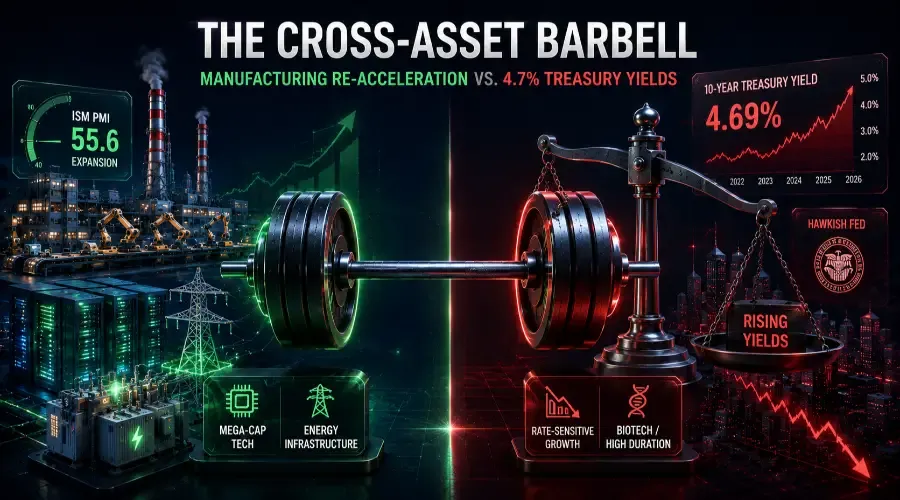
The equity market can rally on a strong growth print–and that is exactly what happened. But if long-end Treasury yields stay near recent highs, the macro story does not resolve into a clean risk-on regime. The 10-year yield remains around 4.69% , having crossed the 4.73% mark on Friday–the highest level in over a year. It declined from Friday's 18-month high on Monday, supported by lower oil prices and easing inflation concerns as hopes grew that Middle East tensions could ease.
But 4.69% is still high enough to keep pressure on valuation multiples, especially in sectors that trade on distant cash flows rather than near-term earnings power. The 30-year bond breached 5.25% last week–its highest reading since 2007.
The Fed is not helping. At its July 28–29 meeting, the FOMC voted 9–3 to keep the federal funds rate steady at 3.50%–3.75%. Three members–Cleveland Fed President Beth Hammack, Minneapolis Fed President Neel Kashkari, and Dallas Fed President Lorie Logan–dissented in favor of an immediate quarter-point hike. It was one of the most分裂 decisions in nearly a decade.
The key cross-asset disconnect. Equities can celebrate better growth, but the rates market can still insist that inflation risk and fiscal supply keep the discount rate elevated. When those two messages diverge, broad market leadership usually narrows instead of expanding.
The AI overlay
The AI trade adds a second layer to the story. The market is already treating the AI complex as the place where growth is most visible and most defensible–which helps explain why names like Amazon can cross the $3 trillion market-cap threshold even while the broader market remains rate-sensitive.
But the physical AI stack is still constrained. Conventional DRAM remains extremely tight. Conventional DRAM contract prices surged 58% to 63% quarter-on-quarter in Q2 2026. Prices are expected to rise another 13% to 18% in Q3. Gartner forecasts annual DRAM prices will rise 125% in 2026. Server DRAM is expected to rise 60% to 67% in Q2. Industry CEOs have flagged the tightest multi-year imbalance in decades.
On top of that, grid interconnection queues continue to limit how quickly new large-load capacity can come online. ERCOT is currently tracking more than 1,800 projects in its interconnection queue, representing over 474 gigawatts of requested load–more than five times the grid's record peak demand. Of that capacity, approximately 90% is attributed to data center load. On August 3, Texas Governor Greg Abbott ordered an audit of every data center in the ERCOT queue before approvals can proceed.
So even as the demand impulse strengthens, supply remains rationed by physical constraints rather than relaxed by capital availability. That is why the AI complex can keep outperforming while the rest of the market struggles to expand its multiple. The AI winners are not just benefiting from optimism; they are benefiting from a structurally constrained supply chain and a market willing to pay for visible conversion of capex into revenue.
What consensus may be missing
The usual interpretation of a stronger manufacturing print is that it should help cyclicals, industrials, and broad risk appetite. That can be true at the margin, but it misses the more important interaction: a stronger real-economy print with sticky prices can keep Treasury yields elevated, and elevated yields can prevent the market from re-rating the broad equity complex.
At the same time, AI constraints do not disappear just because manufacturing improves. If anything, they reinforce the capital concentration already visible in the market. Companies with access to power, memory, and balance-sheet capacity can keep compounding. Companies without those advantages still face a world where financing is expensive and execution risk is high.
That is why the current setup feels less like a broad bull market and more like a barbell: one end is a small group of AI-linked and infrastructure-linked winners, and the other is everything else living under the weight of higher discount rates.
What it means for investors
The implication is not to chase every cyclical name or every AI name. It is to recognize where the market is actually allowing capital to work.
Likely beneficiaries include:
- AI infrastructure and power-related supply chains
- Industrial firms with pricing power and backlog visibility
- Select semis and memory-related names tied to constrained AI demand
- Megacap platforms that can fund growth internally and still command investor confidence
Likely pressure points include:
- Rate-sensitive growth stocks with long duration and weak cash flow
- Companies that need easier financing to justify expansion
- Broad market sectors that rely on multiple expansion more than earnings acceleration
How to evaluate the opportunity: The key framework is the "barbell test" –ask whether a company benefits from the two dominant forces (AI demand pull and physical supply constraints) or is merely exposed to them. Companies with actual contracted capacity, power access, and investment-grade counterparties are in a fundamentally different position than those with only "AI exposure" as a marketing claim.