
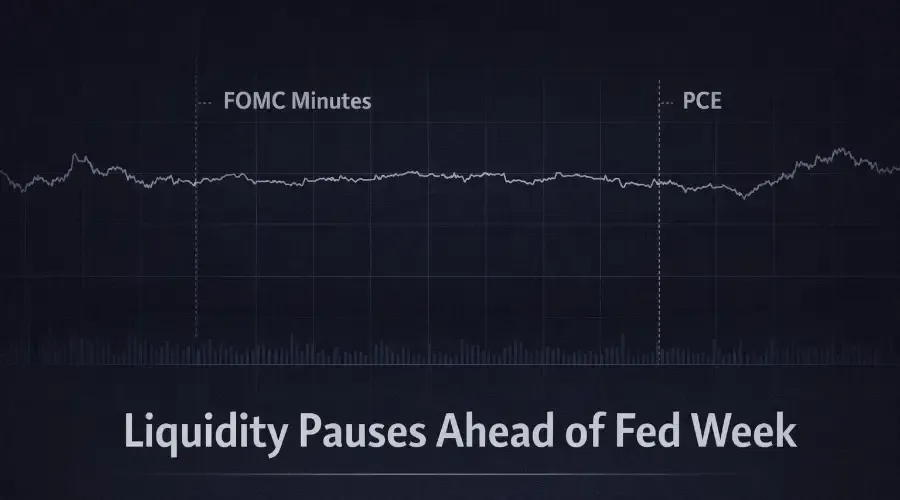
Monday’s session did not produce a breakout move backed by broad institutional participation. Major indices traded within contained ranges, sector leadership remained narrow, and overall volume failed to expand meaningfully. On the surface, it appeared to be a quiet day.
In macro terms, however, the muted activity reflects deliberate positioning restraint ahead of a concentrated Federal Reserve catalyst window.
With FOMC minutes due Wednesday, a Fed speech Tuesday, and PCE inflation data Friday, institutional desks appear to be reducing directional conviction rather than extending risk. The absence of strong participation is itself a signal.
Liquidity Pauses Before Policy Clarity
In policy-driven environments, liquidity rarely disappears without reason. It compresses when large participants face asymmetric event risk.
Ahead of key Fed communication and inflation data, portfolio managers often:
-
Reduce gross exposure
-
Delay sector rotation
-
Avoid initiating high-conviction directional trades
-
Allow positions to remain neutral until clarity emerges
This behavior produces a familiar pattern: narrow index ranges, muted breadth expansion, and softer participation across large-cap equities.
It is not indecision. It is capital preservation.
The Transmission Mechanism
The macro transmission chain is straightforward:
Policy uncertainty
→ Reduced institutional conviction
→ Lower participation
→ Compressed range and volume
Unlike post-data repricing sessions, which are defined by expanding volume and decisive sector moves, pre-catalyst sessions are characterized by restraint. Funds wait for confirmation before committing capital at scale.
With Treasury yields serving as the valuation anchor for equities, and with rate expectations potentially influenced by FOMC minutes and PCE inflation, positioning naturally pauses.
Sector Behavior Reflects Selective Exposure
Even within the compressed environment, exposure was not withdrawn entirely. Rate-sensitive sectors maintained relative stability, while cyclicals and commodity-linked equities lacked meaningful expansion.
This divergence suggests that capital was maintained where conviction already existed but not aggressively increased.
Importantly, there were no signs of broad liquidation. Volatility remained contained, and cross-asset stress indicators did not deteriorate. The message was not risk-off. It was risk-neutral pending information.
What Typically Follows Compression
Liquidity compression phases rarely persist once catalysts resolve.
When event risk clears, markets generally transition into one of two patterns:
-
Repricing with participation — where volume expands and ranges widen as expectations shift.
-
Confirmation with extension — where existing trends accelerate as uncertainty is removed.
Both require institutional re-engagement. That re-engagement typically becomes visible through expanding participation and broader sector involvement.
Structural Context
Markets often feel stagnant during concentrated policy weeks, but these pauses are part of the broader liquidity cycle.
In an environment where Federal Reserve communication continues to anchor cross-asset flows, pre-event compression is rational. It reflects a system waiting for information rather than one lacking conviction.
Liquidity has not exited the market.
It has paused.
And in policy-sensitive regimes, pauses often precede the most informative sessions of the week.