
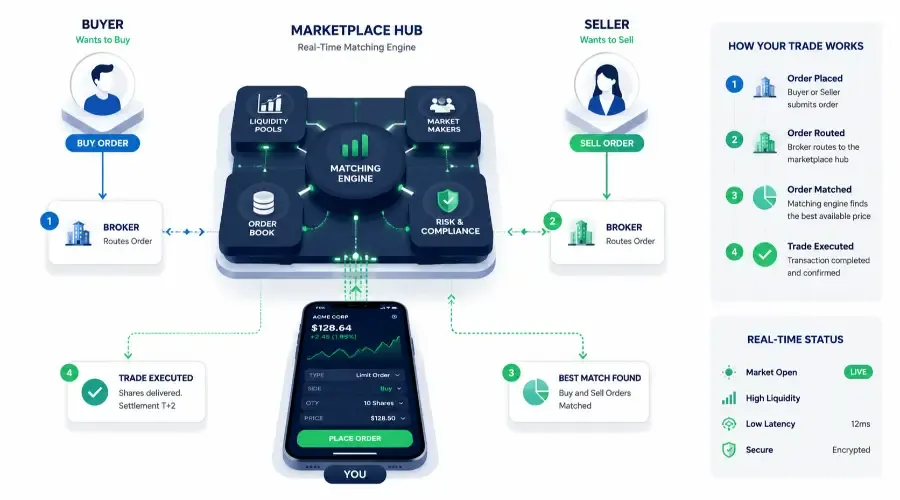
Stocks are bought and sold somewhere. That somewhere has rules, hours, and infrastructure most people never think about – until a trade doesn't go as expected.
Understanding the mechanics takes about five minutes and removes most of the confusion around investing.
A Marketplace, Not a Mystery
The stock market is a collection of exchanges where buyers and sellers trade shares of publicly listed companies. Prices are set by supply and demand: when more people want to buy a stock than sell it, the price rises. When sellers outnumber buyers, it falls.
No single institution sets stock prices. Every price you see reflects the most recent transaction between a willing buyer and a willing seller.
The two primary U.S. exchanges are the New York Stock Exchange (NYSE) and NASDAQ. When you place a trade through a brokerage app, your order routes to one of these exchanges – or to a market maker – where it's matched with a counterpart in milliseconds.
How a Trade Actually Executes
Say you want five shares of a gaming company trading at $25. You open your brokerage app, tap buy, and select a market order. Your broker sends the order to the exchange. The exchange matches it with a seller. The trade confirms in under a second – though the shares don't officially settle in your account until two business days later (T+2).
The price you pay may be $25.00, or it may be $25.03. Quotes shift constantly. A market order guarantees execution, not a specific price. A limit order lets you set a maximum buy price but doesn't guarantee the trade fills.
Why Prices Move
Daily price movement reflects the collective opinion of every market participant about a company's current and future value. Earnings reports, interest rate decisions, product launches, and macroeconomic data all shift that opinion.
Most short-term price movement is noise. A 1.5% intraday swing tells you little about a company's underlying business. Long-term price direction tends to track actual earnings growth and business performance more reliably.
The S&P 500 has averaged roughly 10% annual returns since 1928, across recessions, wars, and market crises. Investors who stayed invested through those periods captured that return. Those who sold during downturns and waited for "better conditions" typically did not.
Market Hours
Regular trading runs from 9:30 AM to 4:00 PM Eastern Time, Monday through Friday, excluding U.S. holidays. Orders placed outside those hours queue for the next session.
Pre-market (4:00 AM to 9:30 AM ET) and after-hours (4:00 PM to 8:00 PM ET) trading exist but carry higher risk – lower volume means wider bid-ask spreads and prices that can move sharply on thin activity. As a starting point, trading during regular hours is the cleaner approach.
What This Means for a New Investor
You don't interact with the exchange directly. Your broker handles routing. Your job is deciding what to buy, at what price, and for how long.
The market opens at 9:30 AM and closes at 4:00 PM. Prices move throughout. Orders place in seconds. The hard part is never the mechanics – it's the patience to stay invested when prices drop and avoid reacting to daily noise.
This content is for educational purposes only and does not constitute investment, legal, or tax advice. Investing in securities involves risk, including possible loss of principal. Always conduct your own research and consult a licensed financial professional before making investment decisions.
Understanding the mechanics of how trades execute is the foundation. The next step is understanding who facilitates those trades and what it costs you in ways that don't appear on your confirmation statement.
→ How Markets Function → Exchanges, market makers, liquidity, and circuit breakers in full - www.breakoutbulletin.com/article/how-stock-market-works-behind-the-app
→ Stock Exchanges Explained → NYSE vs. NASDAQ - what listing standards mean and where your orders route - www.breakoutbulletin.com/article/stock-exchanges-for-teens-nyse-vs-nasdaq
→ The Role of Market Makers → Who is actually on the other side of your trade - www.breakoutbulletin.com/article/market-makers-explained-bid-ask-spread-liquidity