
Published: March 23, 2026 · Analysis by the BreakoutBulletin Editorial Team
As the U.S. issues a direct strike warning to Iran, we analyze the AIS signal gap, the $125 oil scenario, and the sectors most sensitive to escalation.
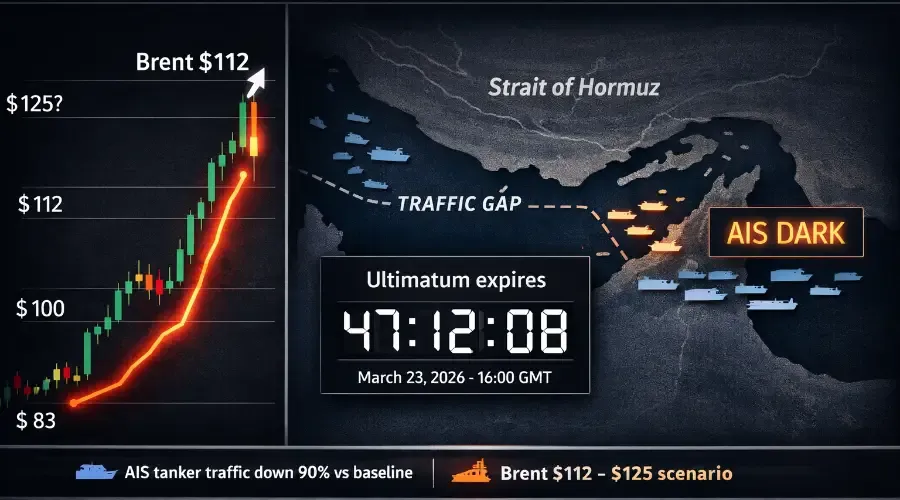
The 48-hour ultimatum issued to Iran to reopen the Strait of Hormuz represents one of the most direct geopolitical escalations in recent years. With Brent crude already trading in the $112–$115 range, markets are no longer pricing just a supply disruption-they are pricing the probability of escalation. What matters now is not the headline, but whether physical oil movement confirms the disruption.
The key shift in this environment is critical: this is not a headline-driven market-it is a data-driven event where tanker movement, not political statements, determines price behavior.
What the Hormuz Ultimatum Means for Oil and Markets
Q: What does the ultimatum mean for oil prices and stocks?
The ultimatum-reopen Hormuz within 48 hours or face direct strikes—is the most explicit threat to global oil supply since the late 1980s. Historically, such escalation introduces an additional geopolitical risk premium into crude prices. However, markets do not react to threats alone-they react to observable supply disruption.
The most reliable confirmation signal is AIS tanker tracking data, not political announcements. If tanker movement collapses or remains absent, the disruption becomes real. If traffic resumes, the premium can unwind quickly.
What Is Actually Happening - The Escalation Sequence
The current situation has progressed through three distinct stages, each with different market implications.
Stage 1 - Supply Shock Premium
Initial disruptions to tanker routes reduced traffic significantly, pushing Brent crude from ~$83 to above $100. This phase was driven by early supply constraints confirmed through AIS data.
Stage 2 - Energy System Expansion
The strike on Qatar’s LNG infrastructure extended the disruption beyond oil into natural gas. This created a broader energy shock, affecting industrial and utility pricing globally.
Stage 3 - Ultimatum Phase (Current)
The introduction of a time-bound military ultimatum changes how markets price risk. This is no longer a passive geopolitical risk-it is a defined event with a countdown.
If the ultimatum expires without action, markets may rapidly reprice lower. If escalation occurs, the supply shock premium can expand significantly.
→ What Happens If the Strait of Hormuz Closes — The Hour‑by‑Hour Timeline |
https://www.breakoutbulletin.com/article/hour-zero-what-happens-when-the-strait-of-hormuz-closes
The Transmission Mechanism - From Oil to Portfolio Impact
The pathway from Hormuz disruption to asset pricing follows a structured chain:
Oil supply shock → Inflation rises → Fed policy constrained → Rate cuts delayed → Discount rates increase → Equity valuations compress → Sector rotation accelerates
This chain explains why:
- Energy stocks outperform
- Airlines and consumer sectors weaken
- Technology faces valuation pressure
- Gold and bonds may underperform cash in this regime
The AIS Monitoring Edge - Why Tanker Data Matters More Than Headlines
In every major Hormuz-related disruption-from the 1987 Tanker War to recent Middle East tensions-AIS data has led price discovery.
Commercial tankers are required to broadcast location signals. When ships:
- Stop moving
- Cluster offshore
- Turn off transponders
…it signals real disruption, not speculation.
This is the key insight: markets price reality, not rhetoric. AIS tracking provides that reality in near real-time.
How to Monitor the Signal
- MarineTraffic.com — Filter tankers in Hormuz corridor (55°–58°E, 24°–27°N)
- TankerTrackers.com — Institutional-level alerts
Signal to watch:
- Traffic resumes → de-escalation
- Traffic absent → sustained disruption
The Scenario Playbook — What Happens Next
Markets now depend on three observable outcomes from AIS data.
Scenario 1 - Full Closure Confirmed
If tanker traffic remains near zero:
- Oil typically spikes further
- Energy sector strengthens
- Airlines and discretionary sectors weaken
Scenario 2 - De-escalation
If tanker movement resumes:
- Oil prices correct sharply
- Pressure eases on inflation expectations
- Risk assets stabilize
Scenario 3 - Partial Flow
If limited movement resumes under escort:
- Oil remains elevated
- Volatility persists
- Sector performance becomes mixed
A secondary signal comes from Saudi Aramco’s Red Sea bypass via Yanbu. Premium pricing on this route indicates that the disruption is operational, not theoretical.
What Traders Should Focus On
The current market environment is defined by a single observable variable: physical oil movement through Hormuz.
Every other signal-oil futures, equities, volatility-is secondary and reactive.
AIS data leads. Markets follow.
Frequently Asked Questions
Is cash the safest asset in this environment?
Historically, during oil-driven inflation shocks, cash and short-duration instruments have preserved value better than long-duration bonds or gold. Rising yields and dollar strength create pressure on traditional safe havens.
Which sectors benefit most from an oil shock?
Energy producers and refiners benefit directly from higher crude prices and expanding margins. This relationship is driven by immediate revenue sensitivity to oil price changes.
Which sectors are most at risk?
Airlines, consumer discretionary, and long-duration tech stocks are typically most exposed. Higher fuel costs, reduced consumer spending, and rising discount rates create multi-layered pressure.
Bottom Line
The 48-hour Hormuz ultimatum is not just a geopolitical headline—it is a real-time test of how markets price supply disruption.
The critical insight is simple: the ultimatum itself is not the signal-AIS tanker data is.
As long as tanker movement remains constrained, markets will continue to price an elevated oil-driven inflation regime. If flows resume, the repricing can reverse just as quickly.
This is a data-driven market, not a narrative-driven one-and the edge lies in watching the signal before the headline.
Go Deeper - Oil Shock Education Series
Oil Shock Sector Map: What Happens to Stocks When Oil Hits $90 - https://www.breakoutbulletin.com/article/oil-shock-sector-map-winners-losers-guide
The $100 Oil Reality: Hormuz Tanker Traffic Collapse - https://www.breakoutbulletin.com/article/hormuz-tanker-traffic-collapse-energy-stocks
What Happens If the Strait of Hormuz Closes Tomorrow: Hour by Hour - https://www.breakoutbulletin.com/article/what-happens-if-the-strait-of-hormuz-closes-tomorrow-hour-by-hour
Disclaimer
This article is for informational and educational purposes only and does not constitute financial, investment, or trading advice. You are solely responsible for your own investment decisions and should consult a licensed financial professional before acting on any information in this post.