
When a public company takes a formal action that affects its shares, shareholders, or capital structure, that's a corporate action. These events shape returns, alter ownership stakes, and sometimes signal important information about where a business is headed. This guide covers every major category: how companies enter public markets, how they return cash to shareholders, how they restructure their share counts, and what each action means for investors holding the stock.
How Companies Enter the Public Markets: The IPO
Every public company was once private. The transition – when shares become available for anyone to buy on a stock exchange – is the Initial Public Offering.
Why companies go public: To raise capital for expansion, to give early investors (founders, venture capital firms, employees with equity grants) a path to sell their holdings (liquidity), and to use publicly traded stock as currency for acquisitions and employee compensation.
The six-step process:
-
The company hires investment banks – underwriters – to manage the offering. Goldman Sachs, Morgan Stanley, and JPMorgan underwrite most significant IPOs. Underwriters advise on timing, structure the deal, and distribute shares to institutional investors.
-
The company files an S-1 registration statement with the SEC. The S-1 is a public document containing audited financial statements, a business description, risk factors, competitive analysis, and planned use of proceeds. The Risk Factors section is particularly informative – it represents the company's own disclosure of what could go wrong.
-
Before pricing, management conducts a roadshow – presentations to large institutional investors to generate demand and gauge pricing appetite.
-
Based on roadshow demand, underwriters and the company agree on a final IPO price. If demand is strong, the final price often lands above the initially proposed range. Airbnb's December 2020 IPO originally suggested $44 to $50 per share. After overwhelming institutional interest, it priced at $68 per share, raising $3.5 billion.
-
On IPO day, the stock lists on NYSE or NASDAQ. The opening price – what retail investors pay – is determined by supply and demand at the open, not the IPO price. Airbnb's first public trade printed at $146, more than double the institutional price of $68.
-
A lockup period (typically 90 to 180 days) prevents insiders from selling immediately. When lockups expire, a significant volume of shares can hit the market simultaneously. This additional supply frequently pressures prices lower. Airbnb peaked at approximately $220 in February 2021 and declined to around $120 within a year, partly reflecting lockup expiration and fundamental valuation adjustment.
The retail investor's structural disadvantage: Institutional investors receive IPO allocations at the IPO price. Retail investors access the stock at the post-pop opening price – historically averaging 15 to 40% above the IPO price.
Research consistently shows that IPOs, as a group, underperform the S&P 500 over 3 to 5-year periods. Waiting 6 to 12 months after listing allows for actual earnings reports, lockup expiration and its price impact, and a clearer picture of business performance under public scrutiny. Many companies that IPO at premium valuations trade at lower prices six months later.
Secondary Offerings: When Companies Sell More Shares
After the IPO, companies can return to the equity market through secondary offerings when they need additional capital. These are the only other moments at which a company directly receives cash from its stock.
Dilutive Offerings (Primary Offerings)
A dilutive offering involves the company creating and selling new shares that didn't previously exist. Total shares outstanding increase; the company receives the proceeds. Every existing shareholder's proportional stake decreases.
The dilution formula: New shares divided by old shares plus new shares, multiplied by 100. A 10-million-share offering on a 200-million-share base creates 4.8% dilution – existing holders own 4.8% less of the company than before the offering.
Secondary offerings typically price 3 to 7% below the prevailing market price to ensure institutional demand. This discount, combined with the market's psychological reaction to the announcement, often produces a 5 to 10% price decline on announcement day.
Snowflake's 2021 secondary offering priced 10.5 million new shares at $230, against a market price of approximately $235 – a roughly 2% discount. Shares declined about 5.5% on announcement day. But Snowflake's revenue grew 85% year over year in the following period. Investors who evaluated the purpose of the raise and held through the initial decline saw a different outcome than those who sold on the announcement.
Non-Dilutive Offerings
A non-dilutive offering involves existing shareholders – founders, early investors, employees – selling shares they already own. No new shares are created. The company receives no proceeds. Total shares outstanding don't change. Your ownership percentage is unaffected.
Non-dilutive offerings primarily transfer who holds the shares, not how many exist.
Evaluating Any Offering
The single most informative section in an offering press release is the use of proceeds. Capital raised for market expansion, strategic acquisitions, or R&D investment describes a company strengthening its competitive position. Capital raised to cover operating losses, repay debt, or sustain a cash-burning model without a clear path to profitability describes something different.
A practical response framework: under 5% dilution with a specific, growth-oriented use of proceeds – review the thesis and hold if it's intact. Between 5 and 10% with vague or defensive use of proceeds – reassess the original investment case against current business conditions. Above 10% dilution or multiple offerings within 12 months – evaluate whether the company's cash generation profile has changed materially from what you originally evaluated.
Multiple offerings within a short window often signals that cash from operations isn't covering expenses. One secondary may be strategy. Three within 18 months suggests a business that cannot fund itself.
Dividends: Getting Paid to Hold Shares
Dividends are cash payments distributed to shareholders on a per-share basis, typically quarterly. When a profitable company generates more cash than it needs for operations and growth, its board can elect to distribute a portion directly to shareholders.
The key dates:
The declaration date is when the board announces the dividend amount and timeline. The ex-dividend date is the ownership cutoff – you must hold shares before this date to receive the upcoming payment. The payment date is when cash arrives in your account.
Dividend yield: Annual dividend per share divided by current share price, multiplied by 100. Coca-Cola's 2024 annual dividend of approximately $1.94 per share on a stock price of $60 produces a yield of roughly 3.2%. For every $100 invested, shareholders receive $3.20 per year in dividend income before taxes.
Yield changes as stock price moves even when the dividend itself doesn't. A stock paying $2 annually that trades from $50 to $80 changes yield from 4% to 2.5% on new purchases. Existing holders who bought at $50 still receive $2 per share – the yield on their cost basis remains 4%.
Dividend reinvestment (DRIP): Most brokerages offer automatic reinvestment of dividends into additional shares rather than distributing cash. Most major brokerages offer DRIPs with no fees, but it's worth confirming. The compounding effect is material over long periods: each share added generates its own future dividends, which buy more shares, and so on. For investors with long time horizons who don't need current income, reinvestment typically produces better outcomes than taking dividends as cash.
Sustainable yield range: Yields of 2 to 4% from companies with long records of maintaining or increasing dividends represent stable, predictable income. Companies classified as "Dividend Aristocrats" have increased dividends for 25 or more consecutive years.
Yields above 6 to 7% typically signal stress. The stock price has declined in anticipation of trouble, which mechanically pushes the yield higher. Buying a 9% yield that gets cut six months later means absorbing both the income loss and a likely 15 to 25% price decline. The payout ratio – dividends paid as a percentage of earnings – provides context: a company paying 40% of earnings retains adequate cushion; a company paying 90% has minimal margin for error.
The trade-off with growth: Dividends are funded by profits not reinvested into the business. A company distributing $500 million annually in dividends directs that capital away from product development, acquisitions, or market expansion. Fast-growing technology companies typically pay no dividend – they generate higher returns for shareholders by deploying that capital internally. Neither approach is inherently better. The right choice depends on the company's growth opportunities and the investor's income needs.
Tax treatment: Qualified dividends – paid by most U.S. corporations and held for more than 60 days during the 121-day period surrounding the ex-dividend date – are taxed at long-term capital gains rates (0%, 15%, or 20% depending on income). Dividends held in a Roth IRA grow without annual tax drag, making tax-advantaged accounts particularly efficient for dividend-paying holdings.
Stock Buybacks: How Companies Repurchase Their Own Shares
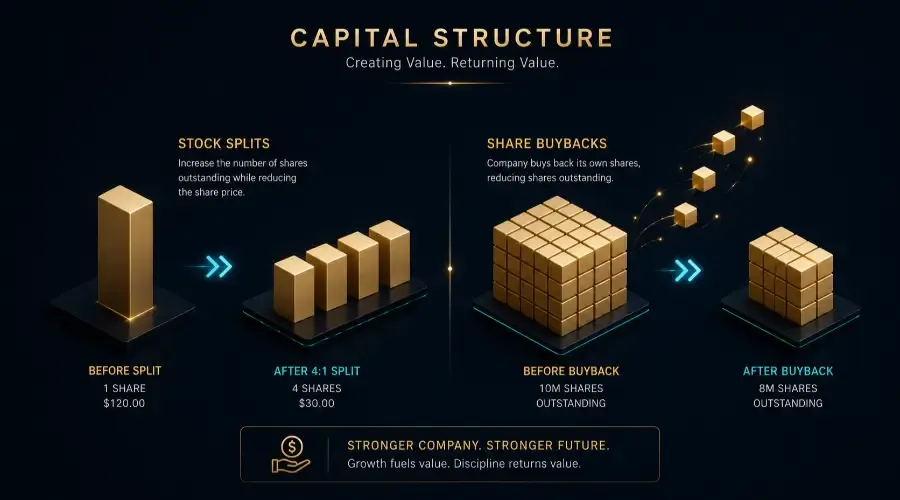
A share repurchase program involves the company buying its own shares on the open market and retiring them – permanently reducing shares outstanding. With fewer shares in existence, each remaining share represents a larger proportional ownership of the same company.
The ownership effect: Before a buyback with 100 million shares outstanding, your 1,000 shares represent 0.001% ownership. After a 5-million-share buyback reducing outstanding shares to 95 million, your same 1,000 shares represent 0.00105% ownership – a 5.3% increase in proportional stake with no additional investment.
The EPS effect: Earnings per share equals net income divided by shares outstanding. A buyback that reduces shares outstanding, all else equal, increases EPS even if net income stays flat. If a company earns $1 billion with 100 million shares, EPS is $10.00. If buybacks reduce shares to 80 million while earnings hold at $1 billion, EPS rises to $12.50 – a 25% increase without any underlying business improvement.
This mechanical EPS boost is both the appeal and the criticism of buybacks. When used to return genuine excess cash from a thriving business, EPS growth from buybacks reflects real value creation. When used by a company with flat or declining earnings to inflate EPS – the figure most tied to executive compensation – buybacks serve management's interests more than shareholders'. If net income is simultaneously declining, buybacks can mask deteriorating profitability per share, making EPS a less reliable signal of business health.
Apple as the defining example: From 2013 through 2023, Apple repurchased and retired approximately 40% of its then-outstanding shares, spending over $550 billion. Apple's total net income roughly doubled over that period. But EPS grew approximately four times over because shares outstanding fell significantly. Apple's stock returned approximately 14 to 15% annually over the decade – buybacks were a significant contributor, enabled by one of the most profitable businesses in corporate history.
When buybacks destroy value:
Buybacks funded by debt rather than free cash flow add balance sheet risk. If business conditions deteriorate, the debt remains while the earnings that justified the buyback disappear. Several major airlines conducted large buyback programs before 2020, leaving themselves with high debt loads entering the pandemic – when revenue collapsed completely.
Buybacks executed at significantly inflated valuations overpay on behalf of remaining shareholders. The same capital deployed at lower valuations buys twice the ownership stake per dollar spent.
Emergency buybacks announced immediately after earnings misses are often PR moves rather than smart capital allocation – a signal worth recognizing.
Three-factor evaluation: Size relative to market cap (a $500 million buyback on a $200 billion company is immaterial; the same on a $10 billion company is substantial), funding source (free cash flow is healthier than new debt), and valuation at time of purchase (buying below historical average multiples creates value; buying near peaks typically does not).
Stock Splits and Reverse Splits
Stock splits change the number of shares outstanding and the price per share simultaneously, leaving total market capitalization unchanged.
Forward Splits
In a 3-for-1 forward split, every shareholder receives three shares for each one previously held. The stock price adjusts to one-third of its pre-split level. An investor holding 10 shares at $900 now holds 30 shares at $300 – portfolio value unchanged.
Companies typically split stock when high per-share prices create a perception barrier for smaller investors, or when they want to improve daily liquidity by increasing the number of shares in circulation. Tesla conducted a 3-for-1 split in August 2022. Apple has split five times in its history, most recently a 4-for-1 split in August 2020.
The split itself has no direct effect on value. Subsequent returns depend entirely on business performance – not the split mechanics.
Cost basis update: After a 3-for-1 split, if you held 10 shares at $300 cost basis each ($3,000 total), you now hold 30 shares with a $100 cost basis each. Most brokerage platforms update this automatically, but verifying against personal records prevents errors when calculating future gains.
Reverse Splits
A reverse split reduces share count and proportionally increases per-share price. In a 1-for-10 reverse split, an investor holding 200 shares at $1.50 now holds 20 shares at $15 – value unchanged.
Reverse splits typically happen because a stock has declined to levels triggering exchange listing concerns. NYSE and NASDAQ require minimum share prices – generally $1 per share – for continued listing. A reverse split raises the per-share price mechanically, satisfying the requirement.
Why reverse splits are reliable warning signals: They address the symptom without addressing the cause. If a company's shares declined 85% because of deteriorating revenue, mounting losses, or failed product launches, a 1-for-10 reverse split doesn't fix any of those problems. The business remains unchanged. History shows that many stocks conducting reverse splits continue to decline afterward – the reverse split buys time but doesn't create value.
Multiple reverse splits by the same company over several years is a more serious pattern – consistent destruction of shareholder value without correcting the underlying cause.
Distinguishing forward from reverse: The context tells you everything. Forward splits happen to companies with high per-share prices, which typically means the stock has appreciated substantially. Reverse splits happen to companies with low per-share prices, which typically means the stock has declined substantially. "Stock split" in a headline warrants a ten-second check on which direction: shares multiplying (forward) or shares consolidating (reverse).
How Companies Make Money from Stock – and When They Don't
A persistent misconception: when a stock price rises, many people assume the company received more money. It didn't.
Companies earn cash from stock only at the point of issuance. The IPO is the first such moment. Secondary dilutive offerings are subsequent moments. In both cases, the company sells newly created shares and receives the proceeds directly.
After issuance, every transaction involving those shares occurs between investors. When you buy Apple from another investor through your brokerage app, Apple receives nothing. The exchange between you and the seller routes through the exchange infrastructure and your respective brokers – not through Apple's treasury.
When Apple's stock price rises 15% in a week, Apple's cash balance changes by $0. Shareholders who hold Apple benefit. Apple benefits only indirectly – through better conditions for future capital raises, more valuable stock-based employee compensation, and stronger acquisition currency.
Market capitalization is not cash. A company with a $10 billion market cap may hold $200 million in actual cash. If business conditions deteriorate, the company can spend only what it holds – not what the market says it's worth. This is why high market capitalization companies can still face financial distress if their actual cash generation is insufficient.
The secondary offering signal: A company that issues stock frequently – multiple secondary offerings within 12 to 18 months – often signals that cash from operations isn't covering expenses. That pattern deserves attention when evaluating whether the business model generates sufficient return on already-deployed capital.
Understanding Shareholders: Rights, Responsibilities, and Reality
Buying shares makes you a partial owner of a real business. That ownership relationship carries specific rights that exist independently of stock price movements.
Voting rights: Common shareholders typically receive one vote per share on significant corporate matters. These matters include electing the board of directors (which hires and fires the CEO), approving executive compensation packages, ratifying the external auditor, and weighing in on major transactions or shareholder proposals.
Proxy statements – documents describing upcoming votes – arrive annually (and occasionally for special meetings). Reading them teaches corporate governance in practice: how executives are compensated, who serves on the board and what their qualifications are, and what shareholder proposals have been submitted. Even small investors who can't swing outcomes through vote count alone contribute to the aggregate retail voting signal that increasingly matters to management and activist investors.
Dividend participation: When a company declares a dividend, shareholders receive their proportional share on a per-share basis.
Asset claims: In liquidation, common shareholders receive whatever remains after creditors, bondholders, and preferred shareholders are paid in full. In practice, common shareholders often receive little or nothing in bankruptcy – which reflects the risk profile of common equity relative to debt.
Dilution and concentration: Your ownership percentage changes when the company issues new shares or repurchases existing ones. A company whose share count has grown significantly over several years through repeated dilutive offerings may be funding operations through equity issuance – worth understanding before evaluating the business. A company reducing its share count through buybacks is concentrating each remaining holder's stake.
Thinking like an owner: The investor who evaluates each stock purchase as acquiring partial ownership in a real business makes different decisions than the investor treating it as a price-movement vehicle. Ownership thinking asks: does this business generate reliable cash flow? Is management allocating that cash wisely? Are shareholders being treated fairly through the dilution, dividend, and buyback decisions management makes? Those questions don't guarantee better outcomes, but they produce a more durable analytical framework than price watching alone.
Putting Corporate Actions in Context
Corporate actions are communications. Each one signals something about management's assessment of the company's position, needs, and priorities.
An IPO says: we're ready for public scrutiny, we need capital for growth, and we're giving early investors a path to liquidity.
A dividend initiation says: we generate enough consistent cash to share it regularly, and we expect to maintain that capacity.
A buyback program says: we believe our shares represent good value at current prices, and we have excess cash to deploy.
A secondary offering says: we need capital – and the use of proceeds tells you whether that capital serves growth or survival.
A forward split says: our stock price has grown substantially and we want to improve accessibility.
A reverse split says: our stock price has fallen substantially and we're managing exchange compliance.
Reading these signals accurately – rather than reacting to the headline number – is one of the more durable skills an investor can develop.
This content is for educational purposes only and does not constitute investment, legal, or tax advice. Investing in securities involves risk, including possible loss of principal. Past performance does not guarantee future results. Always conduct your own research and consult a licensed financial professional before making investment decisions.
Free educational guide by BreakoutBulletin.com
Related reading on BreakoutBulletin.com:
This guide covers every major action a company can take that affects its shares — from going public to returning cash to shareholders. The sections below break each category into detail. Start with whichever event is most relevant to a company you currently hold or are researching.
→ How Companies Return Value to Shareholders → Covering dividends and buybacks - www.breakoutbulletin.com/article/how-dividends-and-buybacks-pay-shareholders
→ Share Events and Structural Changes → Covering IPOs, secondary offerings, and splits - www.breakoutbulletin.com/article/corporate-share-events-ipos-secondary-offerings-stock-splits
→ The IPO Process Explained → Why retail investors rarely get IPO prices and what to do instead - www.breakoutbulletin.com/article/ipo-process-explained-for-beginners
→ Dividend Basics → How dividends work, what yield means, and when high yield is a warning - www.breakoutbulletin.com/article/dividends-explained-for-beginners
→ Stock Buybacks Explained → The Apple case study and when buybacks create vs. destroy value - www.breakoutbulletin.com/article/stock-buybacks-explained-for-teen-investors
→ Stock Splits and Reverse Splits → Why forward splits are neutral and reverse splits are a signal - www.breakoutbulletin.com/article/stock-splits-vs-reverse-splits-explained
The next step is understanding how to actually trade the stocks and corporate events covered here.
→ Stock Market Trading Mechanics → Orders, settlement, PDT rules, and trading timeframes - www.breakoutbulletin.com/article/stock-trading-mechanics-beginners-guide