
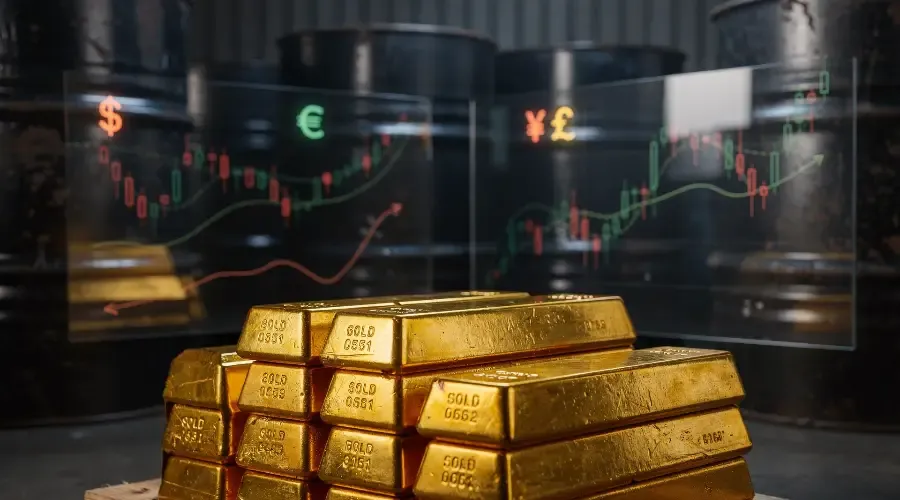
Headline: Gold, Oil, and Your Wallet: 5 Questions Everyone's Asking
SEO Title: Gold & Oil FAQs: Why Prices Are Moving in 2026
Meta Description: Why is gold at $5,000? Will oil spike? Does silver beat gold? We answer the commodity questions people actually ask.
Q1: Why Is Gold at $5,000 Per Ounce?
Short answer: Three reasons - central banks buying heavily, Fed rate cut expectations, and geopolitical safe-haven demand.
The details:
Central bank buying: Countries bought ~70 tonnes monthly in 2025 (World Gold Council). That's $3-4 billion monthly. They're diversifying from dollars after watching Russian assets frozen in 2022.
Catch: This could reverse if countries face crises needing emergency dollars. Happened in 1997 Asian Financial Crisis.
Rate cut bets: Markets expect Fed to cut 0.75% in early 2026. Lower rates make gold's 0% yield more competitive versus bonds.
If: This assumes inflation stays cool (Dec was 2.7%, BLS Jan 15). If Jan/Feb reports show heating, Fed might not cut.
Geopolitical premium: Iran, Venezuela, Kazakhstan tensions add $75-100/oz (Goldman Sachs). These premiums fade fast when situations stabilize—see 2019 Saudi oil attack spike/reversal.
Q2: Does This Mean Higher Coffee and Gas Prices?
Honest answer: Not directly from gold, but there are connections.
Gold at $5,000 doesn't mechanically raise Starbucks prices. But it signals institutional concerns about currency purchasing power and inflation that could eventually show up in consumer prices (3-9 month lag typically).
Oil matters more immediately: Oil at $61/barrel translates to roughly $3-4/gallon gas. If oil hits $80, expect $4-5/gallon within weeks. Oil affects diesel for trucking, fertilizers for farming, plastics, packaging—everything.
Currently: Oil stuck in $59-70 range means stable (if annoying) gas prices unless geopolitics explode.
Q3: Is Gold Actually an Inflation Hedge?
Brutally honest: Partially true over decades, way more complicated over months/years.
Gold has kept pace with inflation since the 1970s over the full period. But during 2022 with 8-9% inflation, gold fell from $2,070 to $1,620 (down 22%). Why?
Real interest rates matter more than inflation headlines.
- Inflation 3%, bonds pay 5% → Real return +2% → Gold struggles
- Inflation 3%, bonds pay 2% → Real return -1% → Gold rallies
In 2022, the Fed raised rates faster than inflation, making real yields go positive. That killed gold despite high inflation.
Better framing: Gold works when real returns on other investments are low/negative, not just when inflation is high.
Q4: Silver Up 37%—Is That Better Than Gold?
Short answer: Bigger potential gains, dramatically bigger risks.
Silver jumped from $75 to $103 (37% monthly) versus gold's 11%. Two reasons:
1. Silver amplifies gold moves: Think gold as sedan, silver as sports car. Every bump feels 2-3x bigger in both directions.
2. Industrial demand: Silver is critical for solar panels (20g each), EVs (25-50g each), electronics. Projected 8-12% annual demand growth through 2028 (Silver Institute).
Risks:
- That 37% can reverse just as fast
- At $103, recycling becomes very profitable, adding supply
- Recession kills industrial demand
- 2008: Silver crashed 57%; 2011-2015: down 71%
Choose silver if: You can handle 30-50% swings and believe in green energy transition.
Choose gold if: You want stability and can't stomach volatility.
Q5: Should Regular People Care About Commodities?
Yes—you're already affected daily:
Oil affects:
- Gas for your car
- Diesel for food delivery trucks
- Jet fuel for flights
- Plastics, fertilizers, everything
Commodities as early warning:
- Oil spiking → inflation coming in 3-6 months
- Gold rallying + oil stable → currency concerns, not growth
- Metals + energy both weak → slowing economy
- Agricultural spikes → food inflation in 3-9 months
Practical use: Watch trends for budget timing (fill propane before spikes), major purchases (delay renovation if lumber spiking), inflation awareness (multiple commodities rising = broader inflation likely).
Practical Insights
- Budgeting: Oil at $59-70 = stable gas prices; watch for breaks
- Inflation: Gold signals concerns, but real rates tell fuller story
- Perspective: 10-20% moves in months are normal; headlines don't always = lasting change
Key monitors:
- EIA oil reports (Wednesdays)
- Inflation data (Feb 12, Mar 12)
- Fed announcements (Jan 29 minutes)
Sources:
- TradingEconomics, Jan 23, 2026: Gold $4,990/oz (+11.22%); Silver $103.38/oz (+37.40%)
- World Gold Council: ~70 tonnes/month through Nov 2025
- CME FedWatch, Jan 23: Fed cut expectations
- BLS, Jan 15: Dec CPI 2.7%
- EIA: Weekly oil data
- Goldman Sachs, Dec 2025: Geopolitical premium analysis
- Silver Institute, 2025: Demand projections, recycling estimates
Note: Commodity markets involve significant volatility and risk. Educational content only, not financial advice.