
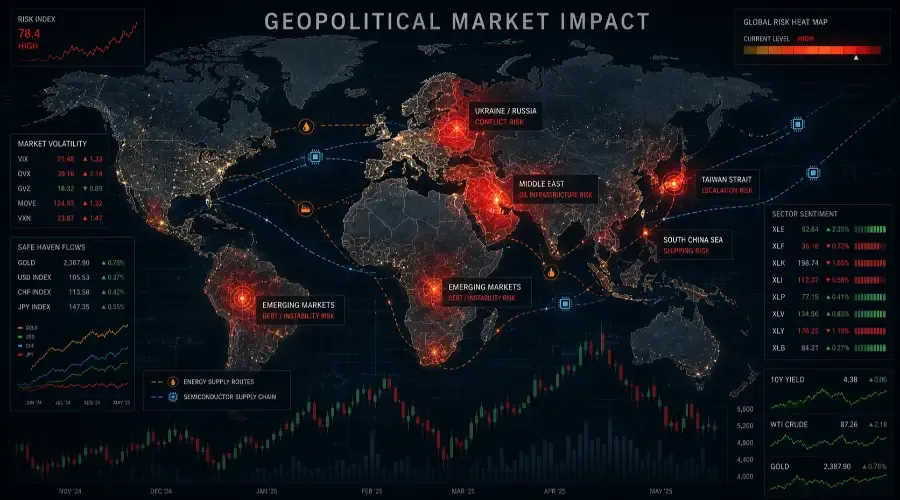
Every category in this series so far has been schedulable. You can put Fed meetings on a calendar. You can anticipate CPI release dates. You can model QE tapering timelines. Even commodity price moves develop over weeks, giving you time to build a thesis.
Geopolitical events give you none of that. A military conflict begins at 5am on a Thursday. An election produces an unexpected result at 2am. An OPEC meeting ends with a surprise production cut. An emerging market sovereign defaults over a weekend.
Unscheduled, binary, and often violent in their initial market impact – geopolitical events are the category that most consistently causes retail traders to make their worst decisions: panic-selling the initial spike in volatility, or freezing entirely because the event feels too complex to analyze under pressure.
This hub exists to solve that problem. The framework here is not predictive – no one consistently predicts geopolitical events. It is preparatory: for each of the six major geopolitical event types, you will know the transmission mechanism, the typical market sequence, the historical base rates, and the trade that has historically rewarded disciplined positioning over panic.
The Defining Characteristic of Geopolitical Events: The Initial Reaction Is Usually Wrong
Across decades of geopolitical market history, one pattern repeats with striking consistency: the market's initial reaction to a geopolitical shock systematically overshoots in the direction of fear, and then partially or fully reverses once the duration and scope of the event becomes clearer. In practice, this is the single most important base rate you need to internalize when trading geopolitical risk.
This is not always true – the 2022 Russia-Ukraine invasion produced an initial market sell-off that was, if anything, an underreaction to the structural energy supply disruption that followed. But the base case, supported by the majority of geopolitical events in the historical record, is that the initial panic is excessive.
The Gulf War began in January 1991 with markets already down 20% in anticipation. Within days of the air campaign's success becoming clear, markets began one of the sharpest recoveries in post-war history. The S&P 500 was at new highs within six months of the invasion of Kuwait that had triggered the selloff.
The September 11 attacks closed the New York Stock Exchange for four trading days. When it reopened, the S&P 500 fell 11.6% in the first week – the largest single-week decline since the Great Depression. It had recovered all of those losses within a month.
Brexit produced a single-day 3.6% S&P 500 decline in June 2016 on the surprise referendum result. Within two weeks, US markets had fully recovered. The UK domestic market took longer – but even there, the initial reaction significantly overstated the immediate economic damage.
The trader's framework from this pattern: In the immediate aftermath of a geopolitical shock, the question to ask is not "how bad will this get?" but "what do we now know about duration and scope that the initial reaction has not yet priced?" Markets price uncertainty with a fear premium. When uncertainty resolves – even partially – that premium deflates rapidly. You’ll notice this is the foundation of how wars affect the stock market over the first few days.
The exception to this rule: geopolitical events that produce structural rather than episodic disruption. The 2022 Russian invasion is the clearest modern example of a geopolitical event where the initial reaction underestimated duration, and the correct trade was to add to the initial directional move rather than fade it. Identifying structural versus episodic geopolitical risk is the single most important analytical skill in this hub.
The Four Variables That Determine Geopolitical Market Impact
Every geopolitical event can be assessed across four variables that collectively determine the magnitude, duration, and breadth of its market impact. Answering these four questions before building any geopolitical trade is the discipline that separates systematic analysis from reactive guessing.
Variable 1: Does It Disrupt a Critical Supply Chain?
Geopolitical events that disrupt the physical supply of energy, food, semiconductors, or shipping routes produce market impacts that are larger, faster, and more sustained than events that affect only financial flows or political sentiment.
Russia cutting European energy supply disrupts the largest energy supply chain in the world – its market impact is structural. A US-Iran diplomatic standoff that does not produce an actual Strait of Hormuz closure disrupts sentiment but not supply – its market impact fades quickly. Always identify the supply chain exposure before sizing the trade.
Variable 2: Is the Duration Episodic or Structural?
An episodic geopolitical event has a natural resolution timeline – a military operation with clear objectives, an election with a definitive outcome date, an OPEC meeting that produces a reversible decision. Structural events have no clear resolution – a multi-year war, a permanent decoupling of two major economies, a sovereign default that restructures years of debt.
Episodic events justify short-duration defensive positioning. Structural events justify multi-quarter or multi-year sector rotation. The most costly geopolitical trading errors consistently come from treating structural events with episodic positioning frameworks.
Variable 3: What Is the Geographic Scope?
A conflict in a commodity-producing region (Middle East for oil, Eastern Europe for wheat and gas, South America for copper) has immediate commodity market implications that transmit globally through supply chains. A conflict in a non-commodity-producing region has primarily sentiment effects on global risk appetite – real but more transient.
Emerging market debt crises demonstrate this variable most clearly: an EM default in a small economy (Ecuador, Sri Lanka) creates contagion risk but typically stays contained. An EM crisis in a systemically important economy (Argentina in 2001, Russia in 1998) produces global financial market contagion because of bank exposure, capital flow reversals, and currency crisis transmission.
Variable 4: What Is the US Domestic Policy Response Likely to Be?
Geopolitical events that trigger US government intervention – sanctions, military deployment, emergency energy releases from the Strategic Petroleum Reserve, emergency fiscal spending – have an additional policy transmission layer on top of the direct market impact. The US government response can amplify, contain, or redirect the initial market signal significantly.
Sector Reaction Map: Geopolitical Events by Type
Military Conflict Outbreak
Energy (XLE): Energy stocks usually react very positively during military conflicts, especially when oil or gas infrastructure is at risk. If the conflict disrupts energy supply, the rally often remains strong for an extended period.
Materials (XLB): Materials stocks generally see a moderately positive reaction because of commodity disruption fears. However, gains often fade if the conflict turns out to be temporary or limited.
Defense (within XLI): Defense-related stocks usually react very positively during military conflicts because defense spending expectations typically increase and remain elevated.
Consumer Discretionary (XLY): Consumer discretionary stocks often react negatively during geopolitical conflicts as investors move away from risk-sensitive consumer sectors. These stocks usually recover if the conflict remains short-term.
Technology (XLK): Technology stocks generally react negatively during military conflicts due to risk-off sentiment and possible supply chain disruptions, especially if semiconductor production is affected.
Financials (XLF): Financial stocks often move negatively during geopolitical uncertainty because of rising credit risk and broader market stress. The sector usually stabilizes once uncertainty begins to ease.
Consumer Staples (XLP): Consumer staples usually show relative positive performance during military conflicts because investors rotate toward defensive sectors during periods of uncertainty.
Healthcare (XLV): Healthcare stocks generally perform relatively positively during geopolitical stress as investors seek defensive and stable sectors.
US Presidential Election
Republican Win: Energy (XLE), Financials (XLF), and Industrials (XLI) often perform positively during Republican victories because markets anticipate deregulation and business-friendly policies. Healthcare (XLV) and Communication Services (XLC) may face pressure from policy concerns such as drug pricing or technology regulation. These trends usually develop over a multi-year policy cycle.
Democrat Win: Healthcare (XLV) and clean energy-related industries within Materials (XLB) often react positivelyduring Democrat victories because of expectations around healthcare expansion and renewable energy support. Energy (XLE) and Financials (XLF) may face pressure from increased regulation. These trends usually continue through a multi-year policy cycle.
Contested Result: Defensive sectors such as Consumer Staples (XLP), Healthcare (XLV), and Utilities (XLU) often perform positively during contested elections as investors avoid uncertainty. Cyclical sectors usually struggle until political clarity returns.
Divided Government: Markets usually see minimal sector rotation during a divided government because policy gridlock limits the probability of major legislative changes.
China-Taiwan Escalation
Technology (XLK): Technology stocks would likely face the most severe negative reaction during a China-Taiwan escalation because Taiwan dominates advanced semiconductor manufacturing. Any blockade or disruption could trigger a global chip crisis.
Industrials (XLI): Industrial stocks would likely react severely negatively because electronics manufacturing and global supply chains could face major disruptions.
Consumer Discretionary (XLY): Consumer discretionary stocks would likely see a significant negative impact because electronics production, automobiles, and consumer goods manufacturing depend heavily on Asian supply chains.
Energy (XLE): Energy stocks would likely react positively because tensions in the South China Sea could disrupt shipping routes and increase energy supply concerns.
Defense (within XLI): Defense-related companies would likely react very positively because geopolitical escalation typically increases military spending expectations.
Consumer Staples (XLP): Consumer staples would likely show relative positive performance as investors rotate toward defensive sectors during periods of geopolitical uncertainty.
Gold / GDX: Gold and gold miners usually react very positively during severe geopolitical stress because investors move toward traditional safe-haven assets.
OPEC+ Supply Cut
Energy (XLE): Energy stocks usually react very positively to OPEC+ supply cuts because lower supply expectations typically drive oil prices higher almost immediately.
Materials (XLB): Materials stocks often react moderately positively because commodity prices tend to rise alongside higher energy prices.
Industrials (XLI): Industrial stocks generally react negatively over the following months because higher fuel and transportation costs pressure business margins.
Consumer Discretionary (XLY): Consumer discretionary stocks often experience a significant negative impact because rising fuel prices reduce consumer spending power.
Consumer Staples (XLP): Consumer staples usually react moderately negatively because logistics and transportation costs increase when oil prices rise.
Financials (XLF): Financial stocks generally react negatively if higher energy prices increase inflation risks and economic uncertainty over an extended period.
The Commodity Channel: Why Most Geopolitical Events Are Energy Events in Disguise
Review the six geopolitical events covered in this hub and a pattern becomes clear: five of the six have an energy component as their primary or secondary transmission mechanism. In other words, energy stocks during geopolitical crisis are rarely a sideshow—they’re often the main story.
Military conflict in the Middle East – energy supply disruption risk. OPEC+ cuts – direct energy supply manipulation. Russia-Europe energy cutoff – the most explicit energy geopolitical event in modern history. China-Taiwan escalation – South China Sea shipping route disruption affecting LNG and oil tanker routes alongside the semiconductor story. Even emerging market debt crises, when they occur in major oil-producing or oil-importing economies, carry an energy dimension.
This concentration in energy is not coincidental. Energy is the input without which modern economies cannot function – which makes energy supply routes, energy-producing regions, and energy-producing governments the most geopolitically contested terrain in the global economy. For traders, this means that building and maintaining a strong foundation in the energy catalyst framework from Hub 1 is a prerequisite for effective geopolitical event trading.
The one exception is China-Taiwan, where the primary market transmission is through semiconductors – specifically through TSMC's dominance of advanced chip manufacturing. A Taiwan conflict scenario is the only geopolitical event in history with the potential to simultaneously disrupt both the energy supply chain (South China Sea shipping) and the technology supply chain (semiconductor manufacturing) at a global scale. This dual disruption potential makes China-Taiwan escalation the highest-impact single geopolitical risk in the current environment – and the one that deserves its own dedicated framework separate from the standard military conflict playbook.
The Election Trade: What History Actually Shows
US presidential elections are among the highest-search-volume events in this hub – and among the most consistently misanalyzed by retail traders. The dominant retail narrative around elections is that the market needs "certainty" and therefore performs poorly before elections and rallies regardless of the outcome afterward. The actual historical record is more nuanced.
The pre-election pattern: The S&P 500 has historically been positive in the twelve months leading into a presidential election approximately 80% of the time – a reflection of the fact that incumbent administrations deploy fiscal stimulus and the Fed tends toward accommodation in election years. The pre-election rally is a real pattern, but it is driven by policy behavior, not the election itself.
The post-election pattern: Markets rally strongly in the two months following the election approximately 75% of the time – including after both Republican and Democrat wins. The relief from uncertainty, regardless of which party wins, tends to be the dominant short-term force. The sector rotation toward the winning party's policy beneficiaries then plays out over the subsequent six to twelve months.
Where the election trade is most reliably expressed: Not in the index level (which tends to go up regardless), but in the sector rotation between the policy beneficiary sectors of each outcome. The 2016 Trump election produced the sharpest post-election sector rotation in decades – XLF surged 15% in the month following the election as deregulation expectations were priced in, while XLV fell on drug pricing rhetoric. The 2020 Biden election began pricing clean energy and healthcare policy immediately. These sector rotations are the real election trade, and that’s the core of any geopolitical sector rotation playbook for election years.
Key Historical Geopolitical Events and What They Produced
1990–1991: Gulf War – The Template for Episodic Conflict
Oil prices doubled from 17 to 35 per barrel in the months between Iraq's invasion of Kuwait and the allied military response. When Operation Desert Storm began in January 1991, the market – which had already sold off 20% – began recovering immediately. The conflict's swift resolution meant the energy supply disruption was episodic, not structural. XLE had already priced the disruption; the resolution was the buy signal. This is the original template for the "buy the start of the conflict" trade in episodic military events, and it remains the most studied case in Gulf War stock market analysis.
1997–1998: Asian Financial Crisis – EM Contagion at Scale
Thailand's baht devaluation in July 1997 triggered sequential currency crises across Indonesia, South Korea, Malaysia, and the Philippines. The contagion reached Russia (sovereign default, August 1998) and Long-Term Capital Management (near-systemic failure, September 1998). US equity markets fell 20% in the August–October 1998 window. The transmission mechanism was financial – currency crisis into banking system stress into credit market seizure – rather than commodity supply disruption. The sector rotation was classic risk-off: XLP and XLV held up; XLF was most damaged by credit and EM exposure. The Fed's three rapid rate cuts in September–November 1998 stabilized markets – illustrating how quickly geopolitical financial crises can be converted into monetary policy events.
2022: Russia-Ukraine – Structural Geopolitical Energy Shock
The February 24 invasion produced an initial market reaction that proved, unusually, to be an underreaction. European natural gas prices increased tenfold at their peak. Global wheat prices surged 60% in the first month. XLE gained 65% in 2022 – the best-performing sector. The conflict's failure to resolve quickly – unlike Gulf War or other recent conflicts – made this the definitive modern case study for structural versus episodic geopolitical risk assessment. Traders who applied the Gulf War playbook (buy the conflict, sell the resolution) repeatedly called the top in energy and were repeatedly wrong throughout 2022 because the structural supply disruption persisted far beyond any episodic framework. This Russia Ukraine market impact redefined how serious traders think about energy crisis investing.
2023: OPEC+ Surprise Production Cut
Saudi Arabia's unilateral announcement of a 1 million barrel per day production cut in April 2023 – on top of the coordinated OPEC+ cuts already in place – sent WTI crude from 80 to 87 in a single day. XLE surged 4% on the announcement day. The downstream consumer impact – higher gasoline prices arriving when the Fed was still fighting inflation – complicated the Fed's rate path expectations and produced a simultaneous bond market reaction (yields rising on re-inflation fears) alongside the equity energy rally. This case study illustrates how geopolitical commodity events can simultaneously trigger the energy, macro, and central bank transmission channels analyzed across multiple hubs in this series. If you’re trading OPEC cuts stock market impact, this example is essential.
How to Trade Geopolitical Events: The Three-Phase Checklist
Before a geopolitical event (when risk is building):
- Assess the four variables: supply chain disruption? episodic or structural? geographic scope? US policy response likelihood?
- Build the commodity exposure map: which specific commodities are at risk, and which sector ETFs have the highest direct revenue exposure?
- Check options market pricing (VIX, oil volatility OVX) – elevated implied volatility before the event confirms the market is pricing genuine risk, not just noise
- Review the historical base rate for similar events – Gulf War, previous OPEC cuts, previous EM crises – to calibrate the magnitude of typical market reactions
During the geopolitical event:
- Separate the initial reaction from the fundamental shift: is the market pricing a genuine structural change, or a fear premium that will partially reverse?
- Watch commodity markets first – oil, gold, and wheat are the fastest geopolitical signal assets; they tell you which supply chains the market believes are actually at risk
- Monitor safe haven flows: USD, gold, Swiss franc, and Japanese yen strengthening simultaneously confirms maximum risk-off – and historically marks the point of maximum fear, not maximum damage
- Track defense sector stocks within XLI specifically – their magnitude of outperformance signals how seriously institutional money is pricing duration of the conflict
After the initial shock (the duration assessment):
- Reassess the episodic vs. structural determination with the new information available – this is the most important decision in geopolitical event trading
- If episodic: position for the mean reversion of the initial overcorrection – the recovery trade in risk assets
- If structural: rotate into the sector beneficiaries of the sustained disruption (energy in a sustained conflict, defense in a prolonged escalation) and build the trade as a multi-quarter position
- Watch for the US policy response – sanctions, SPR releases, emergency legislation – as it defines the ceiling on commodity price moves and the floor on financial market stress
Six Geopolitical Events Covered in This Hub
→ What Happens When War or Military Conflict Breaks Out
The master framework post for geopolitical conflict trading. Covers the episodic versus structural determination framework, the commodity channel as primary transmission, the defense sector trade, and three historical case studies: Gulf War (episodic template), 9/11 (financial market closure and recovery), and Russia-Ukraine (structural template).
→ What Happens When a US Presidential Election Occurs
The highest-traffic post in this hub. Covers the pre-election policy accommodation pattern, the post-election relief rally base rate, and the sector rotation playbook for Republican versus Democrat outcomes. Uses 2016 and 2020 as the primary case studies. Also covers the contested election scenario – the only election outcome that produces sustained rather than transient market disruption.
→ What Happens When China-Taiwan Tensions Escalate
The most consequential tail-risk geopolitical scenario in the current market environment. Covers the TSMC semiconductor concentration risk, the South China Sea shipping disruption channel, the XLK devastation scenario, and the distinction between rhetorical escalation (frequent, limited market impact) and military escalation (rare, catastrophic market impact). [link]
→ What Happens When OPEC+ Cuts Oil Supply Sharply (High priority – 1,000+ monthly searches)
Covers the OPEC+ decision-making framework, the distinction between anticipated and surprise cuts, the downstream consumer transmission chain, and the 2023 Saudi unilateral cut as the primary modern case study. Also covers the US SPR release as a policy counter to OPEC cuts – and why it has historically failed to suppress oil prices for more than a few weeks.
→ What Happens When Russia Cuts Energy Supply to Europe
The post-2022 geopolitical energy framework. Covers the European natural gas market structure, the global LNG market tightening that Russian cuts produce, the differential impact on European versus US equities, and the structural energy transition acceleration that sustained Russian supply cuts have historically triggered.
→ What Happens When an Emerging Market Debt Crisis Hits
Covers the contagion transmission framework – currency crisis to banking stress to credit market seizure – and the three variables that determine whether an EM crisis stays contained (small economy, limited bank exposure) or goes systemic (large economy, significant foreign bank exposure). Uses 1997 Asian crisis and 2001 Argentine default as contrasting case studies.
Explore the Full Market Catalyst Framework
Every major market catalyst – from commodities and central banks to geopolitical risk and elections – connects through broader market behavior. Use the hubs below to continue exploring the complete framework.
→ Pillar: The Complete Market Catalyst Framework
→ Hub 1: Energy Commodities – Oil, Gas, Uranium
→ Hub 2: Industrial & Base Metals – Copper, Steel, Lumber
→ Hub 3: Precious Metals – Gold, Silver, Platinum
→ Hub 4: Agricultural Commodities – Wheat, Corn, Soybeans
→ Hub 5: Macroeconomic Events – Fed, CPI, NFP, GDP
→ Hub 6: Central Bank & Policy – QE, Tapering, Tariffs, Tax
FAQ: Geopolitical Events and Stock Market Trading
What happens to the stock market during wars?
During wars or military conflicts, markets usually react with an initial sell-off due to uncertainty and fear. Energy, defense, and safe-haven assets like gold often rise, while technology and consumer sectors typically decline. Historically, markets often recover once the scope and duration of the conflict become clearer.
Which sectors perform best during geopolitical crises?
Energy, defense, consumer staples, healthcare, and gold-related assets tend to outperform during geopolitical crises. Energy stocks benefit from oil supply disruption fears, while defensive sectors attract risk-averse investors.
How do OPEC production cuts affect stocks?
OPEC production cuts usually increase oil prices, benefiting energy companies and oil ETFs like XLE. However, higher fuel prices can negatively affect transportation, consumer discretionary companies, and inflation-sensitive sectors.
Why do geopolitical events impact commodity prices?
Geopolitical events often disrupt global supply chains, especially energy, metals, and agricultural commodities. Wars, sanctions, or shipping disruptions create fears of shortages, which rapidly increase commodity prices and market volatility.
How do US presidential elections impact the stock market?
US presidential elections typically create sector rotation rather than broad market collapse. Markets often rally after election uncertainty clears, while sectors linked to the winning party’s policies outperform over the following months.
What are safe-haven assets during geopolitical uncertainty?
Gold, the US dollar, Swiss franc, Japanese yen, and defensive sectors like healthcare and consumer staples are considered safe-haven assets during geopolitical uncertainty. Investors move into these assets during periods of high market fear.
Why is China-Taiwan considered a major market risk?
China-Taiwan tensions are viewed as a major market risk because Taiwan dominates advanced semiconductor manufacturing through companies like TSMC. Any disruption could severely impact global technology supply chains and electronics production.
How do emerging market debt crises spread globally?
Emerging market debt crises can spread through currency collapse, banking stress, capital outflows, and global credit market contagion. Large economies with significant foreign exposure can trigger wider financial instability across global markets.
All content on BreakoutBulletin is for educational purposes only and does not constitute financial advice or a recommendation to buy or sell any security.