
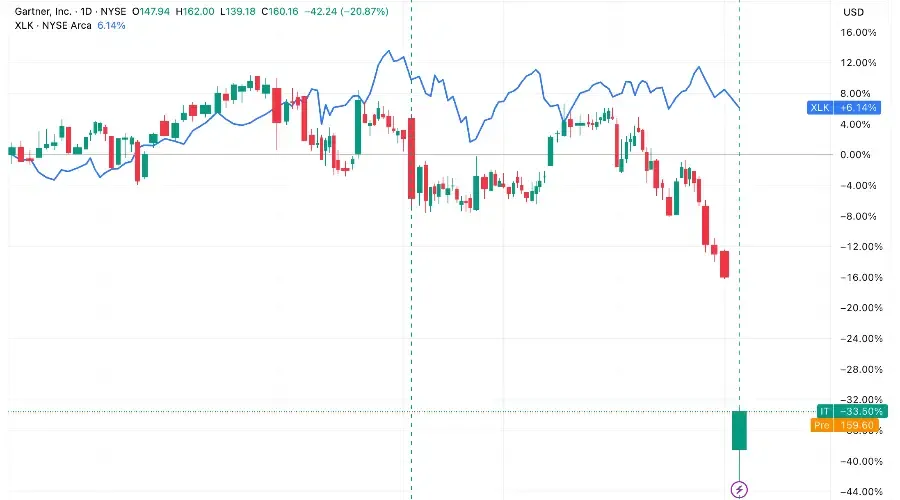
Gartner Plunges 20% on Weak 2026 Outlook; CIOs “Deferring Everything Possible”
Gartner erased nearly $15 billion in market value in a single session, collapsing 20.4% from $485 to $386.52. For anyone trading enterprise software, IT services, or tracking exposure to corporate technology budgets, February 2 delivered a clear signal: enterprise CIOs are pulling back aggressively on AI spending.
The company beat Q4 earnings by 12%, yet the stock imploded because 2026 guidance fell 9% short of consensus. When earnings beat but guidance collapses, markets are repricing future demand—not past execution. In this case, the message was blunt: CIOs are “slowing and deferring everything possible” on AI investments.
That phrase alone explains why software stocks are bleeding even as infrastructure-focused AI names like Palantir surge.
What Actually Happened
On February 2 at 4:30 PM ET, Gartner reported Q4 2025 adjusted EPS of $3.94, well above analyst expectations of $3.51-a clean 12% beat. The reaction turned instantly negative when management issued FY2026 guidance of $12.30 EPS and $6.455 billion in revenue, missing consensus estimates of $13.53 EPS and $6.7 billion in revenue by roughly 9% (NASDAQ).
This was not a marginal miss. It was a structural reset.
Management commentary on the earnings call delivered the key detail: enterprise CIOs are “slowing and deferring everything possible” amid uncertainty around AI investment returns. Gartner’s business model depends on CIO confidence. When CIOs freeze discretionary budgets, demand for research, advisory services, and consulting contracts evaporates.
The market response was swift and unforgiving. IT shares dropped 20.4% on 4.2 million shares of volume-285% above the daily average of 1.47 million. The put/call ratio spiked to 2.1 as institutions hedged enterprise software exposure. The stock closed at its lowest level since 2021, wiping out three years of gains in hours.
The damage did not remain isolated. Accenture fell 3.1%, Infosys dropped 2.8%, and Cognizant declined 2.4%, reflecting the same exposure to enterprise CIO budgets Gartner just flagged as frozen.
Why This Matters
The immediate loss to Gartner shareholders is obvious. The more important takeaway is what this reveals about enterprise AI adoption.
For traders watching technology broadly, Gartner’s warning was interpreted as a sector-wide signal. The Technology ETF (XLK) fell 1.6% despite only modest S&P 500 weakness of 0.84%. Analysts quickly extrapolated Gartner’s commentary to Microsoft, Salesforce, Oracle, and every vendor selling into corporate IT departments.
The underlying concern is not technology quality-it is ROI uncertainty. CFOs are increasingly unwilling to approve AI spending without measurable productivity gains. Until returns are quantifiable, enterprise budgets remain frozen.
The contrast with Palantir is instructive. On the same day Gartner collapsed, Palantir reported 70% revenue growth and surged after-hours. Both operate in “AI,” yet their revenue models face entirely different buyers. Palantir’s government contracts bypass ROI scrutiny altogether. Defense and intelligence agencies deploy AI on strategic necessity with locked, multi-year budgets. Gartner’s clients are enterprise CIOs who must justify every dollar with hard savings and efficiency metrics.
This bifurcation explains why capital is rotating within technology rather than exiting it entirely. Enterprise software names such as CRM, NOW, SNOW, and DDOG face the same headwind Gartner identified: if CIOs are deferring decisions, license growth slows. That dynamic drove the Software ETF (IGV) down 2.1% even as Palantir surged 8% after-hours.
What to Watch Next
Over the next 7-10 days, three developments will determine whether Gartner’s warning was isolated or systemic.
1. Salesforce earnings (mid–late February)
If Salesforce reports revenue growth below 10% and cites deal elongation or cautious IT spending, it confirms Gartner’s signal is sector-wide. That outcome would pressure enterprise SaaS valuations across NOW, WDAY, and VEEV. A 12%+ growth beat with strong AI commentary would suggest Gartner’s issue is specific to advisory services rather than core software demand.
2. Amazon AWS earnings (February 5 after-hours)
AWS growth above 25% would imply enterprises are still investing in foundational cloud infrastructure even while pausing application-layer AI spending. Growth below 20% would validate broad-based enterprise technology weakness. Infrastructure resilience versus application weakness is the key distinction.
3. Microsoft estimate revisions
Watch analyst cuts to Azure and enterprise software estimates following Gartner’s warning. Reductions from 30% growth expectations toward 25–27% would confirm the Street is repricing enterprise demand. Microsoft’s commercial cloud bookings remain a leading indicator for CIO confidence.
The Cross-Story Connection
Gartner’s collapse and Palantir’s surge are not contradictory—they represent opposite ends of the AI adoption spectrum.
Palantir benefits from government-backed demand where ROI scrutiny is irrelevant. Gartner suffers because its customers face CFO-driven decision paralysis. When AI timelines stretch from six months to 18–24 months and productivity gains remain qualitative, budgets freeze.
That explains why Palantir can guide 2026 revenue 14.5% above consensus while Gartner guides 9% below. One sells to strategic necessity. The other sells to discretionary enterprise budgets.
This divide defines the core AI trade of early 2026.
The Question Traders Should Ask
Is Gartner’s enterprise spending freeze a temporary pause, or a structural shift where only government-backed and operational AI use cases deliver measurable returns?
The answer comes with Q1 2026 earnings from Salesforce, ServiceNow, and Workday. Confirmation of deal elongation validates Gartner’s warning. Acceleration invalidates it.
Technically, support sits near $370. A hold could drive a 10–15% short-covering bounce given elevated short interest. A break below $370 on volume opens downside toward $325–340. Resistance now stands near $420, where the 20-day moving average has turned into overhead supply.
This analysis is for educational purposes only and is not investment advice. All trading involves risk. Verify all data independently and consult licensed professionals before making investment decisions.