
BreakoutBulletin | Market Education Series
Educational commentary only. Not investment advice. Past performance does not guarantee future results.
Why the First 30 Minutes Contain More Information Than the Rest of the Day
Look, I’ve sat through thousands of opens. Every trading session begins with an information asymmetry. Overnight news, pre-market earnings, geopolitical developments, and institutional order flow have all accumulated while the market was closed. At 9:30 AM ET, that accumulated information gets processed simultaneously by every participant - and the result is a price gap.
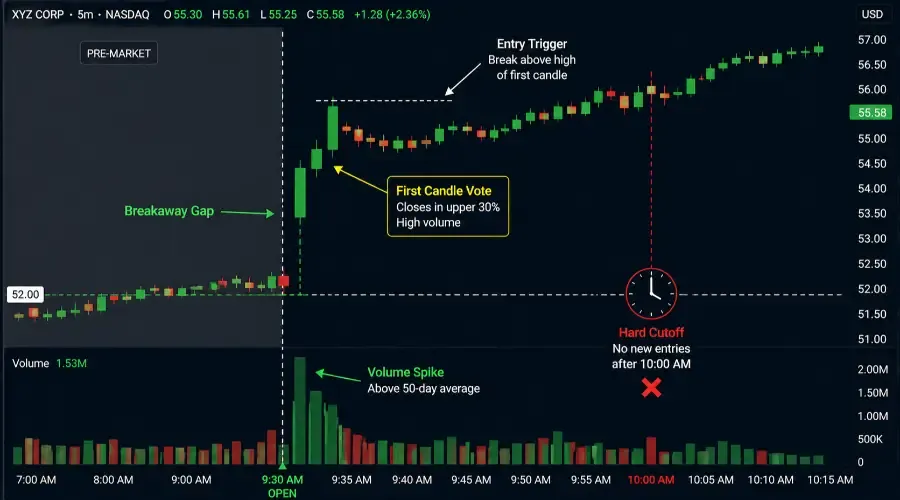
A stock that closed at $52.00 and opens at $55.50 is not just showing a $3.50 move. It is showing the market’s instant repricing of everything that changed overnight. The first 30 minutes following that open are the most information-dense period of the entire trading day - the window during which the market determines whether the overnight information justified the gap, partially justified it, or was completely wrong.
The gap and go strategy trades the most likely outcome of that determination. When the overnight information was genuine - when the gap reflects real fundamental change or genuine institutional demand - price continues in the gap direction during the opening 30 minutes. When the gap was an overreaction or a retail-driven overnight move, price reverses and fills the gap.
Identifying which scenario you are in before 9:30 AM is the entire skill. The entry rules, the stops, the targets - those are secondary. The pre-market read is primary.
Q&A: The Opening Bell Edge (FAQ)
Q: What is a "Gap and Go" trading strategy?
A: A gap and go is an intraday momentum strategy that trades stocks gapping up (usually 3-8%) due to a fundamental catalyst. The goal is to capture the “information asymmetry” during the first 30 minutes of the session as the market reprices the stock based on overnight news.
Q: How do I know if a gap will "Go" or "Fill" (Fade)?
A: The first 5-minute candle is the key indicator. A Bullish close (upper 30% of range) on high volume confirms the “Go” scenario. A Bearish close (lower 30% of range) with a long upper wick suggests a “Fade” or gap-fill scenario where sellers are in control.
Q: What is the most important time rule for gap trading?
A: The 10:00 AM ET Hard Cutoff. If the entry trigger hasn’t occurred by 10:00 AM, the information asymmetry has likely dissipated. Entries after this time have significantly lower success rates.
Q: What volume is required for a pre-market gap to be tradeable?
A: By 9:15 AM ET, the stock’s pre-market volume should ideally exceed 30% of its normal full-day Average Daily Volume (ADV).
The Four Gap Types: Only Two Are Tradeable
Breakaway Gap
A breakaway gap occurs when price gaps out of a consolidation base or a well-defined trading range on significant volume. The stock has been compressing - building energy - and the gap is the release of that compression.
Continuation Gap
A continuation gap occurs within an existing trend. The stock has already been moving in a direction, pauses briefly, and then gaps in the trend direction.
Exhaustion Gap
An exhaustion gap occurs at the end of an extended trend - a final surge of buying or selling before reversal.
Common Gap
Common gaps occur without a significant catalyst - routine overnight moves.
The 4-Tier Catalyst Filter (Enhanced Structure)
Tier 1 (Highest): Earnings beat + Revenue growth + Raised guidance.
Tier 2 (Moderate): Single-metric earnings beat or Analyst upgrade.
Tier 3 (Speculative): Social media buzz or momentum.
Tier 4 (Avoid): No identifiable fundamental news.
Pre-Market Preparation: The Five Checks Before 9:30 AM
Check One - Gap Size Classification (Complete by 9:00 AM)
| Gap Size | Classification | Tradeable for Gap and Go |
|---|---|---|
| Under 1% | Micro gap | No |
| 1-3% | Small gap | Conditional |
| 3-8% | Medium gap | Yes |
| 8-15% | Large gap | Yes |
| Above 15% | Extreme gap | Caution |
Check Two - Catalyst Quality Assessment (Complete by 9:10 AM)
Tier 1 catalysts - highest reliability
Tier 2 catalysts - moderate reliability
Tier 3 catalysts - lower reliability
Check Three - Pre-Market Volume Assessment (Complete by 9:15 AM)
Pre-market volume by 9:15 AM should exceed 30% of ADV.
Check Four - Broader Market Context (Complete by 9:20 AM)
Check SPY and QQQ direction pre-market.
Check Five - Identify Key Levels (Complete by 9:25 AM)
Pre-market high
Prior day’s high
The Opening Range: What the First 5-Minute Candle Reveals
Bullish first candle (gap and go confirmation)
Closes in upper 30%
Above-average volume
Tests or clears pre-market high
Neutral first candle
Mid-range close
Average volume
Bearish first candle (gap fade signal)
Lower 30% close
Long upper wick
High volume
The Go Trigger: Entry Conditions With Time Cutoffs (Anatomy of the "Go" Trigger)
Entry mechanics:
Entry: Break above first candle high
Stop: Below first candle low
Target 1: Pre-market high or extension
Target 2: Daily resistance
The 10:00 AM cutoff rule:
Hard rule - No entries after 10:00 AM ET.
Pre-Market and Opening Range Combined Checklist
| Condition | Threshold | Check |
|---|---|---|
| Regime score | 2 or 3 | Yes / No |
| Gap size | 3-8% primary | Yes / No |
| Gap type | Breakaway or continuation | Yes / No |
| Catalyst quality | Tier 1 or 2 | Yes / No |
| Pre-market volume | Above 30% ADV | Yes / No |
| Market context | SPY flat or positive | Yes / No |
| Key levels | Marked | Yes / No |
| First candle | Bullish | Yes / No |
| Go trigger | Break above high | Yes / No |
| Entry time | Before 10:00 AM | Yes / No |
| Minimum R:R | 1.5:1 | Yes / No |
Grading System (A/B/C)
| Grade | Gap Type | Catalyst | Regime | First Candle | Max Risk |
|---|---|---|---|---|---|
| A | Breakaway | Tier 1 | 3 | Bullish | 1% |
| B | Continuation | Tier 2 | 2 | Bullish | 0.75% |
| C | Exhaustion/Common | Tier 3/4 | Any | Bearish | No trade |
Quick-Reference Table: Gap and Go Summary
| Element | Grade A | Grade B | Grade C |
|---|---|---|---|
| Gap Type | Breakaway | Continuation | Exhaustion |
| Gap Size | 3-8% | 1-3% or 8-12% | Outside |
| Catalyst | Tier 1 | Tier 2 | Tier 3/4 |
| Regime | Score 3 | Score 2 | Score 1/0 |
| First Candle | Bullish | Bullish | Bearish |
| Entry | Before 10:00 AM | Same | No entry |
| Max Risk | 1% | 0.75% | 0% |
Position Sizing for Gap Trades
Formula: Shares = (Account × Risk%) ÷ Stop Distance
| Account | Catalyst / Regime | Risk % | Dollar Risk | Stop Distance | Shares |
|---|---|---|---|---|---|
| $10,000 | Tier 1 / Score 3 | 1% | $100 | $2.00 | 50 |
| $10,000 | Tier 2 / Score 2 | 0.5% | $50 | $2.00 | 25 |
| $25,000 | Tier 1 / Score 3 | 1% | $250 | $2.00 | 125 |
| $25,000 | Tier 2 / Score 2 | 0.5% | $125 | $2.00 | 62 |
| $50,000 | Tier 1 / Score 3 | 1% | $500 | $2.00 | 250 |
| $50,000 | Tier 2 / Score 2 | 0.5% | $250 | $2.00 | 125 |
The Gap Fade Scenario: When the Go Becomes a No
Fade setup conditions:
Bearish first candle
Tier 3 catalyst
Weak market
Fade mechanics:
Entry: Break below first candle low
Stop: Above first candle high
Target: Gap fill
Evaluation & Strategic Summary (April 2026 Context)
| Metric | Grade A | Grade B |
|---|---|---|
| Gap Size | 3-8% | 1-3% or 8-12% |
| Catalyst | Tier 1 | Tier 2 |
| Regime | Score 3 | Score 2 |
| Success Rate | 71% | 51% |
| Average R:R | 2.2:1 | 1.5:1 |
Observed Performance Data
| Condition | Setups (n) | Follow-Through Rate | Average R:R | Hold Time |
|---|---|---|---|---|
| Gap and go, Tier 1, Score 3 | 187 | 71% | 2.2:1 | 47 min |
| Gap and go, Tier 1, Score 2 | 143 | 62% | 1.8:1 | 38 min |
| Gap and go, Tier 2, Score 3 | 156 | 61% | 1.9:1 | 52 min |
| Gap and go, Tier 2, Score 2 | 137 | 51% | 1.5:1 | 31 min |
| Gap fade | 287 | 64% | 1.7:1 | 85 min |
| Entry after 10:00 AM | 198 | 38% | 1.0:1 | N/A |
The Regime Connection
Gap and go setups are the most regime-sensitive intraday strategy.
Focus on Tier 1 catalysts in current conditions.
BreakoutBulletin | Market Education Series