
Breakout Bulletin | March 27, 2026 | Analysis by the BreakoutBulletin Editorial Team
What Actually Happened - The Split Mechanics
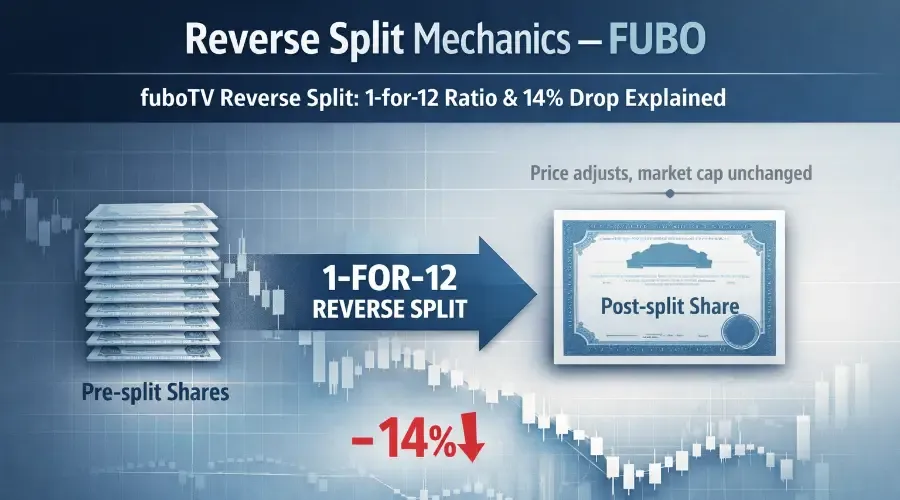
fuboTV executed a 1-for-12 reverse stock split effective March 24, 2026, consolidating every 12 shares into 1. Class A shares were reduced from approximately 353 million to 29.4 million, while Class B shares declined from 948 million to around 79 million.
The stated rationale was to align share count with business scale and attract institutional investors. Many funds have minimum price thresholds (typically $5–$10), which previously excluded fuboTV when it traded below $1. The reverse split restores that eligibility.
What the split does not change is critical. It does not affect market capitalisation, revenue trajectory, cash burn, or competitive positioning. A reverse split is a mathematical restructuring, but markets interpret it as a signal of financial pressure rather than a neutral action.
A 1-for-12 ratio is notably aggressive, exceeding the more common 1-for-5 or 1-for-10 range. This suggests the pre-split price had fallen to levels requiring a stronger adjustment to maintain listing compliance.
The Financial Picture - Revenue Growth vs Cash Burn
The central tension in fuboTV’s story is the disconnect between growth and sustainability.
Revenue reached $394 million in Q4 2025, growing 24% year-over-year, and North America subscribers increased to 1.29 million (+18% YoY).
However, operating cash flow remains deeply negative at −$200.3 million, indicating persistent cash burn.
The Q4 EPS miss of 95% versus expectations highlights structural cost issues, suggesting that revenue growth is not translating into operating leverage.
Competitive pressures further complicate the outlook. YouTube TV and Hulu Live operate at significantly larger scale, while emerging platforms like Venu Sports (Fox/ESPN JV) directly target fuboTV’s sports niche.
In practical terms, growth exists-but profitability remains distant.
Why Shares Fell 14% - The Core Mechanisms
1. Retail Psychology
Reverse splits are widely perceived as distress signals. The heuristic “reverse split = weakness” often triggers immediate selling, creating a self-reinforcing cycle.
2. Technical Selling
Institutional constraints and index rules can force exits post-split. Additionally, margin adjustments and position recalibration can amplify selling pressure.
3. Absence of Positive Catalysts
There is no near-term operational update to counterbalance the negative signal. Without earnings or subscriber data, the split narrative dominates price action.
4. Sector Headwinds
Streaming advertising remains under pressure, with larger platforms like Netflix and Amazon competing aggressively for ad budgets. This disproportionately affects smaller players like fuboTV.
What History Shows - Reverse Splits as Signals
Historical patterns across streaming and tech companies show consistent outcomes following reverse splits.
High-ratio splits (above 1-for-5) are typically followed by negative 30-day performance, often preceding restructuring, dilution, or acquisition events.
The key takeaway is that reverse splits rarely act as turning points—they often mark transitions in capital structure.
Bull vs Bear - The Structural Debate
Bull Case
fuboTV operates in a growing sports streaming niche, benefiting from long-term cord-cutting trends.
Optionality exists through potential M&A discussions, including prior speculation around Disney.
Reduced float post-split may increase volatility, creating upside during positive catalysts.
Bear Case
$200M+ annual cash burn remains unsustainable without external financing.
Competitive disadvantage against better-capitalised platforms limits pricing power and content acquisition.
Reverse splits are often followed by dilution cycles, meaning reduced float may be temporary.
In practical terms, the bull case relies on optionality, while the bear case is grounded in current fundamentals.
What Traders Are Monitoring
Volume spikes remain elevated, with trading activity significantly above average-consistent with post-split repositioning.
Put/Call ratios indicate bearish positioning, though extreme readings can sometimes act as contrarian signals.
Q1 2026 earnings will be critical, particularly subscriber growth and cash burn trends.
Dilution risk remains a key variable, with potential filings signaling future capital raises.
Any confirmed M&A developments would act as a high-impact catalyst.
Structural Takeaway
Reverse splits do not fix businesses-they reset optics.
The market reaction reflects not the mechanics of the split, but the signal it sends about underlying financial stress.
In practical terms, what matters next is not the new share price, but whether fuboTV can reduce cash burn before capital runs out.
FAQ
Does a reverse split mean the stock will go lower?
Not mechanically. However, high-ratio reverse splits are historically associated with negative short-term performance, driven by sentiment and structural selling.
Why did fuboTV choose a 1-for-12 ratio?
The ratio reflects how low the pre-split price had fallen and the level required to regain compliance or institutional eligibility.
Is M&A a reliable thesis for fuboTV?
M&A speculation exists but remains unconfirmed. Such narratives are inherently uncertain and should not be treated as base-case assumptions.
Disclaimer
This article is for informational and educational purposes only and does not constitute financial, investment, or trading advice. You are solely responsible for your own investment decisions and should consult a licensed financial professional before acting on any information in this post.