
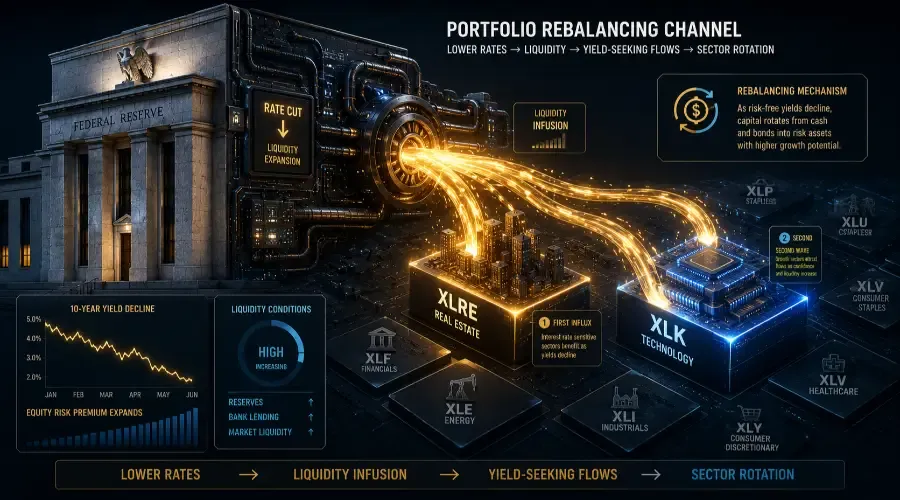
Why It Matters: Mechanical, Not Psychological
Most commentary treats QE rallies as confidence-driven. They are primarily structural. The CBO's balance sheet researchconfirmed that QE lowers long-term rates by removing duration supply – an arithmetic consequence, not a sentiment effect. That said, successive QE rounds have historically produced diminishing returns: QE2 was less potent than QE1; QE3's marginal impact was more modest still. Effectiveness depends on the starting level of rates and risk premia – when yields are already near zero, the yield compression channel has less room to operate.
Sequential Regime Cheat Sheet
| Policy Phase / Trigger | Transmission Channel | Immediate Sector Impact | Tactical Trading Rule |
|---|---|---|---|
| Stage 1: Rate Cuts Exhausted | Policy approaching Effective Lower Bound; alternative tools prepared | Broad equity consolidation; yields floor out | Accumulate defensive cash/yield; monitor FOMC minutes for "accommodation tools" language |
| Stage 2: Balance Sheet Language | Expected discount rate multiple expansion; yield curve flattens | XLRE & XLU begin outperforming | Front-run the announcement: begin scaling into Real Estate and Utilities |
| Stage 3: QE Announcement | Safe-haven supply removal; mechanical liquidity injection | XLK acceleration within 1 quarter | Shift capital to high-beta growth; overweight Technology as multiples expand |
| Stage 4: Sustained Purchases | Dollar weakness channel; global portfolio rebalancing activates | XLB & XLE rotation within 2 quarters | Rotate late-cycle gains into Materials and Energy to capture commodity lift |
The Four Transmission Channels
Channel 1 – Yield Compression: Fed Treasury purchases remove supply, push prices up, and compress yields arithmetically. Lower 10-year yields reduce the discount rate on all future corporate cash flows – expanding equity multiples.
Channel 2 – MBS and Mortgage Rate (XLRE-Specific): When the Fed purchases mortgage-backed securities, it compresses the primary-secondary mortgage spread – the gap between what borrowers pay on new mortgages and what MBS investors receive. This direct intervention drives down capitalisation rates and instantly boosts real estate asset valuations, explaining structurally why XLRE moves before XLK in every QE cycle. This channel is unique to QE and does not activate through Fed funds rate cuts alone.
Channel 3 – Portfolio Rebalancing: Institutions that sold bonds to the Fed receive cash that must be redeployed. With Treasury yields now lower, they move out the risk curve into equities, REITs, and credit. This is mechanical forced buying – the CBO identified it as the primary equity market transmission mechanism.
Channel 4 – Dollar Weakness: QE floods global markets with dollar liquidity, compressing the US-foreign yield differential and weakening DXY. Because industrial commodities are priced in USD, a weaker dollar makes them cheaper for foreign buyers – lifting XLB and XLE revenues. This channel activates latest, typically within two quarters of the initial announcement.
Sector Scorecard
All ranges are illustrative historical central tendencies – not reliable point forecasts. The 2020 QE was paired with unprecedented fiscal stimulus and a pandemic-driven technology boom; attributing all sector gains solely to QE overstates the transmission. Magnitude depends on programme size, economic context, and pre-announcement pricing.
Real Estate (XLRE) – Strong Positive – Immediate
The MBS channel activates before the federal funds rate moves. XLRE is the fastest responder because falling mortgage rates and capitalisation rate compression are direct consequences of MBS purchases, not indirect rate expectations. Historically XLRE has outperformed meaningfully in the twelve months following major QE announcements (e.g., 15–25% in the COVID cycle), though this range should be treated as illustrative, not a forecast.
Utilities (XLU) – Strong Positive – Immediate
Bond proxy repricing and defensive rotation both activate on the announcement. XLU benefits from yield compression and from the portfolio rebalancing channel as income investors seek yield in utility dividends.
Technology (XLK) – Strong Positive – 1 Quarter Lag
Long-duration growth stock multiples expand as discount rates fall – but this takes one quarter as corporate earnings models are recalculated across Wall Street. In the 2020 cycle, XLK gained over 40%; in less expansive QE programmes the gain was more modest. A surprise QE announcement produces faster repricing than a fully telegraphed one where the market has already front-run the move.
Financials (XLF) – Mixed – Split Within the Sector
Net interest margin compression hurts money-center banks; rising asset prices and trading volumes benefit brokers and asset managers. The more precise trade within XLF: underweight money-center banks, overweight brokers and asset managers. ETF-level XLF is approximately neutral – the distinction matters for individual position construction.
Materials (XLB) and Energy (XLE) – Moderate Positive – 2 Quarter Lag
The dollar weakness channel activates latest. XLB copper miners and XLE producers see revenue lift as dollar softens and commodity prices rise in USD terms. Size these positions for a six-to-twelve-month horizon from the announcement.
Consumer Staples (XLP) – Mild Positive / Relative Underperformer
Benefits from the general market lift but underperforms cyclical sectors in a QE environment as defensive premium is no longer valued when risk appetite is high.
Risks and Limitations
QE is not unambiguously positive. Three risks that every QE trade must acknowledge:
Asset bubbles:
QE inflates asset prices, which eventually unwind – housing post-QE1 corrected; the 2022 tech selloff followed directly from COVID QE's multiple expansion. The sectors that benefit most during QE face the largest corrections when tightening begins.
Inflationary consequences:
Persistent QE can produce inflation that forces aggressive tightening, hurting the exact sectors – XLRE, XLU, XLK – that benefited most. The 2022 rate hiking cycle was the direct consequence of COVID QE.
Diminishing returns:
Each successive QE round has historically produced smaller equity market responses. If rates are already near zero when QE is announced, the yield compression channel has limited room to operate.
Historical Cases
QE1 (November 2008 – March 2010):
The first-ever QE. S&P 500 bottomed March 2009 – four months after announcement – and rallied over 60% by year-end 2009. XLRE led as mortgage rates fell from the MBS channel. Most potent QE in history because risk premia and yields had maximum room to compress.
COVID QE (March 2020 – March 2022):
$120 billion monthly. S&P 500 bottomed eight days after the emergency announcement – the fastest bear market recovery in history. XLK gained 40%+ in 2020. XLRE surged as mortgage rates reached historic lows. Caveat: unprecedented fiscal stimulus, direct payments, and pandemic-driven tech adoption amplified QE's sector effects beyond what the monetary channel alone would have produced.
Playbook
Before:
Monitor FOMC minutes for "asset purchases" or "balance sheet tools" language – Stage 2 of the regime table is the optimal positioning window, one to two meetings before the formal announcement.
Surprise QE:
Buy XLRE and XLU immediately – these channels activate fastest and the announcement-day trade is the largest. Move to XLK within one quarter.
Telegraphed QE:
The announcement-day trade is smaller – the market has already front-run it. Watch for a post-announcement dip as "buy the rumour, sell the news" dynamics play out; use the dip as the entry.
Exit signal:
First FOMC minutes referencing tapering language. Reduce XLRE and XLU; the tapering regime is the mirror rotation.
Bottom Line Checklist
XLRE and XLU move first – MBS channel activates before federal funds rate moves
XLK follows within one quarter as discount rate models are recalculated
XLB and XLE rotate in within two quarters via dollar weakness channel
Within XLF: long brokers/asset managers, not money-center banks
Surprise QE: buy immediately · Telegraphed QE: wait for post-announcement dip
Acknowledge diminishing returns – QE2 < QE1; COVID QE included fiscal amplifiers
Exit trigger: first FOMC tapering language – not calendar-based
Q&A
Q: Why is the QE stock market rally mechanical rather than just psychological?
A: QE drives prices up through the portfolio rebalancing channel. When the Fed purchases hundreds of billions in Treasuries and MBS from institutional balance sheets, it strips the private sector of safe yield-bearing assets. Left with cash that earns minimal returns, commercial banks, pension funds, and asset managers are mechanically forced to redeploy into higher-yielding assets – equities, real estate, and credit – to maintain their return mandates.
Q: Why do XLRE and XLU outperform XLK immediately after a QE announcement?
A: Real Estate and Utilities respond instantly through the yield compression and MBS channels. These sectors are bond proxies – highly sensitive to the immediate drop in the risk-free discount rate. The Fed's MBS purchases specifically compress the primary-secondary mortgage spread, driving down capitalisation rates and instantly boosting real estate valuations. Technology requires one additional quarter as corporate earnings models are recalculated across Wall Street to reflect the new discount rate.
Q: How does dollar weakness during sustained QE lift Materials (XLB) and Energy (XLE)?
A: The dollar weakness channel activates within two quarters as the Fed floods global markets with dollar liquidity, compressing the US-foreign yield differential and weakening DXY. Because global industrial commodities are priced in USD, a weaker dollar makes them cheaper for foreign buyers, lifting global demand and the corporate revenues of XLB and XLE companies.
Educational content only. Not investment advice. All sector performance ranges are illustrative historical central tendencies – magnitude varies significantly across QE episodes based on programme size, economic context, and pre-announcement market pricing.