
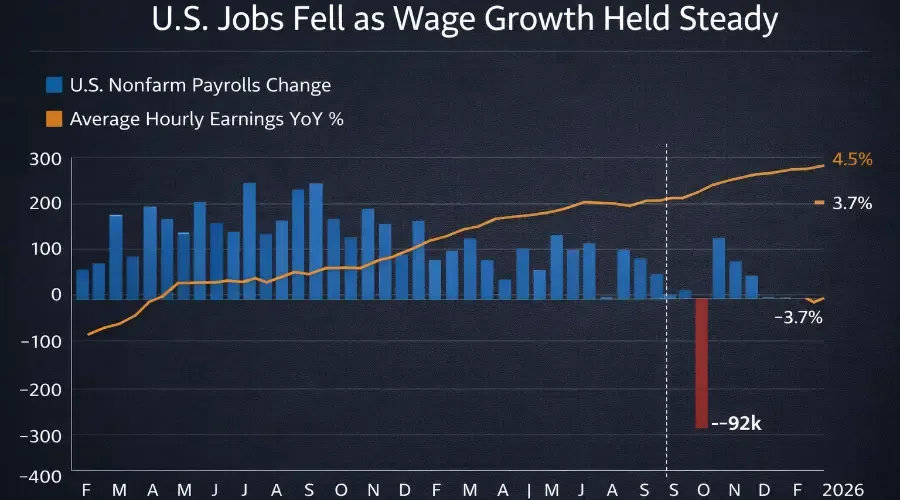
The February jobs report delivered what no economist predicted: an actual decline in payrolls. Nonfarm payrolls fell by 92,000, a dramatic miss against the 50,000 gain forecasters had expected. It was the third time in five months the economy has lost jobs.
But the real story isn't just the drop—it's what happened to wages. Average hourly earnings rose 0.4% for the month and 3.8% from a year ago, both 0.1 percentage points above estimates.
That combination—a contracting labor market with persistent wage pressures—creates a complex policy dilemma the Federal Reserve hasn't faced in years.
What the February Jobs Report Actually Showed
The headline numbers tell a stark story. Nonfarm payrolls declined by 92,000 jobs, following a downwardly revised gain of 126,000 in January. The unemployment rate ticked up to 4.4% , continuing its gradual upward drift.
Private payrolls accounted for nearly the entire decline, falling sharply. But within that number, temporary factors played a significant role.
The Bureau of Labor Statistics noted that a strike at Kaiser Permanente sidelined more than 30,000 workers in Hawaii and California during the survey week, subtracting 28,000 jobs from the health care sector alone. Severe winter weather also disrupted payroll counts in other industries.
Jefferies economist Thomas Simons called the February drop "a perfect storm of temporary drags coming together." But he added a crucial warning: "Looking through the weather-impacted sectors and the strike, this is still a poor jobs number. The risk of a downturn has certainly increased."
Why the Sector Breakdown Matters
Beyond the headline, sector-level data reveals where weakness is concentrated.
Manufacturing lost 12,000 jobs, despite ongoing tariff policies aimed at reshoring production. Information services, a sector increasingly affected by AI-related restructuring, declined by 11,000 as part of a 12-month trend averaging 5,000 losses per month.
Federal government employment fell by 10,000, continuing a slide that has seen 330,000 jobs—roughly 11% of the total federal workforce—eliminated since October 2024.
Transportation and warehousing also declined by 11,000. Social assistance was one of the few sectors posting a gain, up 9,000.
The household survey, used to calculate the unemployment rate, painted an even weaker picture. It showed a drop of 185,000 in those reporting at work and a rise of 203,000 in the unemployed level. The labor force participation rate edged lower to 62% , its lowest since December 2021.
The Stagflation Signal
This report sends a conflicting message. Hiring slowed sharply, yet wage growth remained firm.
Under normal circumstances, weak payrolls would strengthen the case for rate cuts. But wage pressures are closely linked to inflation, and persistent increases here suggest price pressures haven't been fully contained.
Mary Daly, president of the Federal Reserve Bank of San Francisco, captured the dilemma precisely: "We also have inflation printing above target and oil prices rising... both of our goals are in our risks now."
This combination—weaker employment alongside persistent wage growth—resembles the early characteristics of stagflation, where economic growth softens but inflation pressures remain.
Why This Matters for the Federal Reserve
The Fed's dual mandate requires balancing maximum employment against stable prices. The February report complicates both sides.
Following the release, traders pulled forward expectations for the next rate cut to July and priced in a greater chance of two cuts before year-end, according to CME Group's FedWatch gauge.
Fed Governor Christopher Waller, a minority voice pushing for cuts, signaled the data could shift policy. "If we get a bad number... the question is, why are you just sitting on your hands?" Waller told Bloomberg News.
The next FOMC meeting arrives March 17-18 with a far more complicated backdrop than expected just weeks ago.
What This Report Does-And Doesn't-Change
Despite the surprising headline, a single month rarely establishes a definitive trend. Daly cautioned, "I don't think you can look through this report, but I also don't think you should make more of it than one month of data."
Future payroll releases will clarify whether February represents a temporary fluctuation or the beginning of a broader shift.
But one thing is clear. The combination of falling payrolls, rising wages, and elevated oil prices creates a policy environment where the old rules no longer apply.
BreakoutBulletin | Economic Intelligence | March 7, 2026
Educational commentary only. Not investment advice. All data sourced from the Bureau of Labor Statistics and CNBC. No content constitutes a recommendation to buy or sell any security.