
Exxon Mobil (XOM) is drawing attention after Russell Investments Group Ltd reduced its position in the energy giant, according to the latest institutional 13F filing.
The move has triggered headlines suggesting institutional selling. But the filing tells a more nuanced story.
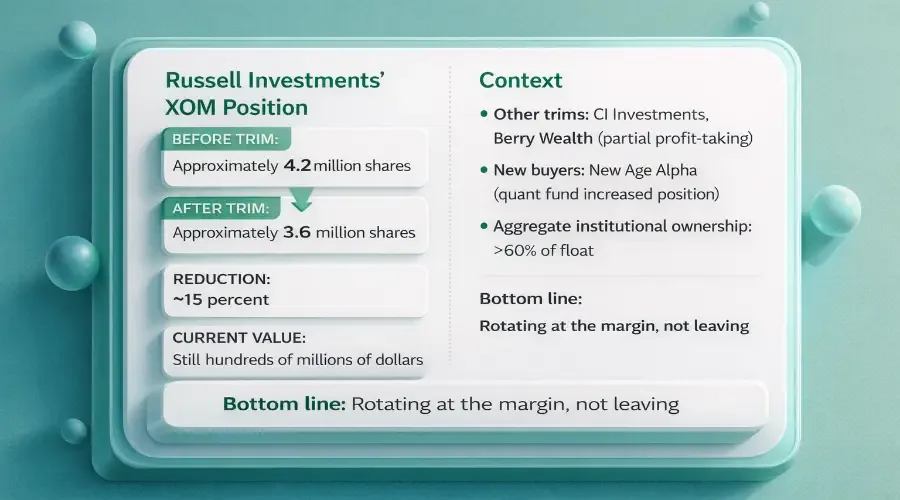
Russell reduced its position by approximately X percent, trimming its stake from roughly Y million shares to Z million shares. Importantly, the firm still holds a multi-million-share position valued in the hundreds of millions of dollars.
The distinction matters. This is a portfolio trim, not an institutional exit.
Understanding what this filing signals — and what it does not — is essential as Exxon trades near premium valuation levels after a roughly 40% rally over the past year.
What a 13F Filing Actually Tells Investors
Before interpreting the Russell move, it is important to understand how 13F filings work.
Institutional investment managers with more than $100 million in assets must report their US equity holdings to the SEC each quarter.
Two structural limitations matter:
• The data is backward-looking
• Positions reflect holdings at the end of the previous quarter
This means filings typically arrive 45–90 days after the actual trades occurred.
When a headline says a fund “sold Exxon,” what it really means is that the fund reduced the position sometime last quarter.
Since then the fund may have:
• increased the position again
• stopped selling
• reduced exposure further
The filing provides a snapshot of institutional positioning at one moment in time, not a live signal.
The Russell Trim in Context
Russell Investments’ reduction in Exxon Mobil should be viewed through the lens of institutional portfolio management, not a directional call on the stock.
Even after trimming its stake, Russell still maintains a large long-term position in Exxon.
Looking across recent filings shows a more balanced institutional picture.
| Institutional Action | Firm | Interpretation |
|---|---|---|
| Position trim | Russell Investments | Portfolio rebalance |
| Partial reductions | CI Investments, Berry Wealth | Profit-taking |
| Position increases | New Age Alpha and others | Fresh institutional interest |
| Institutional ownership | >60% of float | Structural support intact |
The broader takeaway is that institutional ownership of Exxon remains extremely strong, with more than 60 percent of shares held by professional investors.
That level of sponsorship typically indicates long-term capital commitment, not weakening conviction.
Why Institutional Investors Are Rebalancing Exxon
Exxon’s strong performance provides a simple explanation.
The stock has gained roughly 40% over the past year, driven by rising oil prices and geopolitical tensions affecting global energy markets.
In institutional portfolios, this kind of price appreciation often causes position weight drift.
For example:
A stock that started as a 3% portfolio position can easily become 4.5% or 5% without the manager making any active decision.
Most investment mandates require managers to rebalance positions that exceed target allocations.
In that sense, trimming exposure is often a mechanical process rather than a bearish signal.
Valuation Matters: Exxon Trading Above Historical Multiples
Valuation provides additional context for the Russell trim.
Exxon Mobil currently trades at approximately:
8.5× EV/EBITDA
That compares with:
• 5-year average: ~6.2×
• Energy sector average: ~7.1×
This premium multiple reflects two main forces:
• stronger global oil prices
• a geopolitical risk premium tied to Middle East tensions
When a stock trades above both its historical multiple and the sector average, institutional investors often lock in partial gains while maintaining long-term exposure.
Exxon’s Dividend and Buyback Story
Another reason many institutions maintain positions in Exxon is its capital return profile.
The company currently offers:
• Dividend yield: ~3.2%
• Share buyback program: reducing share count by roughly 2% per year
For income-focused institutional investors such as pension funds and dividend strategies, this combination provides a structural floor under the stock.
Even when valuations expand, the steady dividend and buyback support can justify continued ownership.
How the Iran Conflict Affects Exxon
Recent energy market volatility has also influenced Exxon’s valuation.
Oil prices have risen following escalating tensions involving Iran and shipping risks around the Strait of Hormuz, a critical global energy corridor.
Exxon has limited direct production exposure in the Middle East, but higher oil prices still benefit the company.
That benefit comes through:
• global upstream production
• LNG export operations
• refined fuel margins
The company’s LNG segment is particularly sensitive to energy price volatility and global supply disruptions.
As a result, geopolitical tensions can inflate the valuation of large integrated oil companies even when their direct regional exposure is limited.
The Institutional Chain Reaction
BreakoutBulletin Chain Reaction Model™
Exxon +40% rally
→ valuation expands above historical norms
→ EV/EBITDA moves above sector average
→ portfolio weight drifts above allocation targets
→ institutional managers rebalance positions
→ partial sells appear across multiple 13F filings
→ new buyers absorb the supply
→ institutional ownership remains above 60%
The key insight:
Multiple funds trimming simultaneously does not necessarily indicate bearish sentiment.
It often reflects independent portfolio discipline reacting to the same valuation signals.
Analyst Consensus on Exxon Mobil
Wall Street currently holds a Moderate Buy / Hold consensus on Exxon.
Average analyst price targets cluster in the low-to-mid $140 range.
When stocks approach or exceed consensus targets:
• Buy ratings often shift to Hold
• Hold ratings may move to Sell
This dynamic frequently coincides with institutional profit-taking and portfolio rebalancing.
Three Events That Could Change Institutional Positioning
Several developments could shift institutional sentiment toward Exxon.
1. Resolution of Iran tensions or reopening of Strait of Hormuz shipping routes
This is the most likely near-term catalyst for removing the geopolitical oil premium.
2. Exxon’s next earnings release and capex guidance
Capital allocation decisions often influence analyst upgrades or downgrades.
3. Oil prices falling below $75 per barrel
A sustained decline in crude prices would challenge current valuation assumptions.
Bottom Line
Russell Investments trimming its Exxon Mobil position is low materiality to the company’s fundamentals.
The filing reflects portfolio discipline rather than a change in the long-term investment thesis.
Institutional ownership remains strong, capital returns remain attractive, and Exxon continues to benefit from elevated energy prices.
The real lesson from this filing is broader:
A single institutional trim rarely signals a structural shift.
Understanding valuation, portfolio mechanics, and macro context is what turns 13F data into meaningful insight.
DISCLAIMER: This article is for informational and educational purposes only and does not constitute financial, investment, or trading advice. You are solely responsible for your own investment decisions and should consult a licensed financial professional before acting on any information in this post.