
BreakoutBulletin | Advanced Trading Education
Educational commentary only. Not investment advice. Past performance does not guarantee future results.
Start Here If…
You want a complete Elliott Wave trading course that moves step by step from basic structure to live exit signals.
You’ve read Elliott Wave explained elsewhere but never found a system that turns labels into actual trades.
You’re looking for the best Elliott Wave strategy for beginners – one that starts with rules, not patterns.
You need Elliott Wave traps explained (both the B-Wave and X-Wave failure modes) so you stop getting caught in false breakouts.
This nine-post series is designed as a single, coherent trading system. Below you’ll find the full reading order, common questions, and the three non-negotiable rules that hold the whole framework together.
About This Series
Most Elliott Wave educational content teaches wave labelling after the fact – a system that explains prior price action eloquently but produces no actionable entries or exits in real time. This series is built on a different premise: Elliott Wave is a trading tool, not a retrospective analytical exercise.
Every post answers one question: what specific, measurable action does this wave concept produce? The result is a complete Elliott Wave trading system with examples (included throughout the series) that you can follow candle-by-candle. By the time you finish, you’ll know exactly how to trade Elliott Wave step by step – entry, stop, target, and exit – without guessing.
The series builds in sequence. First-time readers should follow the reading order below. Experienced traders can jump directly to specific setups using the index.
How This Series Fits the BreakoutBulletin Architecture
The Elliott Wave series is the cornerstone of the Advanced cluster. It connects directly to:
Structure cluster: Prerequisite reading on HH/HL and LH/LL. Impulse waves produce HH/HL sequences; corrective waves produce LH/LL or ranging structures. Master market structure first, and Elliott Wave comprehension accelerates.
Classic cluster: Wave 3 entries use the same volume confirmation standards as Classic breakout setups (40%+ above 50-day average). The cup and handle base often forms at the Wave 4 correction low – Classic traders spot the pattern, Elliott Wave traders identify the wave position.
Power Momentum framework: Wave 3 entries are the highest-conviction setups. When they score Grade A, the four-factor scoring system applies, typically producing 6-8 on the conviction scale.
The Reading Path
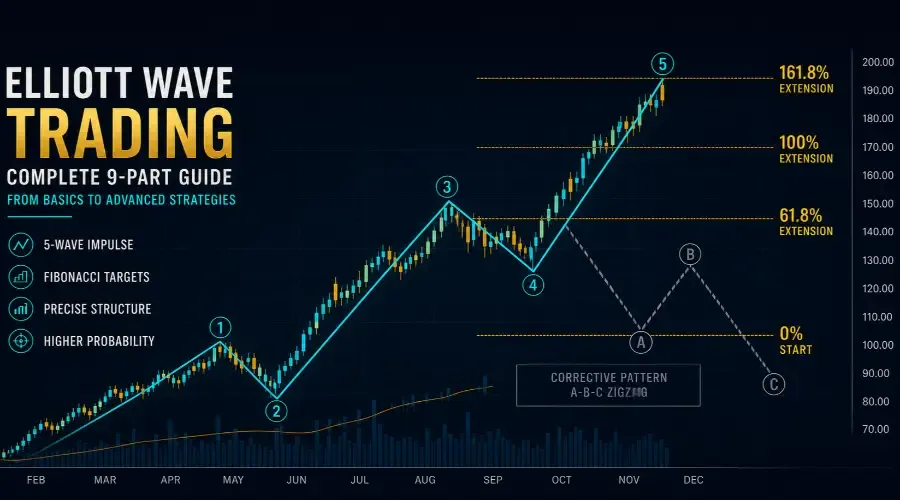
Post 1 – Elliott Wave Trading: Complete Guide from Basics to Advanced Strategy
The entry point for the entire Elliott Wave trading course. Covers the five-wave impulse structure, three-wave corrective structure, multi-timeframe relationships, and all foundational vocabulary. Read this first – the BreakoutBulletin Elliott Wave vocabulary is established here and referenced in every subsequent post.
Best for: Traders new to Elliott Wave or those looking for a clear, structured Elliott Wave trading explained approach.
→ Read Post 1: Elliott Wave Complete Guide
Post 2 – Elliott Wave Rules vs. Guidelines: Building a Structural Validation Framework
The single most important post for traders who’ve found Elliott Wave subjective. The distinction between absolute rules and probabilistic guidelines eliminates false counts before they cost money. Covers the three non-negotiable Elliott Wave rules and guidelines: Wave 2 retracement limit, Wave 3 length minimum, and Wave 4 overlap prohibition.
Best for: Anyone who needs a clear Elliott Wave rules and guidelines filter before risking capital.
→ Read Post 2: Elliott Wave Rules vs. Guidelines
Post 3 – Elliott Wave Motive Wave Strategy: How to Identify Wave 3 and Set High-Probability Targets
The highest-probability entry in the Elliott Wave sequence. This post teaches you how to identify Wave 3 in trading – confirming Wave 2 completion, distinguishing a true impulse from a Wave B bounce, and setting the 161.8% Fibonacci target.
Best for: Traders who want a reliable wave 3 trading strategy with clear identification criteria.
→ Read Post 3: Elliott Wave Motive Wave Strategy
Post 4 – Wave 3 Entry Setup: Entry, Stop Loss, and Fibonacci Target Explained
The execution companion to Post 3. Covers specific entry triggers, stop placement at the Wave 2 low, target calculation, and position sizing. This post completes the Elliott Wave entry and exit mechanics for the highest-conviction setup.
Best for: Traders ready to move from “I see Wave 3” to “I entered, managed, and exited Wave 3.”
→ Read Post 4: Wave 3 Entry Setup
Post 5 – Elliott Wave Fibonacci Targets: Complete Guide to Wave 3, 4 and 5 Price Levels
The complete target framework for the five-wave impulse. Provides specific Fibonacci extension ratios, tolerance bands, and scale-out rules. If you’ve been searching for Elliott Wave Fibonacci levels explained with concrete numbers rather than theory, this is it.
Best for: Active traders who need precise Elliott Wave Fibonacci targets to manage open positions.
→ Read Post 5: Elliott Wave Fibonacci Targets
Post 6 – Elliott Wave Corrective Waves: Zigzag, Flat Patterns and Wave C Targets Explained
The A-B-C correction framework. Covers Zigzag and Flat corrective wave patterns, and how to calculate Wave C termination for the next impulse entry. Connects directly to the Classic pullback strategy – the entry level is often the same.
Best for: Traders navigating Wave 4 corrections who need to know exactly when the correction ends.
→ Read Post 6: Elliott Wave Corrective Waves
Post 7 – The B-Wave Trap: Identifying False Breakouts in Elliott Wave Structures
The post that explains the most common losing pattern in Elliott Wave trading. The B-Wave trap – mistaking a corrective bounce for a new impulse – is the primary reason retail traders get stopped out. This post gives you a checklist to avoid false breakouts in trading and identify Elliott Wave traps (B wave, X wave) in real time.
Best for: Any trader who’s entered a “breakout” only to watch it reverse immediately.
→ Read Post 7: The B-Wave Trap
Post 8 – The X Wave Trap: How to Master Complex Elliott Wave Corrections and Spot the Wave 5 Breakout
The advanced trap post. Complex corrections (Double Zigzag, Double Three) contain X waves that mimic new impulses – the expert-level extension of the B-Wave problem. The post ends with a Wave 5 breakout identification methodology, completing the full cycle.
Best for: Experienced traders facing multi-month corrections that refuse to resolve cleanly.
→ Read Post 8: The X Wave Trap
Post 9 – Elliott Wave Divergence Strategy: How RSI and Volume Confirm Wave 5 Reversals
The exit framework for the whole cycle. Uses momentum confirmation RSI divergence and volume deceleration to signal Wave 5 termination. This Wave 5 divergence strategy is the most reliable exit signal in the entire Elliott Wave toolkit.
Best for: Traders holding positions from Wave 3 or 5 entries who need objective exit signals.
→ Read Post 9: Elliott Wave Divergence Strategy
The Complete Series at a Glance
1 – Complete Guide
Core Concept → Five-wave impulse + three-wave correction
Primary Action → Understand the full cycle
2 – Rules vs Guidelines
Core Concept → Three non-negotiable validation rules
Primary Action → Eliminate invalid counts
3 – Motive Wave Strategy
Core Concept → Wave 3 identification
Primary Action → Identify the entry zone
4 – Wave 3 Entry Setup
Core Concept → Entry, stop, target mechanics
Primary Action → Execute the entry
5 – Fibonacci Targets
Core Concept → Wave 3, 4, 5 price levels
Primary Action → Set and manage targets
6 – Corrective Waves
Core Concept → Zigzag, Flat, Wave C completion
Primary Action → Identify correction end
7 – B-Wave Trap
Core Concept → False breakout identification
Primary Action → Avoid the primary failure mode
8 – X Wave Trap
Core Concept → Complex corrections + Wave 5 breakout
Primary Action → Navigate advanced corrections
9 – Divergence Strategy
Core Concept → RSI + volume Wave 5 exit
Primary Action → Exit the complete cycle
Quick Reference: The Three Non-Negotiable Rules
From Post 2 – apply these before any trade. A count that violates any rule is invalid.
Wave 2 cannot retrace more than 100% of Wave 1.
Wave 3 cannot be the shortest impulse wave (among Waves 1, 3, 5).
Wave 4 cannot overlap Wave 1 in price.
Where to Go After This Series
Fibonacci Retracement Levels – identical ratios, deeper pullback entries.
Harmonic Patterns – ratio structures that often complete at Elliott Wave correction lows.
Order Flow Analysis – real-time volume delta signals that confirm Wave 3 initiation and expose B-Wave traps.
Market Profile – volume distribution showing how Wave 2 and 4 corrections often end at prior Points of Control.
Explore the full Advanced Trading Setups Hub or the Trading Setups and Patterns Master Guide.
Frequently Asked Questions (Elliott Wave Trading)
What is Elliott Wave Theory in trading?
Elliott Wave Theory explains market movements as repeating cycles of 5-wave impulses and 3-wave corrections, driven by crowd psychology. It’s used to identify trend direction, entry points, and reversal zones – exactly what this Elliott Wave trading course teaches you to act on.
Is Elliott Wave good for beginners?
Yes, when learned in sequence. The best Elliott Wave strategy for beginners starts with the basics: five-wave plus three-wave structure, the three non-negotiable rules, and market structure (HH/HL and LH/LL). Jumping straight into complex corrections causes confusion.
What is the most profitable Elliott Wave setup?
The wave 3 trading strategy is the most reliable because it has the strongest momentum, highest institutional participation, and most consistent Fibonacci targets. Many professionals build their entire approach around how to identify wave 3 in trading.
How do you identify Wave 3 in trading?
Wave 3 typically breaks above Wave 1 high with strong volume, shows price acceleration, and later validates with no overlap into Wave 4. Volume confirmation trading and momentum confirmation RSI divergence (or lack of divergence) help confirm a clean Wave 3.
What are the 3 rules of Elliott Wave?
The three non-negotiable Elliott Wave rules and guidelines (the rules are absolute) are: Wave 2 cannot retrace more than 100% of Wave 1; Wave 3 cannot be the shortest impulse wave; Wave 4 cannot overlap Wave 1. Any violation invalidates the count.
What is a B-Wave trap in trading?
A B-Wave trap is when a corrective bounce is mistaken for a new uptrend – a major reason traders need to know how to avoid false breakouts in trading. The key signs are weak volume, RSI divergence, and failure to sustain the breakout. This series has a full post with Elliott Wave traps explained.
How do Fibonacci levels work in Elliott Wave?
Elliott Wave Fibonacci levels explained: Common ratios include 161.8% for Wave 3 targets, 38.2%–50% for Wave 4 retracements, and 127.2%–161.8% for Wave 5 extensions. The full Elliott Wave Fibonacci targets guide is in Post 5.
What is the best indicator to combine with Elliott Wave?
RSI (for divergence), volume (for confirmation), and moving averages (for trend context) form the core Elliott Wave trading system with examples used throughout this series. Confluence across indicators is critical.
Can Elliott Wave predict market reversals?
Yes, especially at Wave 5 termination, where RSI divergence appears, volume weakens, and price makes a final push. The Wave 5 divergence strategy in Post 9 details exactly how to spot this setup.
Is Elliott Wave better than other strategies?
It’s not necessarily better, but it’s more comprehensive – combining trend structure, momentum, and psychology. When you follow a system that shows how to trade Elliott Wave step by step, it becomes a powerful framework for reading any market.