
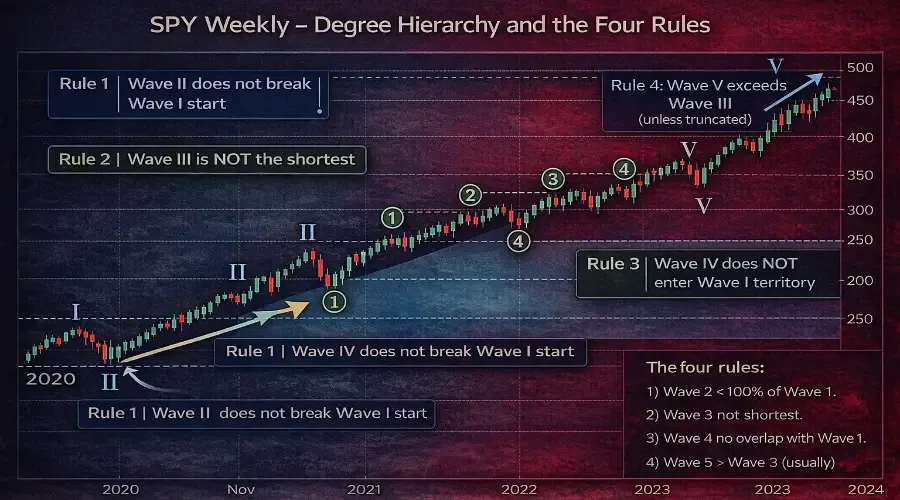
Most Elliott Wave counts fail for one simple reason: traders treat guidelines as rules and rules as suggestions. The result is a structure that appears valid on the surface but collapses the moment it is tested against objective criteria.
Elliott Wave analysis does not operate on opinion. It operates on rules that cannot be violated and guidelines that increase probability. Confusing the two is the fastest way to build a count that is structurally wrong.
This guide separates those concepts clearly and gives you a validation framework you can apply before acting on any count.
The Four Elliott Wave Rules (No Exceptions)
These rules define whether an impulse wave is valid. A single violation does not weaken the count - it invalidates it completely.
Rule 1: Wave 2 Cannot Retrace More Than 100% of Wave 1
If Wave 2 moves beyond the start of Wave 1, then Wave 1 is not Wave 1. The structure must be re-evaluated, either as part of a correction or as a misidentified degree.
This rule has zero tolerance and applies across all timeframes.
Rule 2: Wave 3 Is Never the Shortest
Among Waves 1, 3, and 5, Wave 3 cannot be the shortest. It does not need to be the longest, but it must not be shorter than both Wave 1 and Wave 5 simultaneously.
This rule ensures that the central impulse retains structural strength.
Rule 3: Wave 4 Does Not Enter Wave 1 Territory
Wave 4 must remain outside the price range of Wave 1. If overlap occurs, the structure is not a standard impulse.
It may instead be a diagonal pattern, which follows a different internal structure and requires separate validation.
Diagonal Exception (Important Context)
Leading and ending diagonals allow Wave 4 to overlap Wave 1, but only under specific conditions.
- Internal structure → 3-3-3-3-3 (not 5-3-5-3-5)
- Shape → converging wedge
- Context → appears at the start or end of a trend
If overlap occurs without these characteristics, the count is incorrect.
To understand how these structures behave in real trends: Elliott Wave Motive Wave Strategy (Wave 3 Guide)
Rule 4: Wave 5 Must Exceed Wave 3 (With Nuance)
In most cases, Wave 5 extends beyond Wave 3. However, a truncated Wave 5 — where this does not occur — is a valid but rare condition.
This does not invalidate the count, but it signals extreme exhaustion.
Practical implication:
Treat truncation as a warning, not confirmation. Reduce exposure, tighten risk, and seek confirmation through divergence and volume behavior.
To see how these rules are applied in real trades: Wave 3 Entry Strategy (Entry, Stop, Target)
Degree: The Most Misunderstood Concept
Every Elliott Wave structure exists within a hierarchy of degrees, and misalignment between timeframe and degree is one of the most common sources of error.
Large-degree waves unfold over months or years, while lower-degree waves form over days or hours. Labelling a short-term pullback as a higher-degree wave creates structural distortion and leads to incorrect conclusions.
A critical distinction must be maintained: rules apply within the same degree, not across different degrees. Overlap between waves of different degrees is not a violation, but confusing them is.
To understand how corrections behave across different structures: Corrective Waves: Zigzag vs Flat Explained
The Guidelines: Probability, Not Certainty
Unlike rules, guidelines are tendencies that occur frequently but not always. They help refine probability, not define validity.
Alternation Principle
Waves 2 and 4 tend to differ in character. If Wave 2 is sharp and deep, Wave 4 is likely to be sideways and shallow.
This principle improves forecasting but does not override structural rules.
Wave 3 Extension
Wave 3 often extends to 1.618 times Wave 1, although it may extend further or fall short depending on market conditions.
Wave 4 Support
Wave 4 commonly terminates near the previous Wave 4 of one lower degree, providing a forward reference point for support.
Wave 5 Equality
When Wave 3 extends significantly, Wave 5 often mirrors the length of Wave 1. This relationship helps project terminal targets.
To convert these probabilities into actual price targets: Fibonacci Targets for Wave 3, 4 & 5
When Rules Pass but the Count Still Looks Wrong
There are situations where all four rules are satisfied, yet the structure appears weak or inconsistent. For example, Wave 3 may technically not be the shortest but still lacks momentum or proportional strength.
In such cases, the count is valid but low probability.
This is where guidelines and confirmation tools such as volume and momentum must be used to refine judgment. The goal is not to find a valid count, but to find the most probable count.
To confirm whether momentum supports your wave count: Wave 3 vs Wave 5 Divergence Strategy
Elliott Wave Validation Checklist
Before acting on any wave count, run through this framework.
Rule Validation (All Must Pass)
- Wave 2 does not retrace beyond Wave 1 start
- Wave 3 is not the shortest among Waves 1, 3, and 5
- Wave 4 does not overlap Wave 1 (or diagonal confirmed)
- Wave 5 exceeds Wave 3 (or truncation explicitly noted)
Structural Consistency
- Sub-waves at the next lower degree are clearly visible
- Internal wave relationships follow correct patterns
Degree Alignment
- Timeframe matches the wave degree
- Larger waves take proportionally more time than smaller waves
Guideline Confirmation
- Alternation between Wave 2 and Wave 4 is present
- Wave 3 shows expected extension behavior
- Wave 4 aligns with prior support zones
Red Flags (Abandon the Count)
- Wave 3 is barely longer than Wave 1
- No alternation between Waves 2 and 4
- Momentum and volume contradict the wave position
Key Takeaways
- Elliott Wave rules are absolute and cannot be violated
- Guidelines improve probability but do not define validity
- Degree alignment is critical for correct wave interpretation
- A valid count is not always a high-probability count
- Always validate structure before execution
To avoid the most common structural traps: B-Wave Trap: False Breakout Explained
Frequently Asked Questions (Elliott Wave Rules)
What is the most common reason Elliott Wave counts fail?
The most common reason Elliott Wave counts fail is that traders confuse rules with guidelines, treating probabilistic tendencies as structural requirements. This leads to counts that appear valid visually but collapse under strict rule validation.
Can any of the Elliott Wave rules be violated?
No. The first three Elliott Wave rules have zero tolerance and cannot be violated under any condition.
The fourth rule includes a nuance: Wave 5 truncation is a rare exception that signals exhaustion, not a rule violation, and should be treated as a warning rather than confirmation.
What is wave degree in Elliott Wave theory and why is it important?
Wave degree refers to the hierarchical structure of waves across timeframes, where larger waves contain smaller sub-waves.
It is critical because rules apply within the same degree only. Confusing degrees leads to incorrect counts and is one of the most common structural errors in Elliott Wave analysis.
How do Elliott Wave guidelines differ from rules?
Elliott Wave rules define structural validity and cannot be broken, while guidelines describe high-probability tendencies that improve forecasting.
Guidelines increase probability but do not determine validity. A wave count can follow all rules and still be low probability if guidelines are not aligned.
What is the diagonal exception in Elliott Wave theory?
The diagonal exception allows Wave 4 to overlap Wave 1, but only when the structure is a diagonal pattern.
This requires:
- A 3-3-3-3-3 internal structure
- A wedge-shaped formation
- Appearance at the start or end of a trend
If these conditions are not met, overlap invalidates the count.
Next Step in the Framework
Now that you understand how to validate wave structure using rules and guidelines, the next step is learning how to project precise price targets before the move unfolds.