
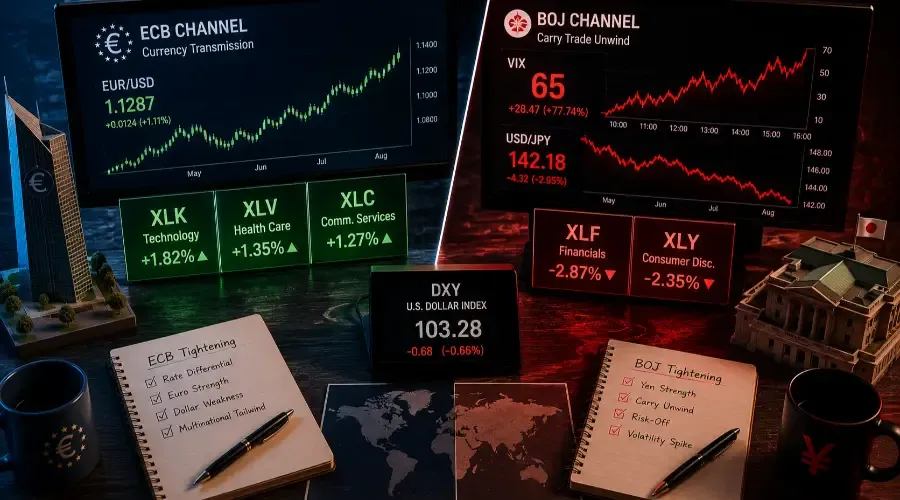
Maseconomics documented it precisely for 2026: the Fed, ECB, BOJ, and BOE are moving in opposite directions – central bank divergence at its most complex. CNBC had tracked the divergence beginning in 2023. CMC Markets and Capital.com cover the FX implications of each policy decision. IG previews the cross-central-bank meetings that markets watch. Every source correctly identifies that ECB and BOJ policy shifts move currencies and reshape rate expectations. None converts that into a US stock-sector winners-and-losers framework – because most retail traders treat foreign central bank decisions as someone else’s problem. They are not. When the Bank of Japan raised rates in July 2024, the VIX spiked intraday to 65 and the S&P 500 fell more than 3% in a single session. The ECB or BOJ is never just Europe’s or Japan’s problem.
Why This Matters More Than Most Traders Realize
The ECB and BOJ matter to US equity investors through two mechanisms that most retail analysis ignores. What makes them different is how they hit your portfolio—gradually through currency translation, or violently through a carry unwind.
The Currency Channel:
When ECB raises rates relative to the Fed, the euro appreciates against the dollar – weakening the DXY and creating the same multinational translation tailwinds described in the dollar weakens post. When BOJ raises rates from near zero, the yen strengthens – creating the same currency dynamic but with an additional leverage that the euro channel lacks.
The Capital Flow / Carry Trade Channel:
Japan holds approximately $1.1 trillion in US Treasury bonds. The yen carry trade – borrowing in cheap yen to invest in higher-yielding US assets – has been one of the largest structural trades in global financial markets for decades. When the BOJ raises rates and yen borrowing becomes more expensive, that carry trade can unwind. Yen-funded leveraged positions in US equities, US Treasuries, and global risk assets are sold to repay yen-denominated debt. This unwinding produces the VIX spikes, equity selloffs, and Treasury yield moves that can shock markets. The August 2024 episode showed how powerful this channel can be – but it’s important to recognize that the early-August turmoil was a perfect storm of soft US jobs data, recession fears, and tech earnings disappointments hitting alongside the BOJ move. The carry unwind amplified the selloff; it wasn’t the sole driver.
The ECB’s currency channel and the BOJ’s carry trade channel operate differently and produce different sector rotations – which is why treating “foreign central bank policy shift” as a single event type without distinguishing the institution produces analytical errors. [LINK: Central Bank Hub]
Regime Change: Policy Divergence Is Structural
A foreign central bank policy shift is a regime change, not a data event. When the BOJ abandons Yield Curve Control or the ECB begins a hiking cycle, those decisions alter the global capital allocation environment for months to years – not days. Traders who treat BOJ rate decisions as one-day events consistently underestimate the structural shift in carry trade positioning and global risk appetite that a sustained BOJ tightening cycle produces.
The divergence dimension makes this uniquely complex: the impact on US equities depends not on the ECB or BOJ decision in isolation but on how that decision relates to the Fed’s current posture. Three scenarios matter here:
ECB/BOJ tightens while Fed holds or cuts:
Rate differential narrows → dollar weakens → US multinational translation tailwinds → XLK, XLV, XLC positive. This is the most straightforwardly positive scenario for US multinationals.
ECB/BOJ tightens while Fed also tightens:
Rate differentials roughly stable → currency effects muted → impact primarily through global growth slowdown concern → neutral to mildly negative for US cyclicals (XLI, XLE, XLB). In this scenario, the simultaneous tightening can amplify risk-off moves and credit stress beyond what the growth concern alone suggests.
ECB/BOJ eases while Fed holds:
Rate differential widens → dollar strengthens → US multinational translation headwinds → XLK, XLV negative. The BOJ easing version of this also expands carry trade capacity → global risk-on → US equities initially positive, but with more fragility.
The ECB vs BOJ Distinction: Two Different Mechanisms
ECB Policy Shifts → US Impact: Primarily Currency
The ECB manages monetary policy for nineteen eurozone economies – a $14 trillion economic bloc that is the US’s largest trading partner. ECB decisions primarily transmit to US equities through the EUR/USD exchange rate. When the ECB tightens and the euro appreciates, approximately 25% of S&P 500 revenues generated in Europe translate into more dollars – creating earnings tailwinds for XLK technology giants, XLV pharmaceutical companies, and XLC digital advertising platforms with significant European revenue exposure.
In practice, though, the currency channel isn’t the whole story. ECB tightening also raises recession risk in the eurozone, which can become a demand headwind for US companies with substantial European sales. Currency translation gains can be offset by lower unit volumes, so the net sector impact is rarely as clean as the exchange rate alone would imply. Still, the ECB’s transmission is relatively gradual and orderly. EUR/USD moves in response to ECB decisions are meaningful but rarely produce VIX spikes or systemic risk episodes. The ECB is a macro tailwind or headwind for US multinationals – important but manageable.
BOJ Policy Shifts → US Impact: Currency PLUS Carry Trade Unwind
The BOJ is categorically different from the ECB in its US equity impact because Japan’s decades-long zero-rate policy created the world’s largest carry trade. Investors globally borrowed in cheap yen and invested those funds in higher-yielding assets – US Treasuries, US equities, European bonds, emerging market debt. When the BOJ raises rates and yen borrowing costs increase, the carry trade can unwind: leveraged positions are unwound, yen-denominated debt is repaid, and risk assets globally are sold. The 2024 BOJ rate hike is the definitive case: the yen strengthened from 160 to 142 against the dollar in weeks, and the global risk asset selloff produced intraday VIX readings of 65 – exceeding the COVID crash briefly.
Crucially, the BOJ’s transmission is faster, larger in magnitude, and more non-linear than the ECB’s, but its severity depends heavily on the degree of hawkish surprise, the starting level of speculative yen short positioning, and the concurrent US macro backdrop. A well-telegraphed BOJ rate hike with moderate positioning may produce only a brief, contained reaction. A surprise hike with extreme positioning can produce a violent unwind. The framework identifies the potential for systemic shock; it doesn’t promise that every BOJ move delivers one.
Sector Scorecard
Here’s how the puzzle pieces fit together across the S&P 500.
Technology (XLK) – Currency Tailwind vs. Carry Unwind Risk-Off – 1–3 Months.
XLK’s international revenue exposure (55–65%) makes it the primary currency channel expression. ECB or BOJ tightening that weakens the dollar produces translation tailwinds visible in XLK quarterly earnings. The BOJ carry trade unwind adds a second dimension: when carry unwinds and global risk assets sell off, XLK high-multiple names face multiple compression regardless of the currency effect. The net XLK signal requires identifying which force dominates – currency tailwind or risk-off carry unwind. In practice, watching VIX and USD/JPY in real time gives a better read than trying to pre-judge the balance.
Healthcare (XLV) and Communication Services (XLC) – Positive (Dollar Weakens) / Negative (Dollar Strengthens) – 1–3 Months.
High international revenue exposure produces translation effects similar to XLK. The carry trade channel is less direct for these sectors than for XLK. Both follow the dollar direction produced by the ECB/BOJ policy differential.
Financials (XLF) – Significant Negative (BOJ Tightening, Especially When Unexpected or Positioned) – Immediate.
BOJ tightening is the most dangerous sector signal for XLF because US banks and global asset managers hold yen carry positions – directly or through clients. When the yen strengthens rapidly, XLF financial intermediaries face mark-to-market losses on yen-funded positions, margin calls, and client redemption pressure. The August 2024 episode – where US regional bank stocks fell significantly alongside the BOJ rate hike – confirmed this direct channel. However, the magnitude of XLF damage depends heavily on whether the hike surprises markets and whether yen shorts were at extremes. A widely anticipated, gradual BOJ move may be mostly priced in, and large institutions actively hedge yen exposure. A blanket “sell XLF on BOJ hike” rule is too coarse; instead, assess positioning and surprise. ECB policy shifts are less directly disruptive to XLF, primarily affecting European-revenue-exposed business lines.
Real Estate (XLRE) and Utilities (XLU) – Mixed.
ECB/BOJ tightening that allows US Treasury yields to drift higher (as foreign buyers of US Treasuries reduce purchases when they can earn better returns at home) creates modest XLRE and XLU headwinds through the discount rate channel. ECB/BOJ tightening that weakens the dollar (benefiting US asset attractiveness) creates a partial offset. The net signal is approximately neutral for XLRE and XLU from ECB shifts; modestly negative from BOJ tightening if the Treasury selling channel activates.
Materials (XLB) and Energy (XLE) – Positive (Dollar Weakens) / Negative (Carry Unwind Risk-Off) – Immediate.
Dollar weakness from ECB or BOJ tightening lifts commodity prices in dollar terms – positive for XLB and XLE through the standard currency-commodity mechanism. However, a BOJ tightening-driven carry trade unwind that pushes VIX above 25 is simultaneously risk-off and commodity-negative. These two forces can cancel, making XLB and XLE the most difficult sector calls in foreign central bank policy analysis.
Industrials (XLI) – Mild Negative (Global Growth Concern) / Mild Positive (Dollar Weakness) – 1–3 Months.
ECB tightening into a weak European economy raises global growth concerns – reducing XLI export expectations and capital goods demand internationally. BOJ tightening that is associated with yen strengthening and carry unwinding is typically associated with risk-off positioning that reduces XLI. The net signal is mildly negative in most ECB/BOJ tightening scenarios.
Historical Cases
2013 | BOJ Abenomics QE Expansion – Maximum Yen Weakness
When Prime Minister Abe and BOJ Governor Kuroda launched “Abenomics” in April 2013, the BOJ announced an unprecedented QE expansion that sent the yen from 80 to 125 against the dollar over two years – a 36% depreciation. This is the carry trade expansion case: cheap yen flooded global financial markets, risk assets surged globally, and US equities benefited from both the carry-funded risk-on sentiment and the dollar strength’s translation headwinds being outweighed by the global liquidity surge. XLK multinationals faced translation headwinds but the broader market benefited from the liquidity expansion.
2022 | BOJ YCC Adjustment – The First Cracks
The BOJ maintained Yield Curve Control (YCC) – capping the 10-year Japanese government bond yield at 0.25% – throughout 2022 while the Fed hiked aggressively. In December 2022, the BOJ surprised markets by widening the YCC band to 0.5%. The yen strengthened sharply, US Treasury yields spiked briefly as markets anticipated reduced Japanese demand, and global equities sold off for several sessions. The December 2022 episode was a preview – smaller in magnitude than 2024 but structurally identical in mechanism.
2024 | BOJ Rate Hike – VIX at 65, but Not Just the BOJ
The July 31, 2024 BOJ rate decision – raising rates to 0.25% from near zero – triggered a major carry trade unwind. The yen strengthened from 160 to 142 over the following weeks. The VIX spiked intraday to 65. The S&P 500 fell more than 3% in a single session. XLF global financial intermediaries were hardest hit as yen-funded leveraged positions required unwinding, and XLK and XLY fell sharply as risk-off sentiment overwhelmed any currency translation benefit. That said, the turmoil wasn’t a pure BOJ event. A softer-than-expected US jobs report, recession fears, tech earnings disappointments, and the unwinding of crowded AI trades all hit simultaneously. The BOJ rate hike was an accelerant, not the sole cause. The lesson is not that every BOJ hike will produce a VIX of 65, but that when extreme yen short positioning meets a macro shock, the BOJ channel can amplify the selloff dramatically.
The Trading Playbook
Before
Monitor BOJ meeting dates and YCC band announcements (Bank of Japan releases at 12pm JST, approximately 11pm ET the prior day). The BOJ meets approximately eight times per year, with the most consequential decisions typically at the January, April, July, and October meetings. When yen carry positioning is at extreme levels – measurable via the CFTC COT report for Japanese yen futures (cftc.gov, Friday release) – the potential unwind magnitude is highest. Net speculative short yen positioning above 100,000 contracts has historically preceded violent unwind episodes, though extreme positioning can persist for months before a reversal, so treat it as a warning light, not a precise timing signal.
Track EUR/USD and USD/JPY weekly relative to rate differential changes. When the US-Germany 2-year rate differential narrows (ECB hawkish) or the USD/JPY falls significantly (BOJ hawkish signals), the dollar weakness channel for US multinationals is activating. Monitor XLK relative performance as the leading equity expression of this currency signal.
Read BOJ and ECB meeting minutes and press conference language for signals of policy normalisation. BOJ language around “appropriate to adjust the degree of monetary easing” has historically preceded actual YCC adjustments by one to two meetings.
During
BOJ tightening detected: Assess the degree of hawkish surprise and the starting level of speculative yen shorts. If the move is unexpected and positioning is stretched, reduce XLF exposure immediately – the carry trade unwind risk is most systemic for US equities under those conditions. Add XLU and XLP defensives for the risk-off component. Wait for USD/JPY to stabilise above a key support level (typically the prior range low) before re-risking, but be mindful that snapbacks can be rapid. If the BOJ move is well-telegraphed and positioning is moderate, the reaction may be brief and contained, and blanket selling of XLF could be counterproductive.
ECB tightening with Fed holding or cutting: Add XLK, XLV, and XLC for the translation tailwind. The currency effect plays out over one to two earnings cycles – position for the next quarterly earnings reporting period when management FX commentary will confirm the tailwind. Keep an eye on European demand indicators; a sharp slowdown can erode the translation benefit.
Either central bank easing while Fed holds: Dollar strengthens → reduce XLK and XLV multinational exposure; maintain domestic-focused sectors. Monitor for yen carry rebuilding (USD/JPY weakening gradually) as a risk-on signal.
After
The BOJ carry unwind resolution signal: USD/JPY stabilising above the prior major support level for two consecutive weeks – confirming that the forced position liquidation has completed and the new equilibrium is establishing. This is the re-risk signal for XLF and high-beta XLK names that fell during the unwind. However, keep in mind that carry unwinds can reverse sharply if the BOJ subsequently softens its tone or US rates move favorably; the two-week rule is a guide, not a guarantee.
ECB/Fed divergence sustainability: Check whether the policy divergence is structural (ECB at multi-year cycle peak while Fed cutting = sustained dollar weakness for 6–18 months) or tactical (one meeting difference = short-lived currency effect). Structural divergence justifies larger, longer multinational overweights; tactical divergence warrants smaller, shorter positions.
The 3 Mistakes Most Retail Traders Make
Mistake 1: Treating BOJ Decisions as Japan’s Problem.
The August 2024 VIX-65 episode is the permanent rebuttal to any trader who ignores the BOJ. A 25 basis point rate increase in Japan was a key accelerant in one of the sharpest risk-off moves outside of COVID and the GFC. The BOJ is the world’s largest carry trade funding source, and its policy decisions have asymmetric impact on global risk assets regardless of their modest fundamental economic significance for Japan itself.
Mistake 2: Applying the Same Playbook to ECB and BOJ Shifts.
ECB policy shifts transmit primarily through the currency channel – gradual, manageable, most impactful for multinational earnings over one to two quarters, but also carrying some European demand risk. BOJ policy shifts transmit through the currency channel AND the carry trade unwind channel – fast, non-linear, most impactful for risk assets within days. Trading both with the same “dollar moves, adjust multinationals” framework misses the carry unwind risk entirely.
Mistake 3: Ignoring CFTC Yen Positioning Data.
The single most predictive pre-trade indicator for BOJ carry unwind severity is the speculative net short yen position in CFTC futures data. When this short position reaches historical extremes – as it did before the 2024 unwind – the unwind magnitude is maximised because more forced covering occurs. However, extremes can persist, so positioning data tells you the potential severity, not the exact timing. Checking the COT report for yen positioning before each BOJ meeting takes five minutes and provides the most direct measurement of unwind risk available to retail traders.
Bottom Line: A Context-Aware Institutional Framework
When ECB tightens relative to the Fed, overweight XLK and XLV multinationals for the translation tailwind through the currency channel, while watching European demand for offsets. When BOJ tightens – especially if the move surprises or yen short positioning is extreme – reduce XLF immediately for the carry trade unwind risk, check CFTC yen positioning for unwind severity, and use USD/JPY stabilisation above prior support alongside VIX normalization as the re-risk signal.
This framework works across cycles because the ECB currency channel and the BOJ carry trade channel are structural features of global capital markets that repeat every time these institutions shift policy direction. The ECB is primarily a quarterly earnings event with some growth contingency. The BOJ is a systemic risk event when carry positioning is extreme and the macro backdrop is fragile. Treating them identically is the most expensive analytical error in foreign central bank analysis – and assuming every BOJ hike triggers a crisis is its own form of error. The framework is a lens, not a mechanical trigger.
Run this scenario through the [Breakout Bulletin Ripple Engine](LINK: Ripple Engine Tool) to see how ECB and BOJ policy shifts transmit across all twelve US equity sectors through the currency and carry trade channels.
Frequently Asked Questions
Q1. How do ECB policy shifts affect US stocks?
ECB policy changes mainly affect US equities through the currency channel. A stronger euro weakens the dollar and benefits multinational US companies with large European revenues.
Q2. Why does the BOJ have such a large impact on global markets?
The Bank of Japan influences global markets because Japan has historically maintained ultra-low interest rates that funded massive global carry trades.
Q3. What is the yen carry trade?
The yen carry trade involves borrowing cheaply in Japanese yen and investing in higher-yielding global assets like US stocks and bonds.
Q4. What happens when the BOJ raises rates?
When the BOJ raises rates, the yen often strengthens and leveraged carry trades unwind, causing volatility in global equities and bonds.
Q5. Why did the VIX spike after the BOJ rate hike in 2024?
The BOJ’s 2024 rate hike triggered rapid unwinding of yen-funded leveraged positions, leading to sharp selling across global risk assets and a major VIX spike.
Q6. Which sectors benefit from ECB tightening?
Technology (XLK), Healthcare (XLV), and Communication Services (XLC) often benefit because dollar weakness boosts foreign earnings translation.
Q7. Which sectors are most vulnerable during a BOJ carry trade unwind?
Financials (XLF) are often most vulnerable because banks and asset managers are directly exposed to leveraged global financing flows.
Q8. How does ECB and Fed divergence affect markets?
When the ECB tightens while the Fed pauses or cuts rates, the dollar often weakens and multinational US companies gain translation tailwinds.
Q9. Why is USD/JPY important for traders?
USD/JPY is one of the most important global macro indicators because it reflects yen strength, carry trade positioning, and global risk appetite.
Q10. How should traders position during BOJ tightening cycles?
Many traders reduce exposure to financials and high-beta growth assets during BOJ tightening while monitoring USD/JPY stabilization for re-entry signals.
| Sector | ETF | Direction | Timing | Magnitude |
|---|---|---|---|---|
| Defence | XLI | ▲ Strong | Immediate | +10–20% |
| Energy | XLE | ▲ Strong | Immediate | +8–15% |
| Technology | XLK | ▼ Moderate | Immediate | −5–10% |
Key Takeaway: Central bank divergence is a structural driver of global macro sector rotation. An ECB policy shift typically flows through the currency channel—weakening the dollar and giving multinationals a translation tailwind. A BOJ policy shift can be far more disruptive: a BOJ carry trade unwind, when combined with extreme yen short positioning, can send the VIX spiking and hammer financials. The trading playbook isn’t one-size-fits-all. It requires monitoring USD/JPY, COT yen positioning, and the interplay with the Fed’s stance to separate the gradual macro shifts from the sudden systemic shocks.
This post is part of the BreakoutBulletin “What Happens When” series. [LINK: Central Bank Hub] · [LINK: Series Pillar Page]
Educational content only. Not investment advice. Past sector performance patterns do not guarantee future results.