
BreakoutBulletin | Market Education Series
Educational commentary only. Not investment advice. Past performance does not guarantee future results.
The Paradox of Confirmation
Every trader wants confirmation before entering a position. Confirmation feels safe - price has proven it can move in the anticipated direction, the pattern has completed, the signal has triggered. The discomfort of uncertainty has been replaced by the comfort of evidence.
The problem is that confirmation has a price. By the time a move is confirmed - by the time the breakout has occurred, the volume has expanded, the pattern has completed - the participants who didn't need confirmation are already positioned. The early institutional buyers who accumulated during the base, the systematic funds whose algorithms detected the volume progression, the experienced traders who read the leading indicators before the setup was obvious - they entered before confirmation arrived. The confirmation you waited for was the signal that they were right.
This is the confirmation paradox. The more evidence you wait for before entering, the safer each individual trade feels - and the worse your aggregate results become. You are buying what the early participants are beginning to sell. The risk-reward that was genuinely compelling at the early entry has already partially resolved by the time you see the confirmation.
The early mover strategy is not about abandoning confirmation entirely. It is about understanding the information cascade that produces price moves - and learning to read the earlier stages of that cascade before the final, obvious confirmation that every retail trader is waiting for.
The Information Cascade: Why Markets Move in Stages
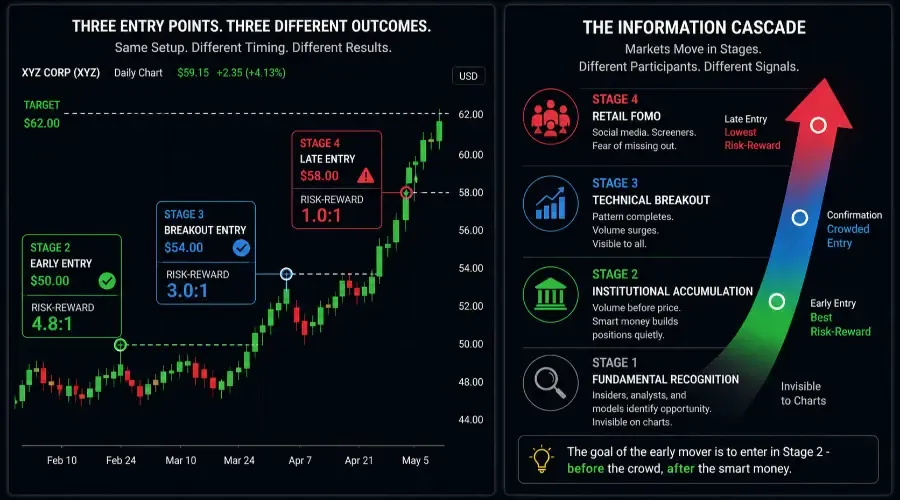
Price moves do not emerge from nowhere. They develop through a predictable sequence - an information cascade - where different participant types react to different signals at different stages of a developing move.
Understanding the cascade makes the early mover concept precise rather than vague. Being early is not about guessing or acting on hunches. It is about reading the stage of the cascade that is currently active and understanding what the next stage implies.
Stage One - Fundamental Recognition (Invisible to Charts)
The first participants to identify an opportunity are those with access to fundamental information. This stage is entirely invisible in price data. Stage One is inaccessible to retail traders.
Stage Two - Institutional Accumulation (Visible in Volume Before Price)
As the institutional thesis develops, large participants begin building positions. They execute carefully - distributing orders across sessions.
This stage becomes visible through volume behaviour and relative strength. Volume begins increasing session over session while price remains flat. Relative strength improves.
Stage Two is where the early mover operates.
Stage Three - Technical Breakout (Visible to All)
The pattern completes. Volume surges. Price clears the key level. This is the confirmation stage.
Stage Four - Retail Recognition (Late Entry Territory)
The stock appears in screeners. Social media amplifies the move. Entries here are late and risk-reward deteriorates.
The Three Stage Two Signals
Three specific signals consistently appear during institutional accumulation before breakout.
Signal One - Relative Strength Divergence
The most powerful Stage Two signal is a stock showing rising relative strength while price is still in a base.
Double-Relative Strength check (critical edge): The stock must outperform both the S&P 500 and its sector ETF.
Signal Two - Volume Before Price (VROC Validation)
Institutional accumulation produces rising volume while price remains range-bound.
VROC validation: Volume Rate of Change must show higher lows even when price is flat.
Signal Three - Support on Down Market Days (The Lower Wick Footprint)
Stocks under accumulation show resilience during market declines.
Lower wick footprint: Frequent lower wicks (50%+ of candle size) signal institutional defence.
When All Three Signals Align
The early mover entry has highest conviction when all three signals align simultaneously.
Relative strength + Volume progression + Down-day support = Institutional accumulation confirmation.
The Cost of Being Early vs The Cost of Being Late
| Entry Stage | Entry Price | Stop | Target | Risk | Potential Reward | R:R |
|---|---|---|---|---|---|---|
| Stage Two (early) | $50.00 | $47.50 | $62.00 | $2.50 | $12.00 | 4.8:1 |
| Stage Three (confirmation) | $54.50 | $52.00 | $62.00 | $2.50 | $7.50 | 3.0:1 |
| Stage Four (late) | $58.00 | $54.00 | $62.00 | $4.00 | $4.00 | 1.0:1 |