
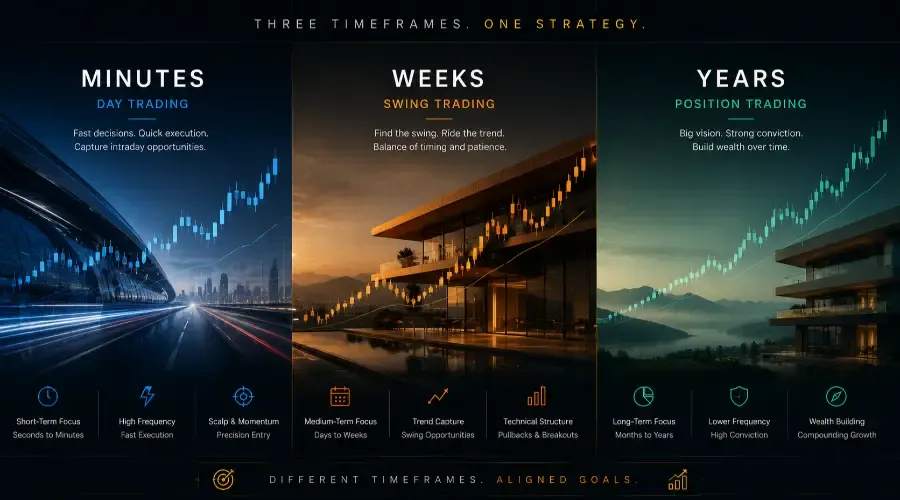
Three distinct approaches to stock market participation differ primarily in how long positions are held – from minutes to years. Each has different capital requirements, time demands, skill prerequisites, and realistic success rates. Choosing the right one means matching the approach to your actual situation rather than your aspirational one.
Day Trading
Day traders open and close positions within a single trading session. No positions are held overnight. The goal is to capture intraday price movements – typically 0.5 to 2% – across multiple trades per day.
Day trading requires full attention during market hours: 9:30 AM to 4:00 PM Eastern Time. Traders monitor real-time price action, news flow, and technical signals continuously. Missing a position for 30 minutes can mean missing the entire move – or holding through a reversal that turns a gain into a loss.
The regulatory requirement is strict: day traders using margin accounts with under $25,000 are limited to three day trades per five-day rolling window by the Pattern Day Trader rule. Trading freely as a day trader effectively requires $25,000 or more in account equity.
Academic and industry research consistently documents that a large majority of day traders lose money, and a substantial portion of the minority who profit do so inconsistently. The Securities and Exchange Commission's website includes disclosures specifically about day trading risk. This doesn't mean profitable day trading is impossible – it means the bar for consistent profitability is substantially higher than most newcomers expect, and the infrastructure required (fast data, direct access platforms, real-time news) represents an ongoing cost.
Swing Trading
Swing traders hold positions for two days to several weeks, attempting to capture medium-term price movements driven by technical patterns, earnings catalysts, or sector trends. The holding period sidesteps PDT restrictions – a position held overnight is not a day trade – which allows investors with under $25,000 to participate actively without account restrictions.
Swing trading typically requires 30 to 90 minutes of research and monitoring daily rather than continuous screen attention. Positions can be reviewed before or after market hours, making the approach more compatible with school schedules or full-time employment than day trading.
The skill requirement is real: effective swing trading generally involves understanding support and resistance levels, chart patterns, volume analysis, and position sizing. The information advantage is smaller than in day trading – you're competing with slower-moving institutional investors rather than algorithmic systems – but it still requires genuine technical knowledge to generate consistent results.
Overnight gap risk is the primary added complexity relative to day trading. News released after hours can cause a position to open significantly higher or lower than the previous close. Stop-loss orders, limit sells, and position sizing are the practical tools for managing this risk.
Position Trading (Long-Term Investing)
Position trading – which most people call investing – involves holding positions for months to years based on fundamental analysis of the underlying business. Positions are built with a thesis about the company's long-term trajectory and held through short-term volatility.
The time requirement is minimal relative to the other approaches. Monthly portfolio reviews are adequate for most long-term investors; quarterly is sufficient for passive index investors. The analytical focus shifts from price momentum to business fundamentals: revenue growth, profit margins, competitive positioning, and management quality.
The historical return data favors this approach. Broad market index funds – which require almost no analytical skill to use effectively – have outperformed the majority of professionally managed active funds over 15-year periods. Tax treatment also favors longer holding periods: positions held more than one year qualify for long-term capital gains rates, which are substantially lower than ordinary income rates applied to short-term gains.
Matching Approach to Situation
An honest assessment of your situation – capital, available time, current knowledge, and income needs – determines which approach makes sense.
For an investor with under $5,000, a full-time school or work schedule, and less than one year of market experience: position trading in diversified index funds is the highest-probability path. The PDT rule eliminates practical day trading access, time constraints eliminate effective swing trading, and the base rate of success is strongest with long-term, diversified ownership.
For an investor with $1,000 to $25,000 who can dedicate 30 to 60 minutes per day and has spent time studying basic technical analysis: swing trading with a small subset of capital is worth exploring, alongside a core position-trading portfolio. Paper trading for three to six months before risking real capital is an underused but genuinely informative step.
For an investor with $25,000 or more, full-time availability during market hours, and documented profitability over at least six months of paper or small-size trading: day trading becomes accessible as a complementary activity, though position trading should still anchor the portfolio.
The Blended Approach
Many experienced investors use a combination: a core portfolio (70 to 80% of assets) in long-term positions built around fundamental research, and a smaller active component (20 to 30%) used for swing trades or, if capital allows, occasional day trades. The core portfolio provides compounding stability while the active component develops skills and generates engagement.
Starting with the core and adding an active component after demonstrating consistent results in the simpler approach is more durable than the reverse.
This content is for educational purposes only and does not constitute investment, legal, or tax advice. Investing in securities involves risk, including possible loss of principal. Always conduct your own research and consult a licensed financial professional before making investment decisions.
The right trading timeframe is a function of your capital, time, knowledge, and regulatory situation - not your ambition. If you're under $25,000, the PDT rule directly constrains two of the three approaches. If you're assessing which rules apply to you, start there.
→ Trading Timeframes and Strategies → The evidence, regulatory framework, and decision criteria for each trading style - www.breakoutbulletin.com/article/trading-timeframes-strategies-day-swing-investing
→ The PDT Rule Explained → The specific regulation that limits accounts under $25,000 to 3 day trades per rolling five days - www.breakoutbulletin.com/article/pdt-rule-explained-the-25k-day-trading-limit-
→ Blog 26: Short Selling Basics → The additional strategy layer and its asymmetric risk that some active traders add - www.breakoutbulletin.com/article/short-selling-basics-explained