
Every limit order requires a duration setting. Most investors accept the default without thinking about it – which is fine until a forgotten order fills weeks later under conditions that no longer match the original reasoning. Understanding the two main options takes two minutes and prevents a category of surprise.
Day Orders
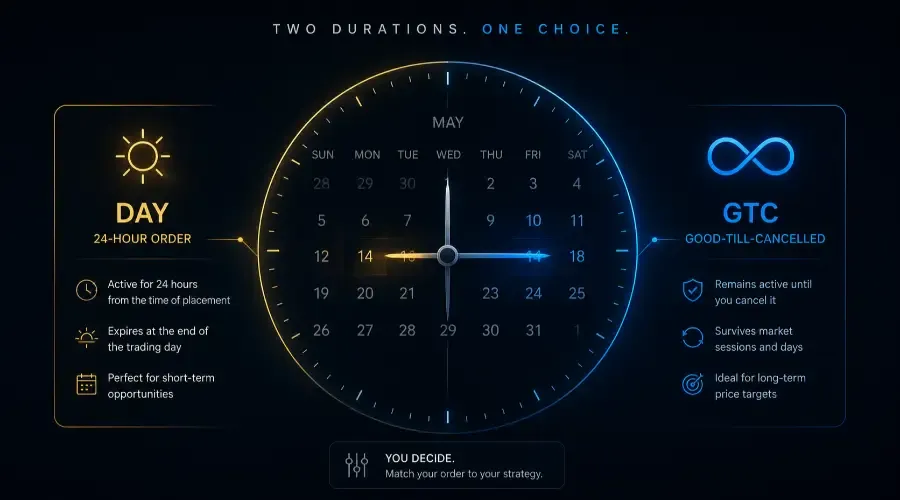
A day order expires automatically at 4:00 PM Eastern Time on the day it's placed if it hasn't been executed. If you place a buy limit order at $48 on a stock trading at $50, and the stock never reaches $48 before the close, the order cancels. Tomorrow is a blank slate – you decide whether to re-enter based on current conditions.
Day orders are the default at most brokerages. Their primary advantage is automatic expiration: no order can fill at a stale price if you haven't actively renewed it. They suit investors who monitor positions regularly and want each day's orders to reflect that day's thinking.
The practical downside is re-entry friction. If you're building a position over several weeks at a target price that hasn't been reached yet, you either remember to re-enter the order each morning or you miss the fill when the stock eventually touches your level.
Good-Till-Canceled Orders
A GTC order remains active until it fills or you manually cancel it – typically up to 90 days depending on the broker. Once placed, the order works for you continuously without daily intervention. If you place a GTC limit buy at $48 and the stock dips briefly to $47.80 during a slow Tuesday three weeks later, your order fills automatically.
GTC orders suit patient investors building positions at specific price targets, investors who check their accounts weekly rather than daily, and value-oriented approaches where the thesis is measured in months rather than days.
The risk is equally clear: a GTC order can fill weeks after placement under conditions that no longer support the original reasoning. An earnings miss, a sector rotation, a macro development – any of these can change the investment case between the day you placed the order and the day it fills. An order placed at what seemed like an attractive entry level six weeks ago may no longer represent an attractive entry today.
When Each Makes Sense
Day orders fit: trades with time-sensitive setups where the rationale is specific to today's conditions, active investors who check accounts daily and want fresh orders each session, and volatile situations where targets can change quickly after news or catalysts.
GTC orders fit: value-oriented investors waiting for a stock to pull back to a specific level, patient accumulation strategies where price targets don't change day-to-day, investors who monitor weekly rather than daily, and price levels significantly below the current market that may take weeks or months to reach.
The Forgotten Order Problem
The most common GTC-related mistake is placing an order during a moment of conviction, then forgetting it exists as weeks pass. If your thesis changes – the company reports weak earnings, the sector deteriorates, or your financial priorities shift – the GTC order remains queued and can fill during a moment of inattention.
The solution is simple: maintain a list of open GTC orders and review it at a fixed interval, typically weekly or bi-weekly. Most brokerage platforms display open orders in a dedicated section. A five-minute review on Sunday morning prevents the surprise of a fill that reflects last month's thinking rather than today's.
Earnings Events and GTC Orders
A specific risk: GTC orders near earnings announcements. If you place a buy limit at $48 on a stock trading at $50, and the company reports a sharp earnings miss after hours, the stock may open at $44. A GTC limit order at $48 fills at the open – but the conditions that made $48 attractive may have changed fundamentally. Reviewing and adjusting or canceling GTC orders before known earnings dates prevents buying into a deteriorating story simply because the price happened to touch your target.
The Hybrid Approach
Many investors use a combination: day orders for active swing positions where setups are time-sensitive, and GTC orders for patient, long-term accumulation targets. Keeping the logic separate – one order type for active management, another for patient positioning – reduces the risk of treating a time-sensitive setup as a standing order or forgetting a standing commitment to a long-term thesis.
This content is for educational purposes only and does not constitute investment, legal, or tax advice. Investing in securities involves risk, including possible loss of principal. Always conduct your own research and consult a licensed financial professional before making investment decisions.
Day orders and GTC orders solve different problems. Knowing which to use and why a GTC order left open through an earnings report is a specific risk - makes your order management more deliberate.
→ How Orders Work → The complete order execution framework from order types to settlement - www.breakoutbulletin.com/article/how-stock-orders-work-placing-executing-settling-trades
→ Market Order vs. Limit Order → The price vs. execution certainty trade-off that determines which order type to use - www.breakoutbulletin.com/article/market-order-vs-limit-order-explained
→ Understanding Settlement (T+2) → How the settlement timeline interacts with rapid follow-on trades - www.breakoutbulletin.com/article/understanding-settlement-tplus2