
By Manish T. | BreakoutBulletin AI Trading Series
Retail traders are handing AI models a role they were never built for. Claude, ChatGPT, and Gemini are language models. They predict the next word in a sequence. They do not predict the next tick in a price series, and the gap between those two abilities is where accounts get damaged.
This post catalogs the specific failure modes. Not "AI is dangerous" in the abstract, but the exact behaviors that cost retail traders money, and the habits that prevent them.
1. The Model Will Invent Data and Sound Certain Doing It
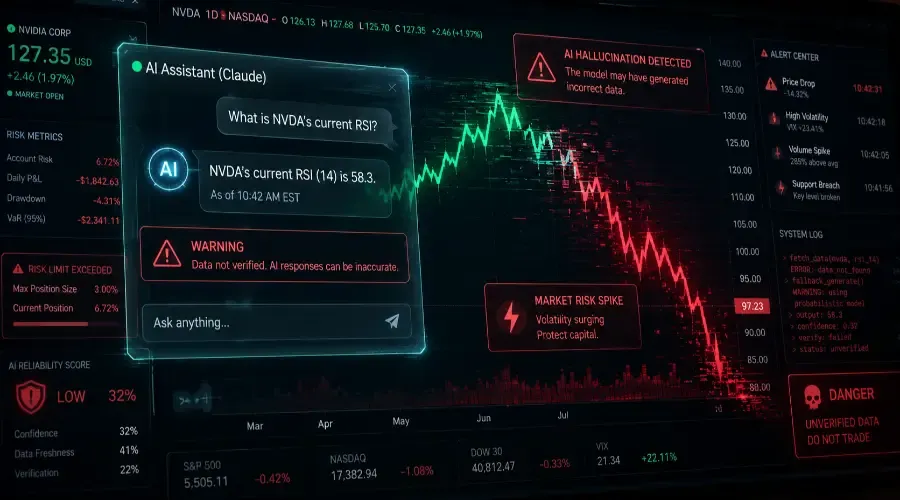
Language models generate text that sounds plausible, not text that is factual. Ask Claude for NVDA's current RSI without providing the data, and it won't say "I don't know." It will give you 58.3 – a number that passes the eye test because it fits the pattern of real market data, but came from thin air.
The failure compounds because the fabricated number is never obviously wrong. A hallucinated RSI reads 58.3, not 940. A hallucinated P/E reads 24.6, not "error." The output slips into trade decisions because it looks exactly like a real data point.
One critical distinction: if the model executes code against price data you've supplied, the resulting RSI or moving average will be mathematically correct – it came from arithmetic on real numbers, not the model's language module. The danger is a number generated inside a chat with no visible code run at all. If you didn't see the code run, the default assumption is that the number was invented.
🛡️ The Habit: Verify every number against an actual source – broker terminal, exchange data, SEC filing, TradingView – before it touches any decision. If the model ran code, check the dataset and the logic. If it didn't, treat the output as suspect.
2. The Training Cutoff Is a Stale-Data Trap – But the Trap Has Shifted
Most models have a knowledge cutoff, and everything after that date doesn't exist for them unless they search the web or you supply the data. The risk today isn't just a model stuck in the past. Many leading models now offer web search or can accept live data through tool use. The new trap: a model may default to its internal knowledge even when search is available, or seamlessly blend old parametric knowledge with retrieved data in ways that are difficult to spot.
A trader asking about "current market conditions" without forcing a search or pasting in current data may get an answer built from a regime that ended months ago. If rates were rising at the cutoff and have since reversed, the entire macro frame points the wrong direction – delivered with the same confident cadence as everything else the model writes.
🛡️ The Habit: Date-stamp everything. If using a search-enabled model, explicitly instruct it to retrieve current data, then cross-check what it pulled against live numbers. Better yet, paste the current data into the prompt and tell the model to reason only from what you supplied. The model works well as an analyst of data you provide; it remains an unreliable source of data it has to retrieve on its own.
3. Sycophancy: The Model Agrees with Your Bad Trade
This one deserves more attention than it gets. Language models are trained on human feedback, and humans reward agreement. The result is a documented tendency to validate whatever framing the user brings.
Tell Claude "I'm thinking of buying this breakout, here's my thesis," and the response will usually organize itself around supporting the thesis. Tell it five minutes later "I'm thinking of shorting this failed breakout," and it can build the opposite case with equal fluency. The model is not evaluating the trade. It is completing your framing.
For a retail trader, this creates a confirmation-bias machine. The psychological failure that already destroys most retail accounts – the search for evidence that agrees with an existing position – now has an eloquent assistant that never gets tired of agreeing.
Sycophancy is not impossible to control. You can substantially reduce it by instructing the model to act as a devil's advocate or to find the three strongest counterarguments. But the drift toward agreement is the model's default, and that drift is quiet and cumulative.
🛡️ The Habit: Never ask the model to evaluate a thesis it knows you hold. Ask for the bear case on your longs and the bull case on your shorts, in separate prompts, without revealing your position. Set the role at the top: "You are a skeptical analyst. Your job is to find flaws, not to agree." If the model only ever strengthens your conviction, the prompts are broken.
4. Backtests That Were Never Run
Ask an AI model "how does this strategy perform historically" and it may respond with statistics: win rates, drawdowns, Sharpe ratios. Unless the model executed actual code against actual price data in that session, those statistics are generated text. They describe what backtest results typically look like, not what your strategy did.
Fabricated backtests are arguably the most expensive hallucination in retail AI use, because they create false statistical confidence. A trader who believes a setup "wins 62% of the time historically" sizes positions accordingly. The 62% came from nowhere.
Crucial distinction: Claude is exceptional at writing Pine Script for TradingView or Python backtesting code for you to execute in a Jupyter notebook. That's a legitimate, powerful workflow. The danger is asking the model to estimate performance inside the chat window. Unless visible code ran against a verified historical dataset in that exact session, any win-rate or drawdown figure is fiction.
🛡️ The Habit: Historical performance claims require executed code and real data, both visible to you. If the model can run code, make it show the dataset, the logic, and the output – and verify against a separate source. If it can't run code, let the model write the backtest script; you execute it elsewhere. The model cannot be the backtest.
5. No Risk Awareness, No Skin in the Game
A model has no account balance, no margin call, no drawdown it can feel. It will discuss a trade that risks 40% of capital with the same equanimity as one risking 0.5%, because both are just token sequences. Position sizing, correlation across holdings, portfolio heat – none of this is native to how a language model processes a question, unless the trader forces it into the prompt every single time.
The asymmetry matters. The trader carries all the risk. The model carries none, and produces text with zero liability shaping its confidence.
That said, many traders successfully embed fixed risk constraints directly in prompts – "Assume a $50,000 account, maximum risk per trade 1%, hard stop-loss, no more than 3 concurrent positions" – and the model can flag when a proposed trade exceeds those limits. This works as long as those constraints are treated as non-negotiable rules, not suggestions the model can override. The moment the trader starts negotiating with the model about bending a risk limit, the framework collapses.
🛡️ The Habit: Risk parameters live outside the AI conversation, or are pasted in as inviolable hard rules at the start. Maximum position size, stop placement rules, and portfolio exposure limits are set in a written plan. No model output overrides them. The AI can operate inside the risk framework; it never rewrites the framework mid-conversation.
6. Fluency Reads as Expertise
This is the meta-problem underneath all the others. Claude writes better than most sell-side analysts. Clean structure, precise vocabulary, institutional cadence. The human brain uses fluency as a proxy for competence, and with language models, that proxy breaks completely. Output quality and analytical reliability are uncorrelated: the prose is polished whether the underlying claim is verified fact or statistical invention.
Retail traders who would never trust a stranger's stock tip will trust a beautifully formatted AI response making the same unverified claim. The formatting is doing the persuading.
🛡️ The Habit: Judge AI output by its weakest verifiable claim, not its strongest paragraph. Strip the formatting mentally and ask what the actual evidence is. Often the answer is: the model's confidence, and nothing else.
7. Prompt-Doom Loops and Outsourced Thinking
The final failure mode is behavioral. Traders start using the model for analysis, then for decisions, then for reassurance during drawdowns, then for every market thought they have. The skill being practiced is prompting, not trading. Market intuition, the pattern library a trader builds by doing the work personally, quietly stops developing.
There is also a subtler cost. A trader who reads AI-generated analysis all day starts absorbing its house style of reasoning: fluent, comprehensive, hedged in all directions. Real trading decisions are not comprehensive. They are narrow, time-boxed, and made under uncertainty with incomplete data. The model's mode of thinking and the trader's required mode of thinking pull in opposite directions.
🛡️ The Habit: The model gets a defined job description – research assistant, devil's advocate, code writer, data summarizer. The decision, the entry, the exit, and the sizing stay with the human, on paper, in a journal the model never sees.
A Growing Risk: AI Agents with Execution Access
A brief but urgent addition, because the landscape is shifting fast. Several platforms now offer AI agents that can not only analyze trades but also place them – connecting language models directly to brokerage APIs. This multiplies every failure mode described above. A hallucinated RSI isn't just a number on a screen; it becomes an executed order. A model that doesn't feel risk will happily size a position that blows past every limit if the prompt wasn't bulletproof. Sycophancy becomes self-destructive automation.
The hard rule: never connect an LLM directly to a brokerage API without a human approval step. Even if the model has risk guardrails, even if the backtest was perfect, even if it's "just a small pilot." The model should recommend; a human should click the button. This boundary is the difference between using AI as a tool and handing it the keys.
What Claude Is Actually Good For
None of this argues for zero AI in a trading workflow. Used inside strict boundaries, the model is a genuine edge for a retail trader: summarizing 10-Ks in minutes, writing and debugging screener code, translating institutional research into plain language, stress-testing a thesis when explicitly prompted for the opposing case, and structuring a trading journal review.
The pattern across every safe use case: the human supplies the data, the model supplies the processing, and the human keeps the decision. Every failure mode in this post comes from breaking one of those three rules.
The line to remember is short. Claude is a language engine, not a market oracle. Traders who use it as the first stay ahead of traders who don't use it at all. Traders who use it as the second fund both groups.
The AI Trading Rule
Human provides the data. AI provides the analysis. Human makes the decision.
Break any one of the three, and the probability of making an expensive mistake rises dramatically. AI should remain an analytical tool, not a substitute for judgment, accountability, or risk management.
Before Taking an AI-Generated Trade, Ask:
Did I verify every number independently?
Am I using current market data?
Did I ask for both the bull and bear case?
Has this strategy actually been backtested?
Does this trade fit my written risk-management rules?
Would I take this trade if AI didn't recommend it?
If the answer to any question is "No," don't place the trade.
Related Reading
How to Feed Market Data into AI the Right Way – Prompt structures for current, verified data.
Building a Risk Management Framework with AI – Keep the model inside your guardrails.
Backtesting with AI: Writing Code, Not Trusting Chat Stats – Pine Script, Python, and safe workflows.
Claude vs ChatGPT vs Perplexity for Traders – Which tool for which job, and when to use none.
This content is for educational purposes only and does not constitute investment advice. Markets involve risk. Verify all data independently before making any trading decision.