
March 3, 2026 | BreakoutBulletin Commodity Desk
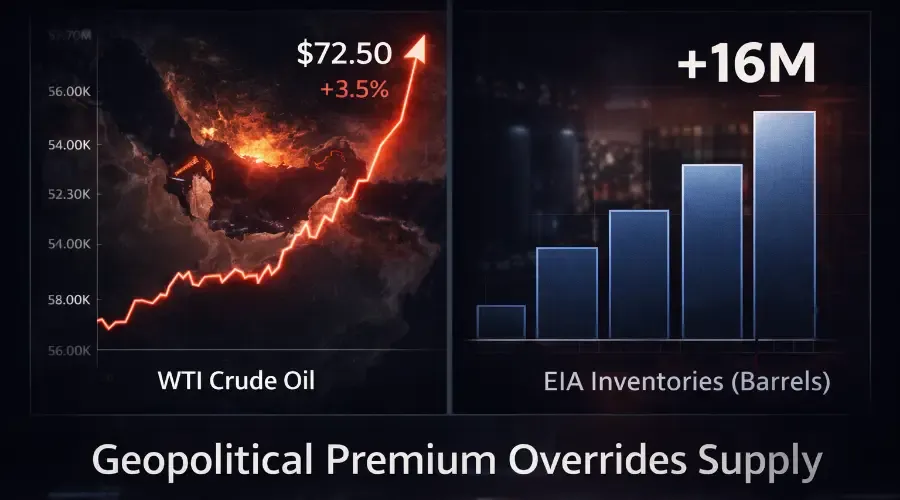
The commodity complex is pricing a geopolitical risk premium today after U.S.-Israeli strikes on Iran facilities triggered Hormuz transit concerns. Energy led the move with WTI gaining 3.5% to $72.50 and Brent up 3.8% to $83.20 - both registering moves that exceed typical single-session volatility. Natural gas followed at +2.8% to $3.45/MMBtu.
The metals complex diverged: gold added 1.2% to $2,650 in classic safe-haven fashion, while silver fell 0.94% to $30.85 - an unusual split that reflects dollar strength (DXY +0.8%) suppressing silver’s industrial pricing premium relative to gold’s pure store-of-value bid. Copper held near flat at $5.8885/lb (+0.1%).
Agricultural commodities registered modest positive movement, with wheat +0.21% and corn +0.5%, but the causal link to today’s primary catalysts is not established. The dominant structural theme is a geopolitical supply shock overlaid on an already-hawkish rate environment - a cross-asset combination that historically produces divergent rather than uniform commodity responses.
Macro and Dollar Context
The dollar index (DXY) is up 0.8% to 104.20, and Treasury yields have moved meaningfully: the 2-year is up 13 basis points to 3.62% and the 10-year is up 8 basis points to 4.05% from 3.97%. This yield curve movement - the 2-year rising faster than the 10-year - reflects short-term rate expectations firming more aggressively than long-term inflation expectations, which is the bond market’s interpretation of a geopolitical shock with transitory rather than structural inflation implications.
For commodity markets, this macro configuration creates a split transmission: oil benefits from geopolitical supply risk regardless of dollar strength, because the supply disruption narrative overrides the currency pricing effect. Gold benefits from safe-haven demand but faces a partial offset from rising real yields. Industrial metals (copper, silver) face the cleanest dollar headwind - their demand is economically driven rather than geopolitically driven, so dollar strength translates more directly into price pressure.
Correlation observed between DXY strength and silver/copper underperformance; causation not conclusively established independent of the geopolitical context.
Energy Complex: Oil and Natural Gas
WTI crude gained 3.5% to $72.50 and Brent gained 3.8% to $83.20 on a single catalyst cluster: U.S.-Israeli strikes on Iran facilities combined with explicit Hormuz transit threat language. The Strait of Hormuz handles approximately 20% of global oil supply daily - any credible disruption signal to that corridor produces immediate front-month price premium regardless of physical inventory levels.
The analytical complexity here is the EIA data released this morning: a +16 million barrel crude build for the week of February 20, against a consensus expectation of a -2.8 million barrel draw. That is an 18.8 million barrel miss in the wrong direction - a build of this magnitude would typically be a bearish catalyst, suppressing oil prices meaningfully. The fact that WTI is up 3.5% on the same day a record-size inventory build was reported tells analysts something precise: the geopolitical premium is currently overriding the fundamental supply data. That divergence is not indefinitely sustainable - if Hormuz threat language de-escalates, the underlying inventory reality reasserts itself.
WTI futures are in contango of $2.50/bbl spot versus May, with spot versus 3-month at +$3.20. Contango in oil generally signals that near-term supply is adequate relative to demand - which reinforces that the current spot price move is geopolitical premium, not physical tightness. Managed money net long positioning is at the 75th percentile at approximately 450,000 contracts - elevated, but not at an extreme that would signal forced liquidation risk on its own.
Natural gas at $3.45/MMBtu (+2.8%) moved in sympathy with the energy complex, though the direct Hormuz catalyst is less applicable to Henry Hub pricing, which is domestically driven. Correlation observed; independent causal link not established for this session.
Metals: Gold, Silver, Copper
Gold at $2,650 (+1.2%) is behaving precisely as the safe-haven framework predicts under geopolitical shock conditions. The divergence from silver is the key analytical signal. Gold managed money net long positioning is at the 90th percentile at approximately 320,000 contracts - an extreme reading that means the market is already heavily positioned for the scenario that is now playing out. Extreme positioning does not prevent further price appreciation, but it does mean the margin of additional buying from the managed money community is structurally thinner than it was six months ago.
Silver at $30.85 (-0.94%) is diverging from gold on two compounding factors: the dollar’s 0.8% gain reduces silver’s appeal as an industrial metal denominated in USD, and silver’s higher beta to risk appetite means that in a genuine risk-off session (equities falling, yields rising), silver loses the industrial demand premium that typically supports it relative to gold. The gold/silver ratio widening on a single session is worth noting as a positioning signal - historically, sharp ratio expansion under geopolitical stress has reverted as the event premium normalises.
Copper at $5.8885/lb (+0.1%) is holding its ground in a challenging macro environment, supported by the mild backwardation structure ($0.08/lb spot versus June) which signals near-term physical tightness in the copper market independent of the day’s geopolitical noise. Copper’s relative resilience against a +0.8% dollar move suggests underlying physical demand is providing a floor.
Agricultural Commodities
Wheat gained 0.21% to $575.73/bushel and corn added 0.5% to $450/bushel. These moves are modest in both absolute and percentage terms and do not appear causally connected to today’s primary geopolitical or EIA catalysts.
The Iran strike narrative carries indirect agricultural relevance - Iran is a Black Sea region adjacency that can create shipping disruption signals for grain exports - but no direct supply disruption from today’s catalyst is established in the available data. The grain moves are consistent with background volatility rather than catalyst-driven repricing.
Correlation with today’s dominant macro theme observed; causation not conclusively established for agricultural commodities.
Conviction Framework
WTI and Brent Oil - Conviction Level 2 of 3
Macro: Geopolitical risk premium active - confirming
Supply: EIA +16M build contradicts price move - not confirming
Positioning: 75th percentile - elevated but not extreme
Curve: Contango - signals no physical tightness
Technical: Price move above recent range - confirming
Three confirming factors (macro geopolitical, technical breakout, elevated positioning) with two contradicting (EIA build, contango structure). Maximum conviction Level 2 given supply data contradiction.
Gold - Conviction Level 2 of 3
Macro: Safe-haven demand active - confirming
Supply: No supply catalyst - neutral
Positioning: 90th percentile extreme - risk of saturation
Curve: Contango $12/oz spot vs June - neutral
Technical: Testing resistance near $2,650 - conditional
Positioning at the 90th percentile is a double-edged signal: it confirms the thesis is widely held, but it also limits incremental buying capacity from the managed money community. Maximum Level 2 given positioning saturation risk.
Technical Structure
WTI’s move to $72.50 represents a test of the mid-range between the 52-week low and the upper resistance zone. The 3.5% single-session gain places the price above the short-term moving average cluster, but the EIA inventory data provides a fundamental counterweight that the technical structure alone cannot resolve.
Gold at $2,650 is approaching a level that has served as resistance in prior sessions. The 1.2% move on elevated existing positioning is technically constructive but requires confirmation through a second session to distinguish between geopolitical premium and sustainable trend. Technical structure noted; independent validation against multi-session price action required before structural conclusions can be drawn.
Cross-Asset Ripple Effects
Oil (+3.5%) pathway:
Energy sector equities (XLE +1.5% pre-market) benefit directly.
Airlines (UAL -6.5% pre-market) face immediate fuel cost pressure.
Inflation expectations may firm at the margin, supporting yield levels.
Emerging market currencies with oil import dependence (INR, JPY) face pressure from simultaneous dollar strength and higher energy import costs.
Gold (+1.2%) pathway:
Gold mining equities (GDX) typically track with a leverage ratio of approximately 2-3x the metal move.
Real yield sensitivity: if 10-year yields continue rising without a corresponding rise in inflation expectations, gold’s bid may moderate.
The gold/silver divergence today may attract mean-reversion positioning in silver if the geopolitical premium stabilises.
These are transmission observations based on historical relationships, not directional calls.
Conclusion
Today’s commodity session is defined by a single dominant theme - geopolitical supply risk - operating in direct tension with a contradictory fundamental signal: the largest EIA crude inventory build in recent memory. The market’s decision to price the geopolitical scenario over the inventory data is analytically significant and reflects how commodity markets assign premium to tail-risk supply disruption when the supply source is a chokepoint of Hormuz’s strategic magnitude.
Gold’s extreme positioning, the EIA-price divergence in oil, and silver’s underperformance relative to gold collectively suggest that today’s moves contain a premium component that is contingent on geopolitical escalation remaining active. The structural takeaway: when catalyst and fundamentals diverge sharply, the catalyst premium is real but typically mean-reverts as event uncertainty resolves.
Disclaimer
This brief is produced by BreakoutBulletin for educational purposes only. All commodity prices, positioning data, and macro indicators referenced are sourced from publicly available market data as of March 3, 2026, and are subject to change. Nothing in this brief constitutes investment advice, a recommendation to buy or sell any commodity, futures contract, or related security. Commodity and futures trading involves substantial risk of loss. Past price behavior is not indicative of future results. BreakoutBulletin is an educational publication and does not hold positions in any instruments mentioned.