
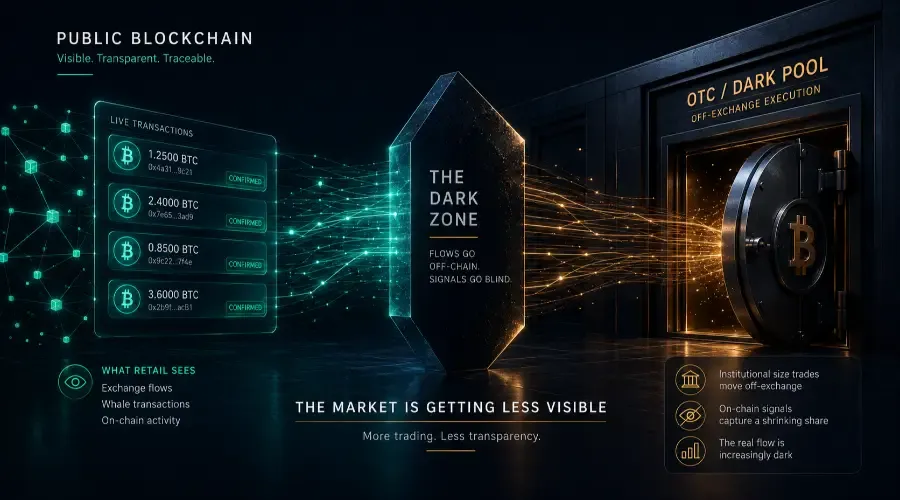
Institutional execution is moving toward OTC desks and dark pools, potentially weakening the on-chain signals behind one of crypto's most popular supply-squeeze narratives.
BREAKOUTBULLETIN · DIGITAL ASSETS / MARKET STRUCTURE
By Manish T. · August 12, 2026
For most of the last decade, on-chain analytics was crypto's genuine edge over traditional markets. You could watch money move in near real time coins leaving exchanges, whales accumulating, stablecoins being minted – with a level of transparency traditional equities could not offer.
That edge is quietly expiring. Not because the data has become wrong, but because institutional money is increasingly moving where conventional on-chain dashboards cannot fully see it.
Crypto Execution Is Moving Where On-Chain Data Can't See It
The structural migration toward off-exchange venues is beginning to show up in institutional execution data:
- Dark Pool Expansion: Prime broker sFOX reported that execution through its dark pool climbed from negligible levels in April to about 15% of its volume by June.
- OTC Dominance: OTC desks routed roughly 77.7% of institutional flow, compared with just 18.4% passing through public exchanges.
- Broadening Institutional Crypto Flow: Institutional execution is increasingly moving toward venues outside public exchange order books.
The signal isn't just the absolute volume – it is the direction and velocity of the change. A venue going from negligible to 15% of a major broker's flow in a single quarter shows crypto walking the path of traditional equities and FX, where off-exchange venues now handle a massive share of trading.
Crypto is simply moving down that path faster.
The Caveat Everyone Writes and On-Chain Analytics Signal Decay
Open almost any serious institutional report and you will find the same boilerplate disclaimer: some flows occur off-exchange through OTC desks and dark pools and therefore do not appear in exchange reserve metrics.
When off-exchange execution accelerates, on-chain analytics signal decay sets in. The share of price-relevant flow visible to public dashboards shrinks month after month. A whale-alert or netflow tracking strategy calibrated on 2021–2023 behaviour is silently losing predictive power as the sample it relies on becomes less representative of where institutional size actually trades.
The data hasn't become inaccurate; the sample has become incomplete.
Bitcoin Exchange Reserves: Is the Supply Squeeze a Mirage?
This brings us to the second-order twist contaminating the year's favorite bull case. The consensus narrative states: Bitcoin exchange reserves are falling sharply from 2020 highs, meaning coins are entering cold storage, holders won't sell, and a structural supply squeeze is developing.
On-chain, a cold-storage transfer and an off-exchange execution migration look identical. A growing share of that apparent exchange "drain" isn't diamond-handed self-custody; it's inventory rerouting to OTC desks and dark pools that never touch a public order book.
The very shift that blinds on-chain visibility also manufactures part of the bullish "supply squeeze" reading. The market is scoring an ambiguous structural shift as unambiguously bullish. When measurement and thesis erode together, investors end up highly confident in a metric that means less than it used to.
Three Second-Order Effects of Off-Exchange Liquidity
- Whale Alerts Become Lagging Noise: Flows are increasingly fragmented across 14 to 19 venues specifically to remain difficult to read. Trackers catch the residue, not the intent.
- Information Asymmetry Widens: Market makers and prime brokers see bilateral flow protected by regulatory agreements, while retail investors rely on a shrinking shadow of institutional activity on public dashboards.
- Apparent Liquidity Becomes Fragile: Bilateral OTC depth is deep during calm markets but doesn't automatically surface on public exchange order books during stress events.
The same fragmentation problem exists across traditional markets, where liquidity can be distributed between exchanges, ETFs, dark pools and other execution venues. Understanding closing-auction liquidity fragmentation, ETF flows and dark-pool activity provides a useful framework for thinking about what happens when displayed liquidity stops representing the full market.
On-Chain Analytics Isn't Dead – It's a Shrinking Sample
Crypto remains substantially more transparent than legacy markets, and composite reads combining multiple signals still provide value. The necessary adjustment is narrower: stop treating single metrics – especially exchange reserves – as absolute truth, and actively mark down their weighting as off-exchange execution grows.
The broader lesson is to treat institutional positioning signals as a composite rather than relying on any single observable metric. When execution migrates between exchanges, OTC desks, derivatives and private liquidity venues, investors need to triangulate positioning from several independent market footprints.
What to Watch: Measuring True Market Structure Beyond the Blockchain
To track institutional positioning as flow goes dark, focus on signals that leave a regulated or structural footprint:
- Basis and Funding: CME block-trade prints and offshore futures basis capture institutional flow that bypasses on-chain metrics. Institutional crypto positioning increasingly requires looking beyond exchange balances and wallet flows. Bitcoin ETF inflows, futures basis and arbitrage activity can provide a second view of institutional demand when spot execution is fragmented across OTC desks, prime brokers and other venues that are less visible on-chain.
- Options Positioning: Dealer gamma and options open interest increasingly dictate short-term spot price behavior around major strike prices.
- Order-Book Depth vs. On-Chain Signals: Compare the rate of exchange reserve declines against spot bid-ask spreads. If reserves are falling but order-book depth is thinning or spreads are widening, the "supply squeeze" is an off-exchange migration artifact.
- Prime Broker Disclosures: sFOX-type institutional crypto flow disclosures offer a direct benchmark for off-exchange migration velocity.
The Bottom Line
The market didn't get less active; execution got less visible. On-chain analytics is quietly sliding from "the whole tape" to a shrinking, biased sample and one of the year's most widely cited bullish supply-squeeze narratives is partly a measurement artifact of that migration. Read public dashboards as one lagging input, not the tape.
BreakoutBulletin publishes analytical research and education for informed investors. Nothing here is a buy or sell recommendation or personalized investment advice; the author is not a registered investment adviser. Figures are the latest available at publication, drawn largely from specialist trade and primary sources, and may be revised. Do your own research.