
Published: June 4, 2026 | Category: Catalyst Deep Dive | Read time: 6 min
All figures in this post are based on publicly available earnings release data and management commentary as of June 4, 2026. Actual outcomes can differ materially.
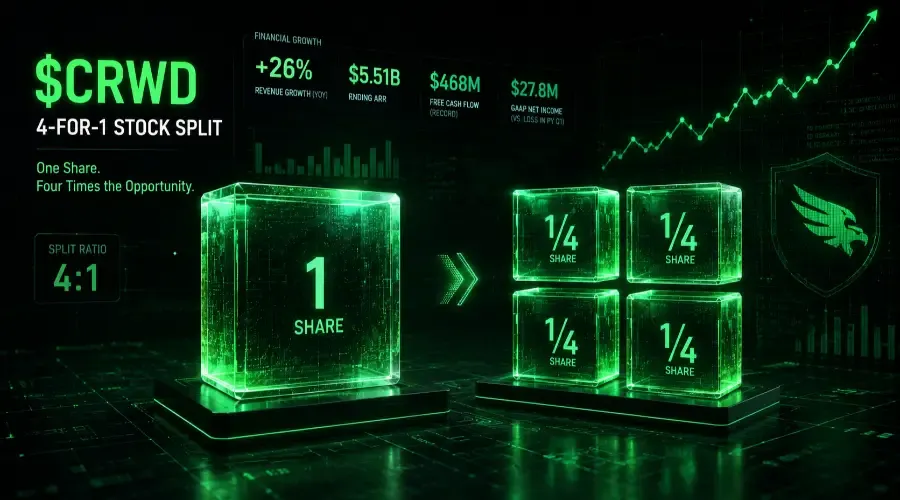
CrowdStrike ($CRWD) just reported Q1 FY2027 earnings and threw a 4-for-1 stock split into the mix. Most of the chatter is about the split. That’s the headline. The better story–the one that actually moves the needle on the stock’s valuation–is what the cash flow, the guidance raise, and a fresh GAAP profitability milestone tell you about the business.
The verified numbers
| Metric | Verified figure | Source |
|---|---|---|
| Q1 FY2027 revenue | $1.39B (+26% YoY) | Company earnings release |
| Revenue vs consensus | Beat (~$1.36B expected) | Company earnings release |
| Non-GAAP EPS | $1.10 vs $1.07 consensus | Company earnings release |
| Ending ARR | $5.51B | Company earnings release |
| Net new ARR | $256M (record Q1) | Company earnings release |
| Free cash flow | $468M (record) | Company earnings release |
| Raised FY2027 revenue guidance | $5.91B–$5.96B (midpoint +21% YoY) | Earnings call |
| GAAP net income | $27.8M (vs. GAAP loss in prior-year Q1) | Earnings release |
| Stock split ratio | 4-for-1 | Company announcement |
| Split record date | June 25, 2026 | Company announcement |
| Split-adjusted trading start | July 2, 2026 | Company announcement |
What the stock split actually means
A 4-for-1 stock split doesn’t change the underlying value of the business. If you hold 1 share at $400 before the split, you’ll own 4 shares at $100 after it. Total value is identical. It’s a cosmetic corporate action.
What splits have historically done is lower the nominal per-share price, which can make the stock more accessible for smaller retail investors. That sometimes sparks short-term bumps in trading volume and search interest around the record and split dates.
A lower share price also makes options contracts easier to trade, which can amplify near-term activity. But whether that attention turns into lasting price appreciation depends entirely on the fundamentals–not the split.
The record date is June 25. Split-adjusted trading starts July 2. If you’re tracking $CRWD around those dates, the price will adjust mechanically. A pre-split price of $400 becomes roughly $100 post-split. Market cap and business value don’t move an inch.
The cash flow story and the GAAP milestone
The operational numbers in this print are far more interesting than the split.
Free cash flow hit $468M–a record. On $1.39B in revenue, that works out to a free cash flow margin of around 33.7%. For a cybersecurity company still growing the top line at 26% year-over-year, that growth-plus-cash combo is what really supports a premium valuation multiple.
Net new ARR came in at $256M, a record for any Q1. Ending ARR crossed $5.51B, confirming that enterprise customers are sticking around and expanding. In software, net new ARR is often a cleaner signal of business health than revenue, because it reflects contracted forward commitments–renewals and expansions, not one-off deals.
And then there’s a number that changes the quality-of-earnings narrative: GAAP net income of $27.8 million. A year ago, this quarter was a deep GAAP loss. Sure, non-GAAP metrics exclude stock-based compensation, but showing a real GAAP profit signals that earnings power is getting real and that dilution from SBC is being absorbed within a growing bottom line. Wall Street tends to reward high-growth SaaS names when they cross that line, and this quarter marks the crossover.
There’s a structural reason cybersecurity cash flows tend to hold up. Enterprise security spending is usually treated as non-discretionary. Companies might delay software upgrades or cut marketing tools when budgets tighten, but they rarely slash cybersecurity spending–the liability from a breach is just too big.
On the call, CEO George Kurtz gave that narrative a forward-looking twist, calling it a “Mythos moment” – the point where frontier AI and enterprise cybersecurity collide. That framing isn’t just buzzword bingo; it positions CrowdStrike as an AI-driven platform consolidator, which could extend the growth runway well beyond traditional endpoint protection.
The multiple question – and the guidance answer
CrowdStrike trades at a big premium to the broader software sector. With a pre-split stock price near $400 and about 243 million shares outstanding, the market cap sits around $97 billion. After factoring in net cash, enterprise value is roughly $93 billion.
Annualized Q1 free cash flow lands near $1.87 billion, implying an EV/FCF multiple in the mid-40s. That’s comfortably above the ~30x median for large-cap cybersecurity peers.
The market has justified that premium based on ARR growth, FCF margin, and the inelastic demand profile of cybersecurity. But this quarter management handed investors a concrete reason to keep that faith: they raised guidance significantly.
CrowdStrike now expects full-year FY2027 revenue of $5.91 billion to $5.96 billion, a roughly 21% increase at the midpoint and well ahead of prior consensus. A guidance bump that large directly addresses the “can this growth last?” question. It tells you the record Q1 net new ARR wasn’t a one-hit wonder and that management has visibility into accelerating demand.
At $5.51B in ARR and current growth rates, the path to $7B–$8B ARR looks visible. If FCF margin keeps expanding alongside ARR growth, the premium multiple may hold. If growth decelerates or margins compress, that multiple will come down. Keep an eye on sales efficiency metrics–like the magic number or customer acquisition cost ratio–as the company scales. Moving to 35%+ FCF margins depends on whether incremental revenue arrives with lower acquisition costs from installed-base expansion, not just aggressive spending.
Risk factors worth weighing: The premium multiple also bakes in a few things that could go wrong. Competition from Microsoft’s integrated security suite and SentinelOne’s aggressive pricing could pressure market share. Cybersecurity budgets have been resilient, but a broad IT spending freeze could eventually trim growth. And if CrowdStrike were to face a major operational incident again, the trust premium could erode quickly. None of these are flashing red right now, but they’re the counterpoints that keep the multiple debate alive.
Three things to monitor
1. Net new ARR in Q2 FY2027
The $256M record sets a high bar. The raised guidance implies continued strength. Q2’s number will show whether the trajectory is accelerating or just holding steady. Deceleration in net new ARR is usually the first sign that the growth engine is losing steam.
2. Free cash flow margin trend and GAAP follow-through
FCF margin around 33.7% in Q1 is strong. With GAAP profitability now on the board, the next check is whether the company can sustain or expand GAAP net income while still investing for growth. A widening gap between non-GAAP and GAAP earnings, or a drop in FCF conversion, would raise questions about the quality of the beat.
3. Post-split trading volume and price action
Starting July 2, the adjusted share price will be roughly a quarter of the pre-split price. Expect elevated volume and possible retail-driven spikes. Any unusual price action that isn’t backed by a fundamental catalyst should be treated as noise–the guidance raise is the real signal, not the ticker change.
What this means in practical terms
If you own $CRWD: This Q1 print is more than a beat. Record FCF, record net new ARR, a guidance raise, and a GAAP profit milestone. The split doesn’t change your economic position one bit. The numbers to track going forward are net new ARR staying above $250M per quarter and FCF margin inching toward the mid-30s.
If you’re watching from the sidelines: The split may stir up retail attention around June 25 and July 2, but that’s a distraction unless Q2 fundamentals back up the raised outlook. The guidance raise and GAAP profitability give you a higher-confidence entry point if you believe the AI-driven platform narrative has staying power. But the valuation means the company still needs to execute nearly flawlessly.
If you track enterprise software broadly: CrowdStrike’s 33.7% FCF margin, 26% revenue growth, and new GAAP profitability set a high bar for peers. Companies growing at similar rates but with much lower FCF margins and no GAAP profit carry higher execution risk for a similar valuation. That dynamic could drive rotation into names that deliver this full-stack earnings quality.
FAQ
Does a 4-for-1 stock split change the value of my CrowdStrike shares?
No. If you owned 1 share at $400 pre-split, you’ll own 4 shares at $100 post-split. Total market value stays the same, and the company’s fundamentals don’t change. The split simply lowers the nominal share price.
What is net new ARR and why does it matter?
Net new ARR is the amount of annual recurring revenue added in a quarter, after subtracting any lost subscriptions. It’s a measure of how much contracted, forward-looking revenue the company locked in. For enterprise SaaS businesses, it’s a cleaner signal of real growth momentum than reported revenue alone.
CrowdStrike just reached GAAP profitability–why is that a big deal?
Many fast-growing software companies report positive non-GAAP earnings while still losing money on a GAAP basis (mainly due to stock-based compensation). When a company like CrowdStrike turns GAAP-profitable, it signals that its earnings power is becoming more concrete and that dilution is being absorbed, which investors often reward with a higher valuation.
How does the raised full-year guidance affect the stock?
Raising revenue guidance to $5.91–$5.96 billion directly tells the market that management sees strong demand ahead. It gives investors more confidence that the record Q1 net new ARR isn’t a fluke and supports the stock’s premium valuation multiple–provided the company continues to deliver.
Should I buy the stock just because of the split?
The split alone isn’t a reason to buy. It’s a cosmetic change. Any decision should be based on CrowdStrike’s underlying business performance: ARR growth, free cash flow margin, GAAP profitability trends, and whether those numbers support the current valuation.
This analysis is for educational purposes only and does not constitute investment advice. All figures are based on CrowdStrike’s Q1 FY2027 earnings release and management commentary as of June 4, 2026. Valuation multiples are approximate and based on publicly available share count and cash data. Consult a qualified financial advisor before making investment decisions. BreakoutBulletin does not hold positions in any securities mentioned.