
What Happens When Corporate Tax Rates Are Hiked
UCLA Anderson Review mapped the hidden costs of raising corporate taxes. The Rate Coalition put numbers on the economic damage. KPMG’s tax research examines whether corporate tax is good or bad for growth. The OECD tracks corporate tax revenues as global rates keep shifting. PwC covers corporate income taxes across jurisdictions. Every one of these sources gets the big picture right—corporate tax hikes reduce profits, weaken investment, and slow spending. What none of them does is translate a rate increase into the sector-by-sector earnings framework that tells equity traders exactly how much EPS falls, which sectors feel it most, and why the proposal phase matters as much as the passage. Because corporate tax hikes are the only policy event in this series where the stock market impact can be estimated with enough sector-specific precision to act before the legislation passes.
Why This Matters More Than Most Traders Realize
A corporate tax hike is a fundamentally different animal from every other policy event in this series. Fed rate hikes work through financial conditions—imprecise, lagged, and dependent on how companies respond to higher borrowing costs. PBOC stimulus works through commodity demand—observable but uncertain in magnitude. A corporate tax rate increase, on the other hand, works through a direct, mathematical reduction in after-tax corporate earnings that you can rough out before the bill lands on the president’s desk.
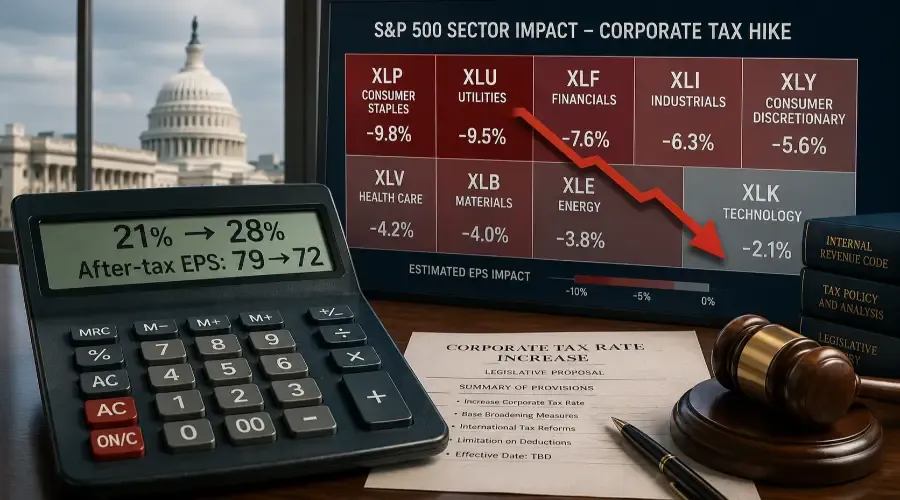
The arithmetic is simple enough to run in your head. If the US corporate tax rate rises from 21% to 28%, the increase represents 7 percentage points on every dollar of domestic pre-tax corporate profit. For a company with 100 inpre−tax earnings :at 2179 after tax; at 28% it earns $72. That is an 8.9% reduction in after-tax earnings – mechanically, before any behavioural response. Applied to the S&P 500, where analysts publish consensus pre-tax earnings estimates, a 7 percentage point rate increase translates to approximately 8–10% lower EPS as a rough, back-of-the-envelope estimate.
But here’s the catch. The “precise” number depends on the whole tax package, not just the statutory rate. Corporate tax legislation almost always bundles rate changes with adjustments to deductions, international provisions (GILTI, BEAT), bonus depreciation, and interest-expense limitations. That means the final effective-rate hit for any given sector won’t be perfectly knowable from the headline rate alone. You can get close enough to rank sectors by vulnerability, but you shouldn’t mistake the initial arithmetic for a two-decimal-place certainty. The framework gives you a compass, not a GPS pin.
Even with those limits, the stock market impact of corporate tax hikes creates the most specific sector positioning opportunity in the series: the sectors with the highest domestic effective tax rates face the largest S&P 500 EPS impact; those with the lowest effective rates face the smallest. [LINK: Central Bank Hub]
Regime Change: A Legislative Event With a Different Timing Pattern
Corporate tax hikes are regime changes—they permanently alter the after-tax return on every investment made by every US corporation until Congress changes them again. But unlike Fed policy (announced at predetermined FOMC meetings) or PBOC stimulus (announced through state media), corporate tax legislation follows a congressional calendar that is inherently uncertain in both timing and final rate.
This uncertainty creates a unique market dynamic: the equity market prices the probability-weighted tax hike as legislation moves through Congress. When a corporate tax hike is proposed (probability: 10–20%), the market discounts a fraction of the full EPS impact. When it passes a committee (probability: 40–60%), more is discounted. When it passes both chambers and is signed (probability: 95–100%), the final discounting occurs. At each stage, the market reprices the affected sectors by the incremental probability increase multiplied by the expected EPS impact.
One practical note: “probability” isn’t a ticker symbol. Different prediction markets, DC analysts, and betting sites produce different numbers. So rather than fixate on a specific percentage, it’s usually better to anchor decisions to observable legislative triggers—for instance, when a budget resolution with reconciliation instructions passes, when a key committee reports a bill, or when a pivotal senator announces support.
Three timing phases matter:
Proposal Phase
Congressional leaders announce intention to raise the corporate rate. Markets begin applying probability weights. Sectors with high domestic effective tax rates begin underperforming. This is the maximum positioning window—lowest prices for the defensive trade.
Legislative Progress Phase
Bill advances through committees, floor votes, and reconciliation. Probability estimate rises. Additional sector underperformance as the probability-weighted EPS reduction increases.
Passage or Failure Phase
If passed, final EPS repricing occurs—but often modest if legislation was fully expected. If failed, sharp reversal as sectors that had priced the hike rapidly recover.
The critical insight: the maximum trading opportunity is in the proposal phase, not the passage phase—because by passage, the market has already done most of the repricing. This is the opposite of most macro events where the data release or announcement is the entry signal.
The Three Channels of Impact
Channel 1 – Direct EPS Reduction.
The most immediate and most calculable channel. Every dollar of US domestic pre-tax corporate profit is reduced by the rate increase. S&P 500 consensus EPS estimates are revised lower by analyst consensus teams within days of legislation reaching a high probability of passage. Remember, though, that the actual EPS hit also depends on whether the bill alters deductions, credits, or other base-broadening measures; the statutory rate change alone is only the starting point.
Channel 2 – Capex and Investment Reduction.
Higher corporate taxes reduce the after-tax return on capital investment. Projects that generated an 8% after-tax return at 21% tax generate only 7.2% after-tax at 28%. Capital allocation decisions—factory expansions, equipment purchases, R&D investment—are deferred or cancelled when after-tax returns fall below hurdle rates. This channel transmits to XLI capital goods order books within two to four quarters of passage.
Channel 3 – Shareholder Return Reduction.
Corporate buybacks and dividends are funded from after-tax free cash flow. Higher tax rates reduce the pool available for both. XLK technology companies—the S&P 500's largest buyback generators—see their EPS growth trajectory slowed when buyback capacity is reduced by higher tax burdens. This channel is less visible than direct EPS reduction but sustained over multiple years. Over longer horizons, companies often adjust by shifting financing structures or accelerating deductible expenses, so the initial sector disadvantage can narrow; the framework captures the initial impact, not the permanent equilibrium.
Sector Scorecard: Who Pays More
The most important variable for sector positioning is the effective tax rate—the actual taxes paid as a percentage of pre-tax income, which varies dramatically by sector due to international tax structures, accelerated depreciation, and industry-specific tax provisions. The ranges provided below are broad sector averages; individual companies within each sector can deviate meaningfully, so always check company-level filings before sizing positions.
Consumer Staples (XLP) – Most Affected – Immediate.
XLP companies – domestic food and household goods manufacturers – pay among the highest effective tax rates in the S&P 500 (typically 22–26%). They have limited offshore tax planning capacity because they earn primarily domestically, cannot easily shift IP to low-tax jurisdictions, and do not have the complex international structures available to technology companies. This domestic concentration is why the XLP corporate tax impact is so pronounced. A rate hike from 21% to 28% produces the largest direct EPS reduction in XLP relative to other sectors. Expect XLP analyst estimate reductions of 8–12% on a 7-point rate increase.
Utilities (XLU) – Most Affected – Immediate.
Regulated utilities earn almost entirely domestically, have minimal offshore operations, and pay effective rates close to or above the statutory rate due to limited tax planning alternatives. XLU also faces a specific structural challenge: rate regulators typically reduce allowed utility returns when tax rates rise—because the tax benefit of infrastructure investment is partially passed through in the rate-setting formula. The XLU corporate tax impact is comparable to XLP; expect EPS estimate reductions of a similar magnitude on any corporate rate increase.
Financials (XLF) – Significantly Affected – 1–3 Months.
Banks pay effective tax rates typically in the 20–25% range and have limited offshore tax planning capacity (banking licenses are jurisdiction-specific). A corporate rate hike reduces bank after-tax earnings proportionally. XLF also faces a secondary impact: higher corporate taxes reduce the attractiveness of the leveraged buyout and corporate financing transactions that generate investment banking revenue, modestly affecting the capital markets-focused XLF names.
Consumer Discretionary (XLY) – Moderately Affected – 1–3 Months.
Retail, restaurants, and domestic consumer businesses pay effective rates in the 20–25% range with limited offshore planning capacity. The EPS reduction is material but smaller than XLP and XLU because XLY contains some globally diversified brands (luxury, auto) with lower effective rates from international structures.
Industrials (XLI) – Moderately Affected – 1–3 Months.
Industrial manufacturers typically pay effective rates of 20–24%. The capex reduction channel is most significant for XLI: when after-tax returns on capital investment fall, the capital goods orders that drive XLI revenue decelerate. This secondary channel adds 12–18 months of underperformance beyond the direct EPS reduction.
Technology (XLK) – Least Affected – 1–3 Months.
XLK is the most frequently misidentified victim of a corporate tax hike. Technology companies have historically maintained effective tax rates of 13–18% – well below statutory rates – through offshore IP holding structures, R&D tax credits, and geographic revenue allocation to low-tax jurisdictions. A US statutory rate increase from 21% to 28% has a smaller percentage impact on a company already paying 15% effective because the gap between their effective rate and the statutory rate narrows but the direct EPS hit is smaller than for companies paying close to the statutory rate. Crucially, this insulation isn’t ironclad: if the legislative package tightens international provisions (GILTI minimum tax, BEAT rules) alongside the statutory rate hike, XLK’s advantage shrinks. Always check the international sections of the bill before overweighting tech.
Health Care (XLV) – Moderately Affected – 1–3 Months.
Pharmaceutical companies have significant international revenue but also complex global tax structures. Medical device manufacturers are more domestically exposed. The net XLV effective rate varies widely – 14–22% depending on the sub-sector. The international provisions in any tax bill matter more for XLV than the statutory rate change itself.
Materials (XLB) and Energy (XLE) – Moderately Affected – 1–3 Months.
Both sectors have significant domestic revenues with some international diversification. XLE specifically has oil and gas tax preferences (depletion allowances, intangible drilling cost deductions) that may or may not survive a tax hike bill – creating additional earnings uncertainty beyond the rate change itself.
Historical Cases
2017 TCJA – The Reverse Case (Tax Cut, Not Hike)
The Tax Cuts and Jobs Act reduced the US corporate rate from 35% to 21% – the clearest modern data point for corporate tax change impacts, run in reverse. S&P 500 EPS jumped approximately 10% in 2018 from the tax change, alongside base-broadening measures and a one-time repatriation provision that complicates a pure rate-cut attribution. XLP and XLU saw the largest EPS gains (highest effective rate reduction). XLK saw the smallest percentage benefit (already paying low effective rates from offshore structures). The mirror logic applies to a tax hike: the sectors that gained most from the cut will lose most from an equivalent increase, but only if the new bill’s structure mirrors the 2017 package, which it rarely does exactly.
2021 Build Back Better Proposal – The Failed Hike
The Biden administration's 2021 Build Back Better proposal included a corporate rate increase from 21% to 26.5%. As the bill moved through Congress in 2021, XLF, XLP, and XLU underperformed as markets priced the probability-weighted EPS reduction. When Senator Manchin announced his opposition and effectively killed the corporate tax provisions in December 2021, those sectors recovered sharply – producing the classic "failed legislation reversal trade." This episode demonstrates that the proposal phase creates positioning opportunity and the failure creates the reversal trade, independent of any actual rate change occurring. Keep in mind that the same period included Omicron volatility and a hawkish Fed pivot, which likely amplified sector moves beyond the pure tax probability effect.
The Trading Playbook
Before
Monitor congressional leadership statements and budget reconciliation timelines. Corporate tax hike legislation requires a budget reconciliation process when the party lacks a 60-vote supermajority – which limits the timing to specific congressional windows. When congressional budget resolutions include corporate tax increase instructions, the proposal phase has begun and the positioning window is open.
Calculate sector-specific EPS impact immediately when a specific proposed rate is announced. Divide the rate increase in percentage points by the rough after-tax earnings margin for each sector. XLP: 7 point hike ÷ current after-tax margin × effective tax rate = estimated EPS impact. This calculation, run across sectors using publicly available consensus data, provides the sector vulnerability ranking before any analyst revisions have been published. But remember to overlay the rest of the bill: base-broadeners and international provisions can shift the ranking, so treat this as a starting point, not a final number.
Track concrete legislative triggers, not just generic probability estimates. For example: (1) inclusion of a corporate rate hike in a budget resolution, (2) House Ways and Means Committee markup, (3) Senate Finance Committee vote, (4) public whip counts or statements from pivotal senators. These milestones give you cleaner entry and exit signals than an abstract probability percentage.
Scan for capital gains provisions in the same bill. If a corporate tax hike is bundled with a capital gains tax increase in a large reconciliation package, the sector dynamics can become more complex: the pre-hike selling rush from the CGT side could create additional pressure on growth-heavy sectors like XLK, partially offsetting the corporate-tax insulation. A quick cross-reference can prevent being blindsided.
During
Underweight XLP and XLU immediately when a concrete legislative trigger (e.g., budget resolution passage with tax instructions) signals a high likelihood of a corporate rate increase. These sectors have the highest domestic effective tax rates and the fewest tax planning alternatives. Size positions for the distance from the current legislative stage to final passage, not for the full EPS impact immediately.
Reduce XLF below benchmark weight for the domestic banking effective rate exposure. Add selectively to XLK only if the bill’s international provisions remain unchanged from current law; if GILTI, BEAT, or other anti-base-erosion measures are tightened, XLK’s insulation weakens and you should reduce the XLK overweight accordingly.
Monitor international provisions alongside the domestic rate – specifically GILTI (Global Intangible Low-Taxed Income) minimum tax rates and BEAT (Base Erosion and Anti-Abuse Tax) rules. When these international provisions tighten alongside the statutory rate increase, XLK's international tax planning capacity is constrained and the XLK underweight should be larger than the statutory rate analysis alone would suggest.
After
If legislation passes: The market typically reprices the remaining probability gap on the passage day but has already absorbed most of the EPS revision through the legislative process. The sustained underperformance of high-effective-rate sectors continues into the next two quarterly earnings cycles as analysts fully revise their models. Over multi-year horizons, companies will adjust—shifting supply chains, accelerating deductions, altering capital structures—so the initial sector performance gaps tend to narrow. Monitor for signs of tax-driven restructuring that could erode the edge.
If legislation fails: Immediately reverse all underweights – XLP, XLU, and XLF typically recover 3–5% relative to SPY within two weeks of legislation failure confirmation. The fastest-moving positions are in the most domestic, highest-effective-rate companies that had the most exaggerated probability-weighted EPS discounts during the proposal phase.
The 3 Mistakes Most Retail Traders Make
Mistake 1: Assuming All Sectors Are Equally Affected.
The most common corporate tax hike error is applying uniform bearishness across the S&P 500 without differentiating by effective tax rate. A 7 percentage point statutory rate increase produces approximately 9% EPS reduction for a domestic utility paying 24% effective rate – and approximately 4% EPS reduction for a technology company paying 16% effective rate through offshore IP structures. Selling XLK and XLP equally on a corporate tax hike announcement misprices the differential impact that effective rate analysis reveals in minutes.
Mistake 2: Waiting for Passage to Position.
The maximum positioning window is the proposal phase – when legislation probability is still low and the market is discounting only a fraction of the full EPS impact. By the time legislation passes with near certainty, most sectors have already absorbed 70–80% of the EPS repricing through the probability-weighted discount accumulated during the legislative process. Late positioning after passage captures only the residual 20–30% of the impact at a much worse risk-reward ratio.
Mistake 3: Ignoring the Failed Legislation Reversal.
The third mistake is holding underweight positions in XLP and XLU after a corporate tax hike bill has clearly failed – a common error because the fundamental concern about future tax legislation lingers after a specific bill fails. When a specific bill is confirmed dead – a key senator's public opposition, a House vote failure, or a presidential veto – the probability drops to near zero and the reversal is complete and rapid. Failed legislation reversals have historically produced 3–5% outperformance in the most affected sectors within two weeks. Holding the underweight through the reversal gives back a significant portion of the gains from the proposal-to-passage positioning.
Bottom Line: A Context-Aware Institutional Framework
When corporate tax hike legislation reaches a high likelihood of passage – signaled concretely by a budget resolution with reconciliation instructions, committee approval, or whip counts showing sufficient votes – immediately underweight XLP and XLU (highest domestic effective rates, least planning flexibility), moderately underweight XLF and XLI, maintain or slightly reduce XLK (offshore structures provide partial insulation, but only if international provisions aren’t tightened simultaneously), and reverse all underweights immediately upon confirmed legislative failure.
This framework works across cycles because corporate tax rates are among the most estimable policy impacts in financial markets. The EPS mathematics give you a directional edge, the sector differentiation by effective rate is documentable, and the legislative signal is observable through concrete congressional milestones. What it won’t give you is perfect precision, because every tax bill is a multi-dimensional package and markets adjust over time. Use the framework to rank sectors and time phases, not to bet on a single decimal-point outcome.
Run this scenario through the [Breakout Bulletin Ripple Engine](LINK: Ripple Engine Tool) to see how a corporate tax rate increase transmits across all twelve sectors, with sector-specific effective rate adjustments that distinguish the high-domestic-rate victims from the internationally-structured partial insulators.
Frequently Asked Questions
Q1. What happens to stocks when corporate taxes rise?
When corporate taxes rise, company after-tax earnings decline mechanically, which usually leads to lower EPS estimates and sector repricing in the stock market.
Q2. Which sectors are most affected by corporate tax hikes?
Utilities (XLU), Consumer Staples (XLP), and Financials (XLF) are often the most affected because they typically pay higher domestic effective tax rates.
Q3. Why are technology stocks less affected by corporate tax hikes?
Many technology companies use international tax structures, offshore intellectual property arrangements, and tax credits that lower their effective tax rates.
Q4. How do corporate tax hikes reduce S&P 500 EPS?
Higher tax rates reduce after-tax corporate profits. For example, a rise from 21% to 28% can reduce earnings by roughly 8–10% depending on sector exposure.
Q5. What is the proposal phase in corporate tax legislation?
The proposal phase is when lawmakers first announce plans for higher corporate taxes. Markets begin pricing the probability of future EPS reductions before legislation passes.
Q6. Why is the proposal phase important for traders?
The largest sector repricing often occurs during the proposal phase because markets gradually discount the probability of passage over time.
Q7. What happens if a corporate tax hike bill fails?
Sectors that previously underperformed due to expected tax increases often rebound sharply once legislation officially fails.
Q8. How do effective tax rates affect sector performance?
Sectors with higher effective tax rates experience larger EPS reductions during corporate tax hikes, making them more vulnerable to underperformance.
Q9. How do corporate tax hikes affect investment and capex?
Higher taxes reduce after-tax returns on investment projects, which can slow corporate spending, expansion plans, and industrial demand.
Q10. How should investors position during corporate tax hike discussions?
Many investors reduce exposure to high-tax domestic sectors while favoring companies with lower effective tax rates and stronger international tax flexibility.
Key Takeaway: The stock market impact of corporate tax hikes isn’t uniform. Sector rotation after tax hikes follows a predictable pattern—high effective tax rate sectors like XLP and XLU absorb the largest S&P 500 EPS impact, while internationally-structured tech names partially dodge the hit. The proposal vs passage trade dynamic means the real edge is in positioning early, during the legislative probability ramp, not after the bill is signed. And if the legislation fails, the reversal in beaten-down domestic sectors can be as sharp as the initial selloff. A clear-eyed corporate tax trading strategy respects both the arithmetic and the messy reality of congressional negotiations.
This post is part of the BreakoutBulletin "What Happens When" series. [LINK: Central Bank Hub] · [LINK: Series Pillar Page]
Educational content only. Not investment advice. Past sector performance patterns do not guarantee future results.