
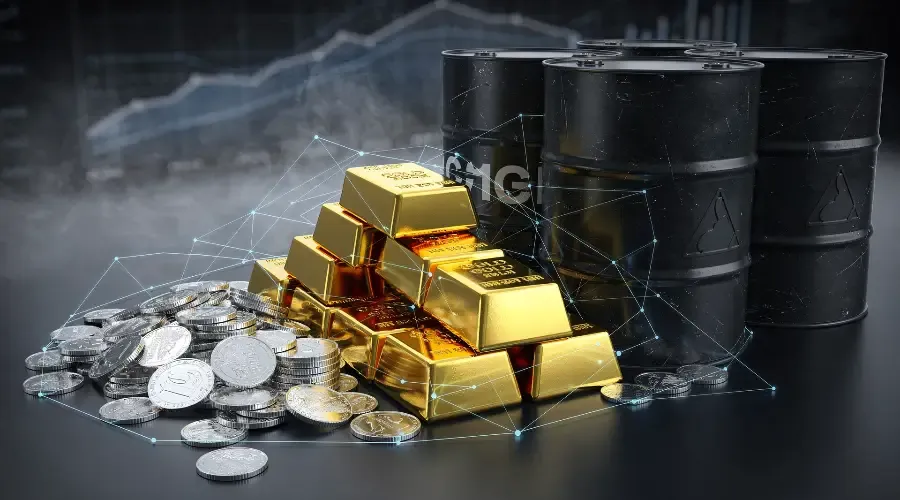
January 2026's commodity moves look random:
- Gold: Testing $5,000, +11% monthly
- Silver: Rocketed 37% to $103
- Oil: Stuck around $61, range-bound
But these markets are telling a coherent story about three forces reshaping the economy:
- Central banks losing faith in pure dollar reserves
- Energy transition creating new demand patterns
- Geopolitical fragmentation disrupting trade
Here's how to read what they're actually saying.
Pattern #1: The De-Dollarization Signal
Gold: Countries bought ~70 tonnes monthly in 2025 (World Gold Council). China, India, Turkey diversifying after watching Russian dollar assets frozen in 2022. Gold can't be sanctioned.
Oil: Should spike on Middle East tensions. Instead, range-bound $59-70. Dollar weakening pressures oil up, recession fears cap gains.
The connection: When central banks buy gold over dollar bonds, it signals currency stability concerns and geopolitical fragmentation making dollar reserves feel less secure.
For regular people: If de-dollarization accelerates, imports become more expensive (weaker dollar). Your grocery bill and gas reflect global currency dynamics.
Pattern #2: Energy Transition Winners and Losers
Silver: 37% surge reflects booming industrial demand—solar panels (20g each), EVs (25-50g each), electronics. Analysts project 8-12% annual demand growth through 2028.
Oil: At $61, pricing in slow-motion transition. Demand isn't collapsing (decades-long process), but growth slowing. U.S. production at 13.8M bpd shows fossils aren't disappearing—but renewable investment redirecting capital.
The connection: Shift from fossil fuels requires massive quantities of certain materials (silver, copper, lithium) while reducing long-term demand for others (oil, coal, gas).
Silver outperforming gold reflects this: monetary demand (like gold) PLUS industrial demand (unlike gold).
For regular people: Electrification costs money upfront (EVs expensive, solar installation) but potentially saves long-term (no gas, lower electric bills). Commodity prices reflect transition growing pains.
Pattern #3: Geopolitical Fragmentation Premium
Across commodities:
- Gold: Safe-haven adds $75-100/oz (Goldman Sachs)
- Oil: Brent trades $5 above WTI (global supply faces more geopolitical risk)
- Silver: Less directly affected, but industrial demand depends on stable supply chains
The connection: World fragmenting into economic blocs (U.S./Europe/allies vs. China/Russia/aligned). Creates supply chain vulnerabilities, trade route risks, pricing premiums for "geopolitical insurance."
What's different: Previous crises (2019 Saudi attack, 2011 Libya) were temporary. Current fragmentation feels structural—reshaping how countries trade and align.
For regular people: Fragmentation increases volatility. Coffee from one region might face tariffs; electronics from another might face sanctions. Makes budgeting harder.
Reading the Mixed Signals
Gold up: De-dollarization and geopolitical hedging outweigh real interest rate headwinds.
Silver up more: Industrial demand layered on monetary demand creates dual drivers.
Oil stuck: Geopolitical supply risks balanced by recession demand fears and U.S. production growth.
What divergence tells us:
- Growth expectations mixed: strong enough for industrial silver, weak enough to worry about oil
- Inflation fears moderate: real rates (~1.5%) positive but not spiking
- Geopolitical risks persistent but not exploding
Short-Term Noise vs. Long-Term Trends
Short-term (3-6 months):
- Fed decisions move markets more than fundamentals
- Geopolitical headlines create volatility
- Monthly data swings sentiment
Gold could range $4,700-$5,200. Silver $95-$115. Oil $55-$70.
Long-term (3-5 years):
- De-dollarization unfolds over years/decades
- Energy transition requires 10-20 years to substantially shift energy mix
- Geopolitical fragmentation could persist or reverse with political changes
Honest takeaway: Commodities are volatile short-term but often signal deeper shifts. Don't overreact to monthly moves, but pay attention to trend direction.
What This Means for Your Life
For consumers:
- Gas likely stays $3-4/gallon unless geopolitics explode or recession hits
- Gold/silver rallies suggest some worry about purchasing power erosion
- Energy transition costs may stay elevated until economies of scale
For savers/investors:
- Diversification matters more when currencies, geopolitics, energy all shifting
- Volatility (10-20% commodity swings in months) is normal
- Time horizon matters: long-term trends play out over years
For economic awareness:
Commodities are "smoke detectors"—don't cause the fire, but alert you to:
- Central bank concerns (gold)
- Growth trajectory (oil, industrial metals)
- Structural transitions (silver, green materials)
Practical Insights
- Don't chase monthly moves: Silver +37% doesn't mean another +37% next month
- Understand drivers: Gold rallies on different factors than oil
- Follow real data: Weekly oil (EIA Wednesdays), monthly central bank gold, inflation reports
- Key monitor: Real interest rates (TIPS yields)—above 2% creates headwinds for most commodities
Sources:
- TradingEconomics, Jan 23, 2026: Gold $4,990/oz (+11.22%); Silver $103.38/oz (+37.40%); WTI $61.07/bbl
- World Gold Council, 2025: ~70 tonnes/month central bank purchases
- EIA, week ending Jan 16: Inventories +3.6M barrels
- Silver Institute/Metals Focus, 2025: 8-12% annual demand growth projections
- Bloomberg, Jan 23: Real yields ~1.5%; Brent-WTI spread ~$5
Note: Commodity markets involve significant volatility and risk. Educational context only, not financial predictions or advice.