
Educational purpose only. This analysis explains how professionals interpret commodity markets. It is not investment advice. Commodities carry high risk, including potential total loss of capital.
Why This Matters Right Now
Markets are currently reacting to Winter Storm Fern, with headlines focused on supply disruptions and price spikes. But beneath the surface, commodity markets are telling a more complex — and more educational — story.
The key takeaway:
Prices are reacting to short-term weather shocks, while fundamentals still point to oversupply and slowing demand.
This creates a perfect real-world case study on how professional analysts separate temporary price noise from sustainable trends.
The Biggest Market Divergence: Natural Gas
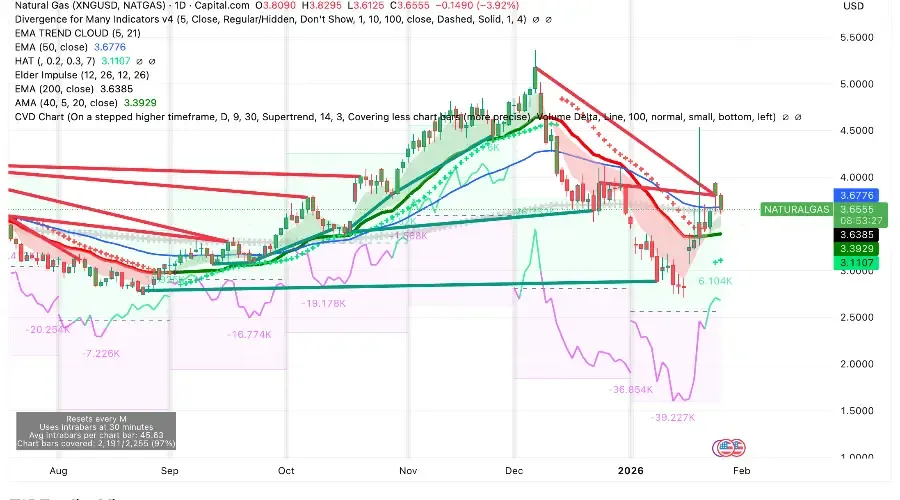
Natural gas recorded its largest weekly gain on record, surging +120% to $6.56/MMBtu (CME, January 26 close).
At first glance, this looks like a breakout. But institutional analysts see it differently.
What’s driving the surge?
- Winter Storm Fern froze 10–12% of U.S. gas production
- Heating demand spiked sharply
- Short-term panic buying lifted futures prices
Why professionals doubt the rally’s durability:
- Production is already recovering
- Seasonal heating demand is temporary
- ETF flows show capital exiting, not entering
- Storm-driven spikes historically reverse within 2–4 weeks
Teaching insight:
Weather can move prices short-term, but supply-demand balance controls long-term direction.
Crude Oil: Prices Rising While Inventories Build
Crude oil prices reacted to storm disruptions, but the underlying data tells a different story.
- U.S. crude inventories rose +3.6 million barrels (EIA, week ended Jan 16)
- Markets expected only a +1.1M build
- This happened despite storm-related production outages
At the same time:
- OPEC+ is pausing production increases
- The IEA forecasts a 3.7 million bpd global surplus in 2026
- Futures curves show minimal backwardation, signaling no real physical shortage
What this teaches:
If prices rise but inventories also rise, the market is likely reacting to temporary disruption — not true scarcity.
Macro Backdrop: Supportive for Metals, Weak for Energy
Federal Reserve Policy
Markets expect the Fed to hold rates at 3.50%–3.75% after prior cuts in late 2025.
Rate-cut expectations for mid-2026 have slowed, signaling a more cautious easing cycle.
U.S. Dollar Weakness
The dollar index (DXY) is down ~9.86% YoY, historically supportive for:
- Gold
- Copper
- Precious metals
Global Growth Signals
- U.S. manufacturing PMI: 51.9 (weak improvement)
- China manufacturing PMI: 50.1 (barely expanding)
- China’s 2026 growth projected near 4.6%
Interpretation:
Metals reflect structural transition demand, while energy reflects cyclical slowdown risk.
Gold: The Strongest Conviction Signal
Gold continues to consolidate above $5,000/oz, up 17.6% YTD.
Why gold remains structurally supported:
- Fed pause lowers real rate pressure
- USD weakness improves gold’s relative value
- Geopolitical risks support safe-haven flows
- Central bank buying remains steady
This places gold in a Level-2 Conviction Zone — meaning multiple factors align, but not enough yet for full trend expansion.
Teaching insight:
Gold trends strengthen when currency, real rates, and risk sentiment align. Two out of three remain supportive today.
Silver: A Retail-Driven Rally With Institutional Caution
Silver has surged 51% YTD, reaching approximately $110/oz — but positioning data reveals a warning sign.
- ETF holdings have fallen
- COMEX net long positioning is near a two-year low
- This suggests retail buyers are driving price, not institutions
Historically:
Retail-driven parabolic rallies tend to correct 20–30% once momentum fades.
Lesson:
Price momentum without institutional confirmation often signals late-cycle enthusiasm.
Copper: Structural Strength, Short-Term Uncertainty
Copper remains near record highs at $5.91–$5.98/lb, reflecting:
- Renewable energy demand
- EV and grid expansion
- Infrastructure transition themes
But near-term risk remains:
- China manufacturing growth is fragile
- Momentum indicators show cooling
- A pullback toward $5.72–$5.80 support remains possible
Professional view:
Copper often leads global growth signals by 3–6 months — consolidation suggests markets are waiting for confirmation.
Agriculture: Supply Is Comfortable, Inflation Pressure Eases
Grain markets remain soft:
- Corn down ~11.7% YoY
- Wheat down ~3.9% YoY
- Soybeans relatively stable
Drivers include:
- High U.S. inventories
- Favorable South American harvest conditions
- Weak export demand
Why this matters:
Lower grain prices today often lead to:
- Lower livestock feed costs
- Lower meat prices in 3–6 months
- Reduced food inflation later in 2026
Teaching insight:
Agricultural commodities impact inflation with long time lags — current weakness suggests softer food CPI ahead.
Institutional Conviction Framework: What’s Strong vs Weak
Strongest Signal: Gold (Level 2 Conviction)
Aligned factors:
- Fed pause
- Weak USD
- Safe-haven demand
- Price holding above $5,000
Weakest Signal: Natural Gas (Level 1 Conviction)
Single-factor move:
- Weather-driven
- Temporary supply disruption
- High historical reversal probability
Crude Oil
Conflicting signals → low conviction
Silver
Momentum without institutional backing → elevated reversal risk
Key Lesson for Traders & Analysts
Professional commodity analysis always asks one question:
Is price confirming fundamentals — or contradicting them?
Right now:
- Natural gas = price ahead of fundamentals
- Crude oil = price masking oversupply
- Gold = price aligned with macro drivers
- Silver = price ahead of institutional positioning
This is exactly how professionals learn to filter real signals from temporary noise.
Final Educational Disclaimer
This report explains how institutional analysts interpret commodity markets.
It does not provide trade recommendations or investment guidance.
Commodity markets involve high leverage, extreme volatility, and risk of total capital loss.
Always verify data independently and consult licensed professionals before making financial decisions.