
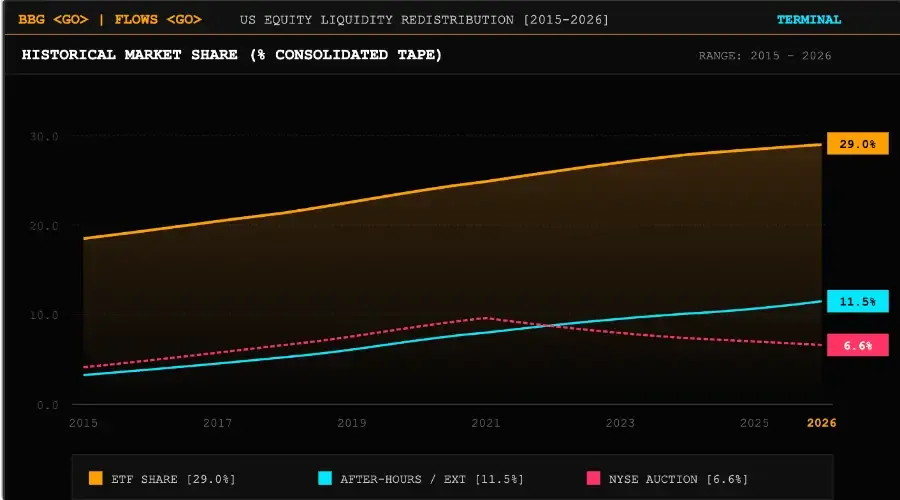
| Venue | Share of Total U.S. Equity Volume | Trend vs. 2019 |
|---|---|---|
| NYSE Closing Auction | ~6.6% (record absolute shares) | Down from ~10% relative share |
| ETF Trading | 29% (all-time high) | Up from ~20% |
| After-Hours (Pre + Post) | >11% | Up from ~5%; doubled in 5 years |
| Off-Exchange / Dark Pools | ~50% | Up from ~40% |
The auction is still the biggest single event of the day.
But it is no longer the whole game–and in relative terms, it is getting smaller.
Why the Close Ruled, and Why Its Grip Is Slipping
The closing auction became dominant because of passive indexing.
When the bell rings, the exchange matches a massive batch of orders at one price the official close.
That price values mutual funds, sets ETF NAVs, and benchmarks performance.
Index funds are almost obligated to trade there because any gap between their fill and the official close shows up as tracking error.
Over fifteen years, this concentrated flow turned the close from a sleepy 3.1% of daily volume into the single largest liquidity event.
But here is the catch: the other channels are exploding faster.
ETF trading now accounts for nearly a third of all market volume.
Extended-hours trading has doubled as a share of activity, with the pre-market session alone growing 15x since 2019.
Off-exchange venues now regularly execute more than half of all U.S. equity trades.
Liquidity no longer concentrates in one moment–it is spread across venues and across the clock.
The Real-World Cost of Fragmented Liquidity
Where liquidity sits determines what a price actually means.
When execution scatters across ETFs, dark venues, and overnight sessions, the old institutional playbook starts to break down in three very specific ways:
The VWAP Algorithm Trap: The workhorse VWAP algorithm slices orders across the day to match the historical volume curve. But that historical curve assumed liquidity was centralized in the daytime session. Now, with a massive share of flow migrating into the closing auction, ETFs, and after-hours, an algo keyed to old history can trade too much into thin intraday windows and too little into the deeper ones.
The "Safe Close" Mirage: Benchmarking to the close treats the auction as a bottomless pool. But as its relative share thins, a strong, orderly close can mask weak intraday depth. Meanwhile, after-hours volume has grown so large that an earnings print or geopolitical headline can fully reprice a stock overnight, before the daytime market gets a chance to absorb it in an orderly way.
The Lit Quote Illusion: Because more than half of all flow now prints off-exchange, the lit quote on your screen represents a significantly smaller slice of true available liquidity than it used to. The screen looks the same. What it's telling you has changed–and that gap is exactly where execution costs and risk surprises hide.
Who Feels It - and How
These shifts don't land on everyone equally.
Market makers and electronic liquidity providers thrive on routing complexity; fragmentation is their home field.
ETF-heavy platforms are riding the fastest-growing channel.
The friction lands elsewhere.
Strategies that assume deep, stable closing-auction liquidity, or that rely on simple VWAP execution and casual after-hours risk management, face a trickier environment than their models assume.
The names most exposed are the ones with the least cushion: small- and mid-cap stocks.
NYSE data shows that over 6.3% of auction volume goes unfilled in these names due to a lack of contra-side liquidity–and one out of every three closing auctions for small-caps has a meaningful portion of volume cancelled back to participants.
The Rules Are Loosening in the Same Direction
The regulation is moving in tandem with the behavior.
On June 11, 2026, the SEC proposed rescinding Rule 611–the Trade-Through Rule that has enforced centralized best-price protection since 2005.
At the same time, the SEC delayed tick-size and access-fee reforms to November 2027.
The policy scaffolding that enforced one protected national price is loosening exactly as liquidity fragments in practice.
That's not a coincidence; it's the same story told twice, once by the tape and once by the rulebook.
Three Signposts to Watch
- ETF share of total volume: If it pushes past 30%, the fragmentation story accelerates.
- After-hours volatility around earnings: The clearest live test of overnight repricing risk.
- Small-cap auction unfilled rates: If the 6.3% figure widens, it signals deepening pressure on less-liquid names.
The Bigger Picture
Markets aren't just a scoreboard of prices–they are plumbing, and the plumbing is being rebuilt in real time.
The closing bell still rings, still sets records, and still commands attention.
But the water is increasingly flowing through pipes you can't see from the trading-floor camera: ETFs, dark venues, and the overnight session.
For anyone trying to read the market, that reframes the job.
Direction is only half of it.
The other half is knowing where liquidity actually forms, at what time of day, and through which venue–because that is what decides whether a move is real, fragile, or just an artifact of where the money happened to be trading.
In a fragmenting market, the plumbing is the signal.
Related Reading
The Oil–Yield–Equity Loop: How an Energy Shock Moves the Whole Market → https://www.breakoutbulletin.com/article/oil-yield-equity-loop-cross-asset-transmission
Financials Sector Analysis: A Hawkish Fed Hold and a 19-Year-High Long Bond → https://www.breakoutbulletin.com/article/financials-sector-analysis-fed-rate-hold-xlf
Disclaimer
BreakoutBulletin publishes educational and analytical content only. Nothing here is investment, financial, legal, or tax advice, or a recommendation or solicitation to buy, sell, or hold any security. Market-structure figures and regulatory details reflect information available as of the publication date and are drawn from public sources (including exchange data, liquidity-provider research, and SEC filings); rules, proposals, and figures may change or be revised. Past performance does not indicate future results. Readers should conduct their own research and consult a qualified, registered financial adviser before making any decision.
Data Sources
NYSE Research & Analytics, "Behind the Record Volumes: A Hidden Opportunity" (April 2026)
Bogousslavsky & Muravyev, "Who Trades at the Close?" (AEA 2021)
Tethys Technology, "Auction Volume Report: Americas" (August 2025)
NYSE, "The Early Bird Gets the Worm" (February 2025)
SEC, "Statement on Proposed Amendments to Regulation NMS" (June 11, 2026)
SEC, "Order Granting Temporary Exemptive Relief" (June 2026)