
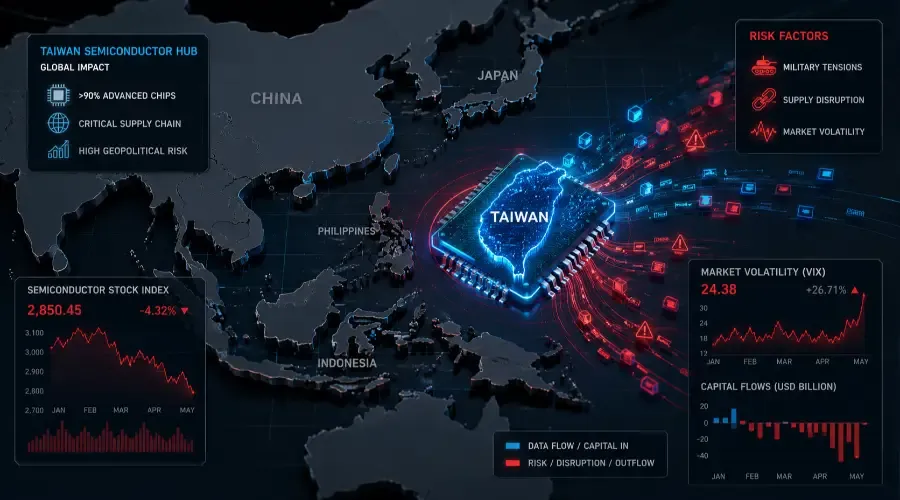
The St. Louis Federal Reserve's February 2025 research on the economic effects of potential armed conflict over Taiwan modelled a 5–10% global GDP reduction in Year 1 of a conflict – larger than the 2008 financial crisis. Rhodium Group's analysis mapped the specific supply chain transmission channels. Reuters reported that investors see no place to hide. The reason is structural: Taiwan produces approximately 92% of the world's most advanced semiconductors. Every sector that uses chips – which is every sector – faces simultaneous disruption in a severe conflict scenario. That makes China-Taiwan the only geopolitical risk in this series where the traditional defensive playbook breaks down.
The Silicon Shield: Why Taiwan Is Different
Taiwan's semiconductor dominance creates what analysts call the "silicon shield" – mutual deterrence that has maintained the status quo for decades. China loses access to global financial systems and advanced technology if it invades. The US faces semiconductor supply catastrophe if it allows Taiwan to fall. This mutual deterrence is both a protection and an amplifier: any escalation toward conflict is priced by markets as a tail risk to the entire global semiconductor supply chain, not merely a diplomatic incident.
The primary US equity transmission channel is not oil prices or currency flows – it is the chip supply chain that every sector in the modern economy depends on simultaneously.
Quick-Reference: The Four-Level Escalation Framework
Note: S&P 500 impact ranges for Levels 1–2 are drawn from a limited historical record – primarily the August 2022 episode. Treat them as indicative, not prescriptive. Level 3–4 figures are modelled estimates with no direct historical precedent in the modern semiconductor era.
| Escalation Level | Core Catalyst | Expected S&P 500 Impact | Immediate Trading Action |
|---|---|---|---|
| Level 1: Diplomatic | Rhetoric / Official warnings | Minimal (<0.5%) | Do nothing – background noise |
| Level 2: Military Signalling | Exercises / ADIZ incursions | −2% to −5% | Reduce XLK, add gold/defence; play 2-week reversal |
| Level 3: Economic Coercion | Naval blockade / Sanctions | −10% to −20% (model estimate) | Deeply reduce equity exposure; maximise cash and gold |
| Level 4: Armed Conflict | Kinetic invasion / Strikes | Catastrophic (model: −5 to −10% global GDP) | Systemic exit; gold is primary safe harbour |
Sector Scorecard
Technology (XLK) – Most Severe Negative – Immediate at Level 2+
XLK faces both supply chain and demand disruption simultaneously. The supply chain: NVIDIA, AMD, Apple, and Qualcomm all depend on TSMC fabrication for their most advanced chips. The demand: China represents a major revenue market, and escalation raises retaliation risk through technology market access restrictions. In the August 2022 Level 2 episode, XLK underperformed by an additional 2–3% beyond the broader market decline. This is the clearest sector to reduce at any escalation above Level 1.
Industrials (XLI) – Split Signal – Immediate
The defence sub-sector (Lockheed Martin, Raytheon, Northrop Grumman) benefits from any meaningful military escalation – procurement cycles expand and don't reverse when tensions ease. Critical caveat: defence contract revenue takes months or years to reach corporate income statements, while the semiconductor supply chain shock to the industrial automation sub-sector within XLI is instantaneous. In the "During" phase, the defence overweight applies to the long-term horizon; the industrial automation underweight applies immediately.
Materials (XLB) – Positive (Gold) / Mixed (Industrials)
Gold surges on safe-haven demand at Level 2 and above – the most reliable tactical trade in any Taiwan escalation. Industrial metals within XLB face demand concern if the escalation signals global economic disruption.
Consumer Staples (XLP), Healthcare (XLV), Utilities (XLU) – Partial Shelter at Level 2; No Shelter at Level 4
At Level 2, these sectors provide relative defensive shelter through capital rotation. At Level 4, the "no safe harbour" dynamic applies – modern smart grids, medical devices, and consumer goods manufacturing all contain advanced semiconductors. Partial exceptions exist: companies with minimal semiconductor content in their operations, non-Taiwan-dependent manufacturers, and cash-equivalent positions would provide some insulation even at Level 4. The "no safe harbour" claim applies to broad sector ETFs, not every individual position.
Financials (XLF) – Moderate Negative at Level 3+
Financial market contagion from Taiwan escalation would be severe at Level 3 and above. China holds approximately $775 billion in US Treasury bonds – any kinetic escalation raises Chinese Treasury selling as retaliation risk. Trade finance volumes across Asia-Pacific collapse at Level 3+.
Historical Cases
August 2022 – The Definitive Level 2 Case
Speaker Pelosi's Taiwan visit triggered seven days of Chinese military exercises surrounding Taiwan, ballistic missile launches over the island, and naval exercises blocking major ports. S&P 500 fell approximately 3%, XLK underperformed by an additional 2–3%, VIX rose from 23 to 26. Recovery was complete within two weeks of exercises concluding – confirming the Level 2 dynamic: significant immediate impact, rapid recovery when escalation level is confirmed stable. Rhodium Group's post-exercise analysis confirmed no actual TSMC production disruption occurred, validating that Level 2 impact is purely about escalation probability pricing, not real supply chain damage.
1995–1996 – Historical Precedent With Caveats
China's missile tests and exercises preceding Taiwan's first democratic election produced US equity market declines of 5–8% before recovery. Important caveat: TSMC had not yet achieved its current 92% advanced node dominance in 1995. The current vulnerability significantly exceeds the 1995 precedent – meaning the 1995 case likely understates what a similar episode would produce today.
Trading Playbook
Before:
Monitor Taiwan's Ministry of National Defence daily ADIZ report – sustained incursions above 20 aircraft in a single day have historically preceded larger exercises. Watch TSMC's ADR (ticker: TSM) – a 5%+ single-session decline without a broader tech selloff signals Taiwan-specific risk premium being priced by institutional investors.
During (Level 2):
Reduce XLK. Add gold within XLB. Add XLI defence names for the long-term procurement cycle – but do not expect immediate revenue impact. Wait 48 hours before assessing whether escalation is advancing to Level 3. Most Level 2 episodes resolve within two weeks.
During (Level 3+):
Apply broad equity reduction. Gold is the primary defensive asset. At Level 4, model estimates suggest catastrophic disruption – but also expect massive fiscal and monetary policy responses, potential market closures, and capital controls that would distort all relative sector performance in ways that are genuinely unpredictable.
After:
When PLA exercises conclude without advancing to Level 3, the XLK recovery trade has historically produced 3–6% outperformance within two weeks. The reversal is as tradeable as the initial decline.
Bottom Line Checklist
Identify escalation level first – the entire sector rotation depends on it
Level 2: Reduce XLK, add gold (XLB), add XLI defence (long-horizon)
Level 3: Broad equity reduction, maximise cash and gold
Level 4: Systemic exit – model estimates only, no historical precedent
Monitor: Taiwan MND ADIZ daily count + TSM single-session moves
Exit rule: PLA exercises conclude → buy XLK reversal within 48 hours
Do not apply Level 4 positioning to Level 2 events
Q&A
Q: Why are China-Taiwan tensions uniquely dangerous for US stocks compared to other geopolitical conflicts?
A: Unlike typical geopolitical crises that transmit through oil prices or currency volatility, a China-Taiwan conflict hits the global economy through the semiconductor supply chain. Because TSMC manufactures roughly 92% of the world's most advanced chips, any disruption throttles production across every modern economic sector simultaneously – tech, automotive, healthcare, and industrials.
Q: What is the "Silicon Shield" and how does it impact equity markets?
A: The Silicon Shield refers to Taiwan's dominance in advanced semiconductor fabrication, which creates mutual deterrence – China relies on these chips for economic stability, while the US is incentivised to defend Taiwan to protect its technology foundation. Markets therefore treat any escalation as a direct tail-risk pricing of a potential global supply chain freeze.
Q: How does a Level 2 escalation typically affect XLK tech stocks?
A: Based on the August 2022 episode – the primary modern data point – XLK underperformed the broader market by an additional 2–3% during the exercises. The S&P 500 itself fell approximately 3%. Losses were fully recovered within two weeks of exercises concluding. Treat these as indicative ranges from a single episode, not reliable statistical averages.
Q: Are defensive sectors like XLU and XLP safe in a Taiwan conflict?
A: At Level 2, yes – they provide relative shelter through capital rotation. At Level 4 (actual armed conflict), the answer becomes more complex. Modern utilities and consumer staples manufacturing both depend on advanced semiconductors, reducing their traditional defensive value. However, cash positions, gold, and companies with minimal semiconductor content in their operations would provide partial shelter even in severe scenarios.
Q: What are the earliest indicators traders should watch for escalating Taiwan risk?
A: Two specific metrics: (1) PLA daily ADIZ incursions via Taiwan's MND daily report – sustained above 20 aircraft in a single day has preceded larger exercises. (2) TSM (TSMC ADR) declining 5%+ in a single session without a broader tech selloff – this signals institutional investors pricing Taiwan-specific risk premium.
Educational content only. Not investment advice. Past sector performance patterns do not guarantee future results. All market impact estimates for Level 3 and Level 4 scenarios are model-based projections with no direct historical precedent in the modern semiconductor era.