
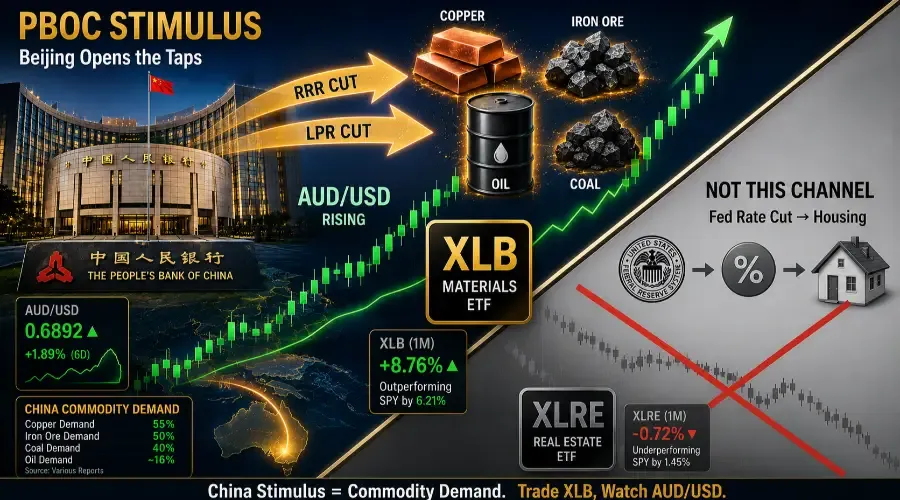
When Beijing opens the stimulus taps, the trade isn’t in US rates or housing – it’s in copper, iron ore, and the Aussie dollar. The real US stock market impact of China’s PBOC stimulus is a commodity story, not a monetary one, and that’s the framework most market analysis misses.
Schroders documented it in detail: China took major steps to bolster its economy in September 2024 – the PBOC cut the reserve requirement ratio by 50 basis points, reduced loan prime rates, and delivered a broad package that sent commodity prices and emerging market assets surging. WisdomTree covers China's central bank role. CEP analyses the aggregate and structural implications of Chinese monetary stimulus. Investopedia explains how China manages its money supply. Bloomberg tracks the mounting risks that set the stage for each new PBOC action. What none of these sources provide is the US stock-sector framework that tells traders which ETFs move when Beijing opens the stimulus tap – because PBOC stimulus does not transmit to US equities through monetary channels the way Fed policy does. It transmits through commodity demand, and understanding that distinction is the entire analytical edge.
Why This Matters More Than Most Traders Realize
Here’s the thing: the PBOC is not the Federal Reserve with different governance. It’s an institution that blends monetary policy, credit direction, and industrial policy into a single tool set – operating within a financial system where the state owns the major banks and can direct lending to specific sectors through administrative guidance, not just price signals.
That structural difference creates a fundamentally different transmission path to US equity markets. When the Fed cuts rates, the channel looks like this: cheaper money → lower mortgage rates → more home purchases → XLY demand improves. When the PBOC cuts reserve requirements or loan prime rates, the channel flips entirely: Chinese banks lend more → Chinese construction and industrial activity accelerates → commodity demand rises globally → XLB and XLE surge. The consumer and rate-sensitive sectors of the US equity market are largely unaffected by PBOC stimulus; the commodity complex is directly and immediately affected.
The quantitative framing makes this concrete. China consumes approximately 55% of global copper, 50% of global iron ore, 40% of global coal, and nearly one-fifth of global oil. When PBOC stimulus activates Chinese construction and manufacturing, the demand pull on every one of these commodities is immediate and material – producing XLB outperformance that can exceed 15–20% over the stimulus cycle. [LINK: Central Bank Hub]
China’s Share of Global Commodity Consumption
Commodity
China’s Approx. Share of Global Demand
Copper
55%
Iron Ore
50%
Coal
40%
Oil
~16% (nearly one-fifth)
This concentration explains why a single RRR cut in Beijing can move Materials ETFs in New York within hours. There is no equivalent demand-side force in raw materials markets.
Regime Change: PBOC Stimulus as a Commodity Demand Regime
In practice, PBOC stimulus is a regime change, not a data event. When the PBOC delivers a meaningful stimulus package – confirmed by both monetary tools (RRR and LPR cuts) AND credit guidance (lending targets for real estate, infrastructure, and manufacturing) – it establishes a commodity demand regime that persists for one to three years as the construction and manufacturing cycle works through the economy. This duration is the investment horizon for XLB and XLE positions built on the PBOC stimulus signal.
The tools the PBOC uses determine the channel and the magnitude:
RRR (Reserve Requirement Ratio) cuts
The most immediate and most powerful tool. Reducing the fraction of deposits banks must hold in reserve immediately frees up lending capacity across the entire banking system. A 50 basis point RRR cut releases approximately 1 trillion yuan ($140 billion) in additional lending capacity. Markets respond to RRR cuts fastest – within days – because the credit availability signal is unambiguous.
LPR (Loan Prime Rate) cuts
Reduces the benchmark rate for business and consumer loans, directly lowering borrowing costs for property developers, infrastructure projects, and manufacturing companies. LPR cuts transmit to commodity demand within one to two quarters as projects move from financing approval to materials procurement.
MLF (Medium-term Lending Facility) injections
Direct liquidity provided to commercial banks at a specific term and rate. Less market-moving than RRR cuts but signals the PBOC's commitment to maintaining ample system liquidity – supporting the broader stimulus package's durability.
Targeted re-lending facilities
Specific credit quotas for designated sectors – green energy, rural development, technology manufacturing. These tools indicate which sectors China intends to build, which determines which commodity demand surges (copper for EV infrastructure, steel for green energy projects).
Which Channel Is Active: The Commodity Demand Mechanism
Unlike Fed policy (monetary channel → financial conditions → economic activity → corporate revenues) or BOJ policy (carry trade channel → currency → capital flows → US asset prices), PBOC stimulus operates primarily through the physical commodity demand channel – the most direct and most durable transmission to US equity sector prices.
The sequence runs as follows: PBOC cuts RRR and LPR → Chinese banks increase property and infrastructure lending → Chinese construction companies order more steel, copper, and cement → iron ore shipments from Australia accelerate → Australian dollar (AUD/USD) rises as Chinese commodity demand pulls → XLB global materials names surge as commodity prices rise in dollar terms → XLE follows as oil demand expectations improve with Chinese industrial recovery → AUD/USD is the real-time indicator of the transmission's progress.
The AUD/USD cross rate – available on any trading platform continuously – is the single most important real-time monitoring tool for PBOC stimulus transmission. Australia's economy is approximately 45% dependent on commodity exports to China: iron ore, coal, copper, and agricultural products. When PBOC announces stimulus and the commodity channel is activating, AUD/USD rises within hours. When the stimulus announcement disappoints in actual credit delivery, AUD/USD gives back gains within days. The currency is the market's continuous real-time vote on whether the PBOC announcement is producing genuine commodity demand or simply headline relief.
Sector Scorecard
Materials (XLB) – Strong Positive – Immediate.
XLB is the primary and most direct beneficiary of PBOC stimulus – the clearest first-mover in the entire series for a non-US policy event. Copper miners, iron ore producers, fertiliser companies, and industrial metals names within XLB all see forward demand expectations reprice within the first week of a confirmed PBOC stimulus package. The magnitude scales with stimulus credibility: a 50bps RRR cut plus LPR reduction plus lending target expansion has historically produced XLB outperformance of 10–20% over the following two quarters. Watch AUD/USD for real-time confirmation – XLB positions are validated when AUD/USD sustains gains above its prior range high.
Energy (XLE) – Moderate Positive – 1–3 Months.
China's industrial recovery from PBOC stimulus drives oil demand through three channels: increased factory production, expanded construction site activity, and improved transportation volumes as goods movement rises. WTI and Brent crude respond within weeks of confirmed Chinese industrial activity data – PMI above 50 combined with rising freight volumes is the confirmation. XLE positions are sized for the one to three quarter window between PBOC announcement and actual Chinese industrial demand recovery appearing in official data.
Industrials (XLI) – Mild Positive – 1–3 Months.
Chinese infrastructure investment from stimulus packages creates demand for capital goods manufactured by global industrial companies. Caterpillar and Cummins both disclose China revenue specifically – their quarterly earnings commentary on "China construction activity" is the most direct corporate confirmation of infrastructure demand recovery. The XLI positive from PBOC stimulus is real but lagged – one to two quarters behind XLB's immediate commodity price response.
Technology (XLK) – Mild Positive – 1–3 Months.
China is one of the world's largest markets for semiconductor consumption and consumer electronics. PBOC stimulus that recovers Chinese consumer spending and manufacturing activity supports semiconductor demand from Chinese factories. XLK names with significant China revenue – multiple major semiconductor companies source assembly or generate revenue in China – see forward guidance improve when Chinese economic activity accelerates. The positive is mild because geopolitical uncertainty and export restrictions create cross-currents that partly offset the demand recovery signal.
Financials (XLF) – Mild Positive – 1–3 Months.
The EM credit quality improvement channel applies: PBOC stimulus reduces the probability of Chinese growth collapse, which reduces default risk on EM sovereign and corporate debt held in XLF portfolios. Global asset managers and banks with EM exposure – JPMorgan, Citibank – see credit risk expectations improve when China avoids a hard landing. The positive is mild and concentrated in globally-exposed XLF names.
Consumer Discretionary (XLY) – Mild Positive – 3–9 Months.
Multinational consumer brands with significant China exposure – luxury goods, premium apparel, consumer electronics – see forward revenue guidance improve as Chinese consumer confidence recovers from PBOC stimulus. The transmission is slow – six to nine months from PBOC announcement to Chinese consumer spending recovery appearing in US multinational earnings. Not a near-term trade; a medium-term earnings revision story.
Utilities (XLU), Real Estate (XLRE), Consumer Staples (XLP), Healthcare (XLV) – Approximately Neutral.
These sectors lack direct commodity demand exposure or significant China revenue concentration sufficient to produce tradeable impacts from PBOC stimulus. XLP multinational food companies see some China-related revenue fluctuation but it is modest relative to the direct commodity and industrial impact.
Historical Cases
2015–2016 | Six RRR Cuts and Six Rate Cuts – The Commodity Recovery
The PBOC delivered one of its most sustained stimulus cycles in 2015–2016 against the backdrop of a Chinese growth scare that sent commodity prices to multi-year lows.
Six RRR cuts and six LPR cuts over eighteen months ultimately stabilised Chinese growth and rekindled construction demand. Iron ore prices, which had fallen below 40 per tonne in late 2015, surged above 80 by April 2016. Copper recovered from below 2 to above 2.50 per pound.
XLB outperformed SPY by approximately 9–10 percentage points from its February 2016 trough to year-end 2016. AUD/USD was the leading indicator: it bottomed and began recovering two to three weeks before XLB prices confirmed the commodity demand recovery. The case confirms that PBOC stimulus cycles are multi-quarter trades in XLB and XLE – not single-session events.
September 2024 | The Schroders "Major Steps" Package
The PBOC delivered the most comprehensive single stimulus announcement since 2015 in September 2024: 50bps RRR cut (releasing approximately 1 trillion yuan in lending capacity), LPR reductions for existing mortgages, and a new real estate support facility. Schroders documented the package and its implications. AUD/USD rose immediately – from approximately 0.67 to above 0.69 in the week following the announcement. XLB surged 4.2% in that first week, and copper prices jumped 6.8% – the largest single-week commodity complex move of 2024. Emerging market equities broadly rallied. However, the subsequent monitoring question – whether credit growth actually followed the announcement or whether the package was front-loaded on headline and thin on delivery – became the critical analytical test over the following two quarters.
The Playbook
Before
Monitor PBOC RRR and LPR announcement calendars – the PBOC does not publish meeting dates as predictably as the Fed, but RRR and LPR decisions are often preceded by People's Daily or Xinhua News Agency articles signalling upcoming measures. When Chinese state media begin reporting on "targeted monetary tools" or "timely RRR cuts," the announcement is typically one to four weeks away.
Track AUD/USD weekly as the pre-announcement commodity demand signal. When AUD/USD begins strengthening without an apparent Australian domestic catalyst – rising against both the USD and EUR simultaneously – Chinese commodity purchase expectations are building. This AUD/USD movement sometimes precedes official PBOC announcements by one to two weeks.
Watch China's monthly credit data – Total Social Financing (TSF) and M2 money supply (released mid-month by the PBOC). Accelerating TSF growth confirms that PBOC lending capacity is being drawn down by borrowers – the key distinction between announcement stimulus and delivery stimulus.
During
Buy XLB on the RRR cut announcement – this is the single clearest and fastest-transmitting PBOC stimulus trade available to retail investors. Confirm with AUD/USD holding above its pre-announcement level through the first week after the cut. Size for a two to three quarter holding period.
Add XLE with a one to two quarter delay, after Chinese manufacturing PMI (Caixin PMI, released first business day of each month) confirms above-50 expansion for two consecutive months – signalling that Chinese industrial activity has genuinely recovered to commodity-demand-positive levels.
Monitor China's monthly cement and steel production data (National Bureau of Statistics, released mid-month) for physical demand confirmation. Rising cement and steel output is the hardest evidence that construction activity is responding to credit stimulus – and the most reliable confirmation that XLB gains are sustained rather than speculative.
After
The exit signal for PBOC stimulus trades is a slowdown in China's Total Social Financing growth – specifically, month-over-month TSF growth falling below its three-month moving average for two consecutive months. This signals that the credit impulse from the stimulus has peaked and commodity demand growth will decelerate within one to two quarters. Reduce XLB overweight when TSF decelerates; exit XLE position when Chinese manufacturing PMI (Caixin) falls back below 50 for a second consecutive month, confirming the industrial demand recovery has stalled.
The 3 Mistakes Most Retail Traders Make
Mistake 1: Trading PBOC Announcements Without Confirming Credit Delivery
The most consistent PBOC stimulus trading error is buying XLB on the announcement without waiting for evidence that the credit tools are being drawn down. PBOC has a well-documented pattern of announcing stimulus packages – lending quotas, RRR cuts, targeted facilities – where the announced capacity significantly exceeds the actually deployed credit. Markets initially rally on the announcement; when the subsequent TSF and credit growth data reveals underdelivery, XLB and AUD/USD give back gains. The "announcement vs delivery" problem is unique to PBOC among global central banks and must be built into every PBOC stimulus trade through the TSF monitoring discipline.
Mistake 2: Expecting US Rate-Sensitive Sectors to Move
PBOC stimulus is a commodity demand event, not a monetary conditions event. Traders who buy XLRE (expecting lower rates) or XLU (expecting bond proxy repricing) on a PBOC stimulus announcement are applying the Fed rate cut playbook to a mechanism that does not operate through US interest rates. PBOC stimulus does not compress US Treasury yields, does not affect US mortgage rates, and does not reprice XLU dividend yields. The rate-sensitive sector trades that are correct for Fed policy moves are irrelevant for PBOC policy moves.
Mistake 3: Ignoring AUD/USD as the Validation Tool
The third mistake is holding XLB and XLE positions based solely on the PBOC announcement without monitoring AUD/USD as the real-time demand validation indicator. When XLB rises after a PBOC announcement but AUD/USD fails to confirm – holding flat or declining – the market is sceptical that commodity demand will materialise. When XLB rises AND AUD/USD rises AND holds gains through the first week, the confirmation is strongest. XLB without AUD/USD confirmation is speculative. XLB with AUD/USD confirmation is high-conviction.
Bottom Line: The One-Sentence Institutional Framework
When PBOC cuts RRR and LPR simultaneously, buy XLB immediately using AUD/USD confirmation to validate commodity demand activation, add XLE with a one-to-two-quarter delay after Chinese PMI confirms above-50 expansion for two consecutive months, and exit both positions when Total Social Financing month-over-month growth decelerates for two consecutive months – signalling the credit impulse has peaked – while also exiting XLE if Chinese manufacturing PMI falls back below 50 for a second consecutive month.
This framework works across cycles because China's commodity demand is structurally the largest marginal demand force in global raw materials markets, and the PBOC's transmission to US equity markets runs through that physical demand channel – not through monetary conditions. The retail edge is AUD/USD monitoring (free, continuous, institutional) and TSF growth confirmation (free, monthly, definitive) that together distinguish announcement-driven rallies from genuine credit-delivery commodity demand cycles.
Run this scenario through the [Breakout Bulletin Ripple Engine](LINK: Ripple Engine Tool) to see how PBOC stimulus transmits through the commodity demand channel to US equity sectors – and compare how differently it affects XLB and XLE versus XLRE and XLU relative to a Fed rate cut acting on the same sectors.
Frequently Asked Questions
What is PBOC stimulus?
The People's Bank of China stimulates the economy using tools like Reserve Requirement Ratio (RRR) cuts, Loan Prime Rate (LPR) cuts, liquidity injections, and targeted lending programs to boost credit growth and industrial activity.
Why does XLB rise after China stimulus?
China consumes a massive share of global industrial commodities like copper, iron ore, and coal. When PBOC stimulus increases Chinese construction and manufacturing activity, commodity demand rises sharply, benefiting materials stocks inside the XLB.
What is the most important indicator for tracking PBOC stimulus transmission?
AUD/USD is considered the best real-time confirmation tool because Australia exports large quantities of commodities to China. A rising AUD/USD often signals that markets believe Chinese commodity demand is genuinely improving.
Does China stimulus affect US real estate stocks?
Not significantly. Unlike Federal Reserve policy, PBOC stimulus impacts US markets mainly through commodity demand rather than lower US interest rates. That means sectors like XLRE usually do not benefit directly.
Which US sectors benefit the most from PBOC stimulus?
The biggest beneficiaries are:
XLB (Materials)
XLE (Energy)
XLI (Industrials)
What is the “announcement vs delivery” problem in China stimulus?
Markets often rally immediately after a PBOC announcement, but if actual credit growth and lending fail to follow, commodity prices and related ETFs may reverse. Traders monitor China’s Total Social Financing (TSF) data to confirm whether the stimulus is truly reaching the economy.
How long do PBOC stimulus cycles usually last?
Historically, major Chinese stimulus cycles can create commodity demand trends lasting one to three years, especially when infrastructure and construction activity accelerate.
This post is part of the BreakoutBulletin "What Happens When" series. [LINK: Central Bank Hub] · [LINK: Series Pillar Page]
Educational content only. Not investment advice. Past sector performance patterns do not guarantee future results.